
Calosoma externum
Say, 1823
Narrow Searcher Beetle, Churchyard Caterpillar Hunter
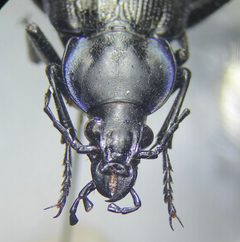
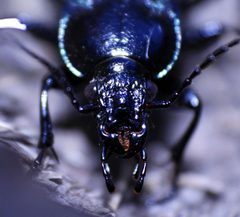
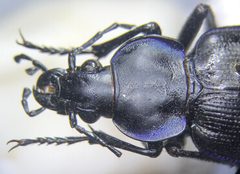
Calosoma externum is a large predatory ground beetle in the Carabidae, commonly known as the narrow searcher or churchyard caterpillar hunter. First described by Thomas Say in 1823, this is notable for its arboreal hunting , ascending trees to prey on caterpillars. reach 28–35 mm in length and are distinguished by their black bodies with bluish marginal reflections. The species occurs across much of the United States and into southern Canada.
Pronunciation
How to pronounce Calosoma externum: /kəˈloʊsəmə ɛkˈstɜrnʊm/
These audio files are automatically generated. While they are not always 100% accurate, they are a good starting point.
Identification
Distinguished from similar Calosoma by its black coloration with bluish marginal reflections rather than metallic green, purple, or tones seen in such as C. scrutator (fiery searcher) or C. sayi (black caterpillar hunter). C. externum is smaller than C. scrutator and lacks the intense purple pronotal coloration of that species. The specific epithet 'externum' refers to the marginal (external) coloration.
Images
Habitat
Inhabits fields and margins of standing water. Also found in upland forest areas during caterpillar , where it ascends trees to hunt.
Distribution
Most of the United States; recorded from northern shores of Lake Erie in Canada.
Diet
prey on caterpillars of several , including Melanoplus, Cirphis, Lachnosterna, Malacosoma, and Porthetria.
Host Associations
- Melanoplus - caterpillar prey
- Cirphis - caterpillar prey
- Lachnosterna - caterpillar prey
- Malacosoma - caterpillar prey
- Porthetria - caterpillar prey
Behavior
Arboreal that actively climbs trees to hunt caterpillars. are fast-moving and difficult to approach for photography. When captured, may release defensive chemical secretions.
Ecological Role
of caterpillars; may contribute to control of such as cankerworms and tent caterpillars.
Human Relevance
Beneficial insect for of caterpillar pests. May be attracted to lights at night. Can release defensive chemicals when handled that linger on skin.
Similar Taxa
- Calosoma scrutatorLarger size (25+ mm), more elongated and , intense purple central pronotal coloration; C. externum is smaller with bluish rather than purple reflections.
- Calosoma sayiAll black without bluish reflections; lacks marginal coloration characteristic of C. externum.
- Calosoma wilcoxiSmaller cousin of C. scrutator with different color pattern; C. externum distinguished by specific marginal bluish reflections.
More Details
Taxonomic History
Described by Thomas Say in 1823, one of the earliest American entomologists.
Etymology
The specific epithet 'externum' refers to the external/marginal bluish coloration of the body.
Sources and further reading
- BugGuide
- Wikipedia
- GBIF taxonomy match
- iNaturalist taxon
- Ground beetles up in the air: Calosoma wilcoxi and Calosoma scrutator — Bug of the Week
- Feasting on the bounty | Beetles In The Bush
- May | 2011 | Beetles In The Bush | Page 2
- Best of BitB 2012 | Beetles In The Bush
- Bug Eric: ID Tip: Ground Beetle or Darkling Beetle?
- November | 2012 | Beetles In The Bush | Page 2