
Pacifastacus leniusculus
(Dana, 1852)
Signal Crayfish
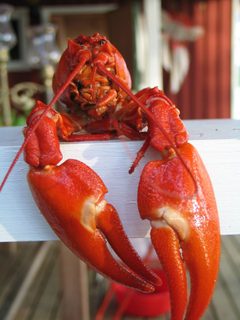
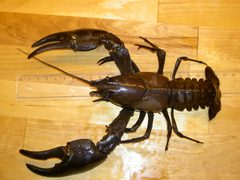
The signal crayfish is a large North American freshwater crayfish introduced to Europe in the 1960s to replace declining native fisheries. It has become one of the most ecologically impactful decapods in Europe, outcompeting native crayfish and serving as a carrier of crayfish (Aphanomyces astaci). The establishes self-sustaining rapidly, with six age cohorts documented within a few years of introduction. It shows sex- and size-specific coloration patterns, with males displaying more saturated and brighter claw surfaces than females, suggesting a role in intraspecific communication.

Pronunciation
How to pronounce Pacifastacus leniusculus: /ˌpæsɪˈfæstəkəs lɛˌniːʊsˈkjuːləs/
These audio files are automatically generated. While they are not always 100% accurate, they are a good starting point.
Identification
Large-bodied crayfish reaching up to 14.8 cm total length in European , larger than some native Californian populations. Coloration varies intraspecifically: claw surfaces are more saturated and brilliant than surfaces, with males showing more intense coloration than females, especially on lower claws. Color intensity and brightness increase with size, with brightness more variable in males. These patterns may aid in distinguishing from native European crayfish, which lack such pronounced in coloration.
Images
Habitat
Freshwater rivers and streams; occupies riffles (shallow, fast-flowing sections), small tributaries, and lakes. In Mediterranean regions, shows preference for cooler, higher-altitude reaches with lower anthropogenic disturbance compared to other crayfish. Capable of exploiting degraded but also advances into headwater systems.
Distribution
Native to northwestern North America (California, Pacific Northwest). Introduced to Europe beginning in the 1960s, now present across Scandinavia, the British Isles, continental Europe including Italy (Clitunno River basin, detected 2020), Portugal, Spain (Segura River basin, detected 2015; Catalonia), and Poland. Also introduced to Japan.
Diet
; diet shifts with invasion stage. Core individuals rely more on lower such as plant detritus, while front individuals show higher δ15N values indicating greater consumption of macroinvertebrates and higher trophic level prey.
Life Cycle
Six age cohorts documented (0+ to 5+ years), including young-of-the-year, indicating quick acclimatization and establishment of self-sustaining . Maximum size 14.8 cm total length reported in Italian populations.
Behavior
Predominantly but remains active during daylight hours (~34% of total activity time). Shows sex- and size-specific patterns. Front individuals in invasion gradients display more exploratory than core individuals. Capable of subtle deep visual detection against . Coloration patterns suggest signal partitioning between camouflage ( surfaces) and conspicuousness for communication ( surfaces).
Ecological Role
One of the most ecologically impactful introduced decapod crustaceans in Europe. Alters elemental availability in through differential bioaccumulation of essential, potentially toxic, and technology-critical elements. Acts as carrier of crayfish (Aphanomyces astaci), to which native European crayfish are highly susceptible. Outcompetes native crayfish through , competition, and transmission.
Human Relevance
Introduced intentionally in the 1960s to supplement Scandinavian Astacus astacus fisheries affected by crayfish . Now subject to intensive control efforts including trapping, electrofishing, and attempts. Target of early detection and rapid response protocols due to its status as a of Union concern under EU regulations. Conservation of native white-clawed crayfish (Austropotamobius pallipes) to 'ark sites' are conducted specifically to rescue from signal crayfish invasion.
Similar Taxa
- Austropotamobius pallipesNative white-clawed crayfish; distinguished by smaller size, lack of pronounced sexual color dimorphism, and susceptibility to crayfish carried by signal crayfish
- Procambarus clarkii red swamp crayfish; distinguished by more rapid spread rate, preference for degraded lowland , and different thermal tolerances; signal crayfish occupies cooler, higher-altitude reaches
- Astacus astacusNative European crayfish; signal crayfish introduced specifically to replace this in fisheries but proved to be carrier instead
Sources and further reading
- BugGuide
- GBIF taxonomy match
- iNaturalist taxon
- NCBI Taxonomy
- Catalogue of Life
- New NeoBiota special issue explores invasions in aquatic systems
- Conservation Translocations: It’s Not Just Beavers - Buglife Blog - Buglife
- Is Britain too poor for wildlife? - Buglife Blog - Buglife
- Save wildlife - close the UK borders to plants - Buglife Blog - Buglife
- The one year anniversary of the Great Britain Non-native Species Strategy - Buglife Blog - Buglife
- Color variation in signal crayfish Pacifastacus leniusculus
- Detecting North American signal crayfish (Pacifastacus leniusculus) in riffles
- Control planning for invasive crayfish: the case of Pacifastacus leniusculus (Decapoda, Astacidae) in the Clitunno River (Central Italy).
- Ocurrence of the invasive species Pacifastacus leniusculus (Dana, 1852) (Decapoda, Astacidae) in the Segura River Basin (SE, Spain)
- Density, Growth and Reproduction in Populations of Astacus astacus and Pacifastacus leniusculus in an Isolated Pond
- Spatial Expansion and Ecological Correlates of Invasive Crayfish Procambarus clarkii and Pacifastacus leniusculus in Mediterranean Rivers of Catalonia (NE Iberian Peninsula)
- Differential Elemental Accumulation of the Signal Crayfish (Pacifastacus leniusculus) Along an Invasion Gradient
- Feeding ecology of the signal crayfish Pacifastacus leniusculus in a British lowland river
- Morphometric differentiation in four populations of signal crayfish, Pacifastacus leniusculus (Dana), in Poland
- Sex- and size-specific migration patterns and habitat preferences of invasive signal crayfish (Pacifastacus leniusculus Dana)
- Supplementary material 6 from: Rusch JC, Strand DA, Laurendz C, Andersen T, Johnsen SI, Edsman L, Vrålstad T (2022) Exploring the eDNA dynamics of the host-pathogen pair Pacifastacus leniusculus (Decapoda) and Aphanomyces astaci (Saprolegniales) under experimental conditions. NeoBiota 79: 1-29. https://doi.org/10.3897/neobiota.79.82793