
Pacifastacus
Bott, 1950
Pacific Crayfish
Species Guides
2- Pacifastacus gambelli
- Pacifastacus leniusculus(Signal Crayfish)
Pacifastacus is a of freshwater crayfish to western North America, comprising six including the widespread signal crayfish (P. leniusculus) and two extinct species. The genus has gained significant conservation attention due to the spread of P. leniusculus in Europe and Japan, where it transmits crayfish and displaces native species. Within its native range, several Pacifastacus species declines from degradation and competition from invasive crayfishes.


Pronunciation
How to pronounce Pacifastacus: //ˌpæsɪˈfæstəkəs//
These audio files are automatically generated. While they are not always 100% accurate, they are a good starting point.
Identification
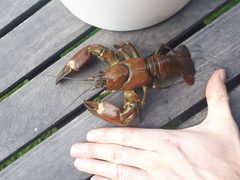
Pacifastacus are distinguished from other North American crayfish by a combination of morphological features including rostral characteristics and structure. The signal crayfish (P. leniusculus) is identifiable by a white to pale blue patch on the upper surface of the claw hinge, giving the species its . P. connectens and P. gambelii are morphologically similar pilose crayfishes requiring careful examination for separation. Identification to species level often necessitates examination of reproductive structures in mature males.
Images
Habitat
Native occupy diverse freshwater across western North America. P. leniusculus occurs in streams, rivers, and lakes from Alaska to California. P. connectens and P. gambelii are associated with larger streams and rivers with less extreme upstream temperature and precipitation seasonality, including groundwater-dominated springs in some areas. The Shasta crayfish (P. fortis) is restricted to cold, spring-fed habitats in northern California.
Distribution
to western North America. Native range spans from Alaska through British Columbia, Washington, Oregon, Idaho, Nevada, Utah, Wyoming, and California. P. leniusculus has been introduced to western Europe (first introduced to Sweden in 1960), Japan, and other regions. P. connectens occurs below Shoshone Falls and in the Harney Basin; P. gambelii occurs above Shoshone Falls and in the northern Bonneville Basin. Two are extinct: P. chenoderma (Miocene-Pliocene fossil) and P. nigrescens (Sooty crayfish, historically in Oregon).
Behavior
P. leniusculus exhibits seasonal activity patterns with in lake systems, moving to deeper waters in winter and shallower areas in warmer months. Juveniles have been observed residing gregariously in some . Females carry attached to pleopods, with maternal care of offspring observed in related . In populations, P. leniusculus demonstrates rapid acclimatization and establishment of self-sustaining populations within short timeframes.
Ecological Role
As native , Pacifastacus crayfishes function as benthic omnivores and engineers, modifying through burrowing and foraging. P. leniusculus serves as a for branchiobdellidan annelids in its native range. In invaded regions, P. leniusculus acts as a for Aphanomyces astaci (crayfish ), causing mass mortality of native European crayfishes. Its presence is associated with altered benthic and displacement of native species.
Human Relevance
P. leniusculus was intentionally introduced to Europe for aquaculture following declines in native Astacus astacus from crayfish . It has become a significant causing ecological and economic impacts. In the UK, conservation efforts involve translocating native White-clawed Crayfish (Austropotamobius pallipes) to 'ark sites' protected from P. leniusculus invasion. The supports commercial and recreational fisheries in both native and introduced ranges. attempts have been undertaken in Italy following early detection.
Similar Taxa
- FaxoniusFormerly included in Orconectes; North American crayfish with overlapping distribution but distinguished by different and rostral features
- AstacusEuropean crayfish ; P. leniusculus introduced to Europe often occurs in sympatry with Astacus astacus, distinguished by presence of signal patch on claw and resistance to crayfish
- AustropotamobiusEuropean native crayfish highly susceptible to crayfish carried by P. leniusculus; distinguished by morphological and physiological traits
More Details
Species composition
The contains six : P. leniusculus (signal crayfish, Least Concern), P. fortis (Shasta crayfish, Critically Endangered), P. gambelii (pilose crayfish), P. connectens (Snake River pilose crayfish), P. chenoderma (extinct, Miocene-Pliocene fossil), and P. nigrescens (Sooty crayfish, extinct).
Conservation status
P. fortis is listed as Critically Endangered due to extremely restricted range and threats from and alteration. P. connectens and P. gambelii have experienced substantial range declines attributed to displacement by crayfishes (Faxonius virilis and P. leniusculus) and stream habitat impairment.
Invasion biology significance
P. leniusculus is one of the most ecologically impactful decapod introductions globally, listed as a of Union concern in Europe requiring early detection and rapid . It combines competitive superiority with resistance to crayfish , creating a 'perfect storm' for native crayfish displacement.
Sources and further reading
- BugGuide
- Wikipedia
- GBIF taxonomy match
- iNaturalist taxon
- NCBI Taxonomy
- Catalogue of Life
- New NeoBiota special issue explores invasions in aquatic systems
- Conservation Translocations: It’s Not Just Beavers - Buglife Blog - Buglife
- Figure 4: Suitable habitat for Pacifastacus connectens and Pacifastacus gambelii (combined) in the western US.
- Distribution, habitat associations, and conservation status updates for the pilose crayfish Pacifastacus gambelii and Snake River pilose crayfish Pacifastacus connectens of the western United States
- Distribution, habitat associations, and conservation status updates for the pilose crayfishPacifastacus gambelii(Girard, 1852) and Snake River pilose crayfishPacifastacus connectens(Faxon, 1914) of the western United States
- Control planning for invasive crayfish: the case of Pacifastacus leniusculus (Decapoda, Astacidae) in the Clitunno River (Central Italy).
- Maternal-Offspring Behavior of the Crayfish, Pacifastacus trowbridgi (Stimpson)
- Ocurrence of the invasive species Pacifastacus leniusculus (Dana, 1852) (Decapoda, Astacidae) in the Segura River Basin (SE, Spain)
- Density, Growth and Reproduction in Populations of Astacus astacus and Pacifastacus leniusculus in an Isolated Pond
- Native Population Characteristics of Pacifastacus leniusclus (Dana, 1852) in Tryon Creek, Oregon
- Seasonal Activity, Migration and Distribution of the Crayfish, Pacifastacus Ieniusculus, in Lake Tahoe