
Astacidae
Latreille, 1802
Astacid Crayfishes, Freshwater Crayfish
Genus Guides
1- Pacifastacus(Pacific Crayfish)
Astacidae is a of freshwater crayfish comprising four extant : Astacus, Austropotamobius, Pontastacus, and Pacifastacus. Members are native to Europe, western Asia, and western North America. The family is distinguished by a positioned on the of the third pair of legs in males (fifth pair in females), a trait shared with all Astacoidea. Several , particularly Pacifastacus leniusculus (signal crayfish), have become outside their native ranges, carrying crayfish (Aphanomyces astaci) that threatens native European .
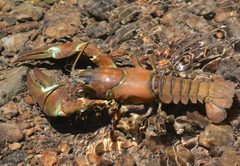
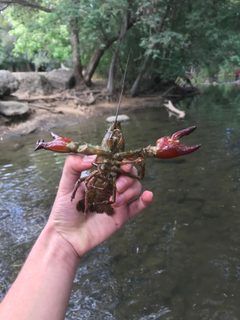
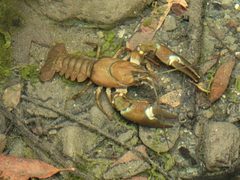
Pronunciation
How to pronounce Astacidae: /æˈstæsɪˌdaɪ/
These audio files are automatically generated. While they are not always 100% accurate, they are a good starting point.
Images
Habitat
Freshwater aquatic environments including lakes, slow-flowing rivers, streams, and brooks. Specific preferences vary by : Astacus favor lentic waters and slow-flowing rivers; Austropotamobius torrentium is rheophilic, inhabiting fast-flowing streams with rocky substrates; Austropotamobius pallipes occupies streams and small rivers with moderate flow; Pacifastacus species are found in rivers and streams of western North America.
Distribution
Native to Europe, western Asia, and western North America. European and western Asian range includes Astacus, Austropotamobius, and Pontastacus . North American range restricted to Pacifastacus on the Pacific coast of the United States and British Columbia. Several have been introduced outside native ranges, particularly Pacifastacus leniusculus in Europe and elsewhere.
Diet
, feeding on detritus, plant material, , and occasionally carrion.
Host Associations
- Aphanomyces astaci - Crayfish fungus; carried by Pacifastacus leniusculus, causing mortality in native European
Life Cycle
-bearing females observed in spring; juveniles released in summer. Sexual maturity reached at 2-3 years. Multiple age classes present indicating multi-year . Females carry eggs attached to pleopods (swimmerets) during . Mating typically occurs in autumn with egg-laying in spring.
Behavior
activity patterns. Burrowing observed in some . Upstream movements documented. Aggressive territorial behavior, particularly in males. behavior using specialized setae on appendages. Sensory perception through mechanoreceptive and chemoreceptive setae on , antennules, and mouthparts.
Ecological Role
in freshwater . Ecosystem engineers through burrowing activities that modify substrate and create . Important prey for fish, birds, and mammals. Contribute to nutrient cycling and organic matter processing.
Human Relevance
Several commercially harvested for food, particularly Astacus astacus (European crayfish) and Pontastacus leptodactylus (Turkish crayfish). Pacifastacus leniusculus widely introduced for aquaculture and has become in Europe, causing ecological damage and threatening native crayfish through competition and transmission. Subject to conservation concern; multiple species listed in EU Directive Annex II. Management efforts include attempts for invasive populations and protection of native species.
Similar Taxa
- ParastacidaeSouthern Hemisphere freshwater crayfish; distinguished by position on fifth legs in males (third in Astacidae), and geographic distribution
- CambaridaeNorth American freshwater crayfish ; distinguished by morphological differences in structure and geographic distribution primarily in eastern North America
Sources and further reading
- BugGuide
- Wikipedia
- GBIF taxonomy match
- iNaturalist taxon
- NCBI Taxonomy
- Catalogue of Life
- New NeoBiota special issue explores invasions in aquatic systems
- The setae of Austropotamobius pallipes (Crustacea: Astacidae)
- DISTRIBUTION OF AUSTROPOTAMOBIUS TORRENTIUM (DECAPODA: ASTACIDAE) IN SLOVAKIA
- Distribution, phylogeny, ecology and conservation of crayfish of the family Astacidae in Montenegro
- A new species ofAustropotamobiusSkorikov, 1907 (Decapoda: Astacidae: Astacidae) from the late Miocene (Messinian) of Slovenia, with remarks on the evolution of European crayfishes
- Ocurrence of the invasive species Pacifastacus leniusculus (Dana, 1852) (Decapoda, Astacidae) in the Segura River Basin (SE, Spain)
- On the threat to the European crayfish: A contribution with the study of the activity behaviour of four crayfish species (Decapoda: Astacidae)
- The Occurrence and Distribution of Pteridines and Purines in Crayfish (Decapoda, Astacidae)
- Assessment of Freshwater Crayfish (Malacostraca: Astacidae) in Protected Aquatic Basins in Bulgaria
- Distribution and Natural History of the Crawfish Orconectes difficilis (Decapoda: Astacidae) in Louisiana
- Control planning for invasive crayfish: the case of Pacifastacus leniusculus (Decapoda, Astacidae) in the Clitunno River (Central Italy).
- A Prickly Problem: Genome Skimming Reveals Varying Levels of Phylogenetic Diversity in the Freshwater Crayfish Euastacus armatus Complex (Parastacidae) With Implications for Taxonomy and Conservation.