
Eumorpha
Hübner, 1807
sphinx moths, hawk moths
Species Guides
8- Eumorpha achemon(Achemon Sphinx)
- Eumorpha fasciatus(Banded Sphinx)
- Eumorpha intermedia(Intermediate Sphinx)
- Eumorpha labruscae(Gaudy Sphinx)
- Eumorpha pandorus(Pandora sphinx moth)
- Eumorpha satellitia(Satellite Sphinx)
- Eumorpha typhon(Typhon Sphinx)
- Eumorpha vitis(Vine Sphinx)
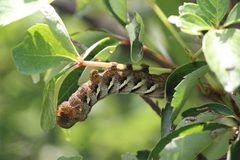
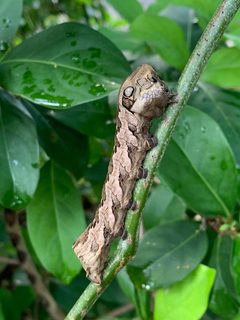
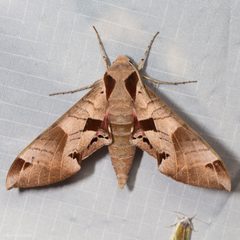
Eumorpha is a New World of sphinx moths (Sphingidae) comprising 26 described distributed primarily across North, Central, and South America. The genus is characterized by variable larval eyespots—circular markings on the body segments that function in deterrence. Molecular phylogenetic studies indicate Eumorpha originated in Central and South America and subsequently expanded into North America. are medium to large hawkmoths with rapid, agile ; many species are or flower visitors. Larvae are hornworms that feed primarily on members of the grape (Vitaceae), though plant associations vary among species.
Pronunciation
How to pronounce Eumorpha: //juːˈmɔːrfə//
These audio files are automatically generated. While they are not always 100% accurate, they are a good starting point.
Identification
Eumorpha can be distinguished from other Philampelini by forewing shape and pattern: more pointed and less rounded than Darapsa, with more complex maculation than Ampeloeca. Hindwing coloration is often diagnostic at the level. Eumorpha pandorus has greenish forewings with a distinctive pinkish-brown patch; E. achemon has pink hindwings with a dark brown border; E. fasciatus shows bold, contrasting light and dark bands. Larval identification relies on eyespot and plant association; E. achemon larvae have highly variable coloration (green, orange, or brown) while maintaining consistent eyespot structure. Eumorpha vitis larvae lack the eyespot entirely, distinguishing them from most .
Images
Habitat
Occurs across diverse terrestrial from sea level to montane elevations. In Brazil, documented in Atlantic Forest, Amazon, Cerrado, Caatinga, Pampa, and Pantanal biomes, with highest and occurrence records in Atlantic Forest and Amazon. Tropical forest collections include undisturbed forests and pioneer areas; one specimen of E. phorbas collected at 275 m elevation in French Guiana. Also found in agricultural and urban settings: E. achemon larvae recorded on cultivated grapevines in California, and observed at outdoor lighting in urban Santarém, Brazil.
Distribution
Primarily Neotropical and Nearctic. Native range extends from southern Canada through the United States, Mexico, Central America, and South America to Argentina. In the United States, E. achemon occurs across the country but is never particularly common in any region; E. pandorus ranges from Florida to Nova Scotia. Brazil 13–14 with 623 occurrence records from 233 georeferenced points, showing concentration in southern and southeastern Atlantic Forest. French Guiana records nine Eumorpha species, with E. phorbas abundant and active year-round. Distribution gaps exist in western Amazon, northern Atlantic Forest, Pantanal, and much of Caatinga.
Seasonality
activity varies by latitude and . In tropical regions (French Guiana), E. phorbas is active year-round. In temperate North America, E. pandorus has multiple in the southern part of its range but only one in the far north. E. achemon produces multiple annually in Florida but likely only two in Maryland. Adult are primarily or , with E. pandorus documented visiting flowers at dawn and dusk.
Host Associations
- Vitaceae (grape family) - primary larval Documented for multiple : E. achemon feeds on Vitis californica (native California grape) and cultivated grape leaves; E. pandorus lays on grape members. E. vitis specific epithet reflects association with Vitis.
- Parthenocissus quinquefolia (Virginia creeper) - larval Documented for E. achemon
- Ampelopsis brevipedunculata (porcelain berry) - larval Documented for E. achemon
Life Cycle
Complete with , larva, pupa, and stages. Eggs laid on plant leaves. Larvae pass through multiple instars, growing to substantial size (E. achemon caterpillars reach approximately 3.5 inches). occurs in soil or leaf litter. Number of per year varies geographically: multiple in tropical and subtropical regions, fewer in temperate zones. Specific developmental durations not documented in available sources.
Behavior
exhibit rapid, hovering characteristic of sphinx moths, enabling access to tubular flowers. E. pandorus visits flowers at dawn and dusk. Larvae display anti- defenses including eyespots that function to startle or deter predators through startling or deflection. When disturbed, larvae may retract the and , exposing the eyespot to simulate a larger animal. Failed by fire ants (Solenopsis cf. saevissima) on adult E. phorbas documented through museum specimen, indicating vulnerability to collective hunting despite adult mobility.
Ecological Role
serve as , transferring pollen while feeding on nectar from tubular flowers including honeysuckle (Lonicera), trumpet vine (Campsis), and mandevilla. Larvae function as herbivores, consuming leaf tissue of plants; rarely reach densities that cause significant damage. The serves as prey for diverse : documented by Cotesia congregata (Braconidae) on E. analis in Panama, with 204 individuals emerging from a single host larva. Fire ants (Solenopsis) prey on adults. Sphingidae, including Eumorpha, have been proposed as sensitive bioindicators of environmental change.
Human Relevance
Larvae occasionally feed on cultivated grapes (Vitis vinifera) but are never common enough to be considered agricultural pests. E. achemon described as
Similar Taxa
- DarapsaBoth Philampelini with similar size and associations (Vitaceae). Darapsa forewings are more rounded and less pointed than Eumorpha; D. myron (Virginia creeper sphinx) lacks the complex forewing maculation of most Eumorpha .
- XylophanesSimilar New World sphinx moth with comparable size and . Xylophanes typically show more cryptic forewing patterns and lack the distinctive hindwing coloration (pink, green) of many Eumorpha species.
- ManducaLarger sphinx moth with superficially similar larvae. Manduca larvae feed on Solanaceae rather than Vitaceae; have broader, more triangular forewings and lack the eyespot-related larval defenses characteristic of Eumorpha.
More Details
Molecular phylogeny
A 2015 phylogenetic study based on four genes (CAD, EF-1α, Wingless, COI; 3773 ) from 62 individuals representing 23 of 26 Eumorpha revealed that the probably had an ancestor with a larval eyespot, with subsequent loss in at least three lineages. The eyespot trait shows evolutionary lability rather than consistent diversification pattern.
Parasitoid record
First documentation of Cotesia congregata parasitizing Eumorpha analis in Panama (Sarigua National Park, 2024). This gregarious endoparasitoid produced 204 individuals from a single larva, expanding known host range beyond the typical Manduca sexta and M. quinquemaculata associations.
Museum specimen value
A 2024 study documented a unique -prey interaction through a 1987-collected museum specimen: Eumorpha phorbas female with Solenopsis cf. saevissima attached to , representing failed collective by fire ants. This highlights how preserved specimens can reveal ecological interactions never directly observed.
Sources and further reading
- BugGuide
- Wikipedia
- iNaturalist taxon
- NCBI Taxonomy
- Catalogue of Life
- The Achemon Sphinx Moth: A Lovely Beast, Indeed | Bug Squad
- Images of sphinxes and hummingbirds - Sphingidae — Bug of the Week
- Between Forests and Fields: The Distribution of Eumorpha (Lepidoptera, Sphingidae) Moths Across Brazilian Biomes
- Nuevo registro de parasitismo de Cotesia Congregata (Say, 1836) (Hymenoptera: Braconidae) sobre Eumorpha Analis (Rothschild & Jordan, 1903) (Lepidoptera: Sphingidae) en el parque nacional Sarigua, Panamá
- David couldn't bring down Goliath: museum specimen reveals a failed predation attempt by fire ants (Solenopsis Westwood, 1840) upon a large hawk moth Eumorpha phorbas (Cramer, 1775)
- A molecular phylogeny of Eumorpha ( L epidoptera: S phingidae) and the evolution of anti‐predator larval eyespots