
Eumorpha labruscae
Linnaeus, 1758
Gaudy Sphinx
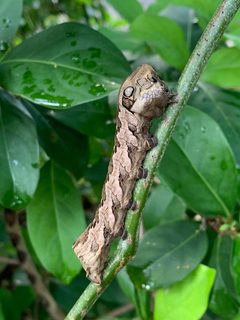
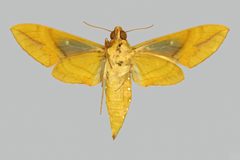
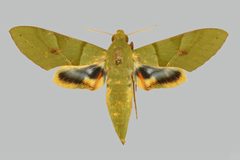
Eumorpha labruscae, commonly known as the gaudy sphinx, is a large sphinx moth ( Sphingidae) first described by Carl Linnaeus in 1758. display striking coloration with deep green forewings and purple-blue hindwing patches with yellow borders. The occurs in North America with a (E. l. yupanquii) to the Galápagos Islands. Larvae feed on grape family plants and pupate underground.
Pronunciation
How to pronounce Eumorpha labruscae: /juːˈmɔrfə læˈbrʌski/
These audio files are automatically generated. While they are not always 100% accurate, they are a good starting point.
Identification
Images
Habitat
Associated with grape (Vitaceae) plants. found in areas with suitable larval food sources including cultivated and wild grapes.
Distribution
North America; records from Manitoba and Saskatchewan (irregular). E. l. yupanquii restricted to Galápagos Islands.
Diet
Larvae feed on leaves of grape (Vitis) and vine (Cissus). probably feed on flower nectar.
Host Associations
- Vitis - larval main plant
- Cissus - larval main plant
Life Cycle
Females lay on plant leaves. Larvae hatch and feed, then climb down host plant to burrow underground for . Pupa wiggles to surface just prior to . Newly emerged adults climb vegetation to pump fluid into wings for extension. Females emit at night; males fly into wind to track odor plumes.
Behavior
are . Males engage in upwind to locate female plumes. Pupae exhibit pre- of wiggling to soil surface.
Ecological Role
Larval herbivore on Vitaceae. Probable of tubular flowers.
Human Relevance
Larvae feed on cultivated grapes but are not common enough to be considered a significant pest. Subject of entomological interest due to striking appearance and historical significance as one of Linnaeus's original descriptions.
Similar Taxa
- Eumorpha achemonSimilar size and plant use (grape ), but differs in hindwing coloration (pink in E. achemon vs. purple-blue patches with yellow borders in E. labruscae)
- Eumorpha pandorusConvergent green coloration and grape association, but E. pandorus has different wing pattern elements and lacks the distinctive red spot near hindwing inner margin
More Details
Historical significance
One of the original described by Carl Linnaeus in the 10th edition of Systema Naturae (1758), marking it among the earliest formally described Lepidoptera.
Subspecies
Eumorpha labruscae labruscae (mainland) and Eumorpha labruscae yupanquii (Galápagos Islands, described by Kernbach, 1962).