
Eumorpha pandorus
Hübner, 1821
Pandora sphinx moth, Pandorus sphinx moth
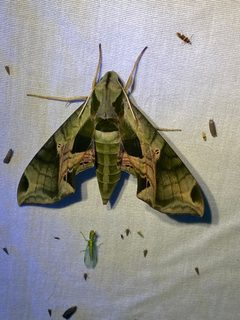
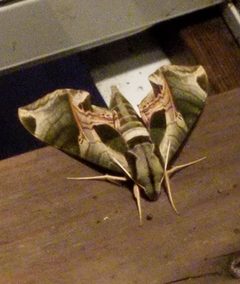
Eumorpha pandorus is a large North American sphinx moth with a wingspan of 8.3–11.7 cm. are characterized by greenish-olive forewings with pink markings and distinctive hindwings featuring black patches on a white to greenish-olive background with pink at the torni. The is , flying at dusk to feed on nectar using its long . Larvae feed on grape plants and pupate underground.
Pronunciation
How to pronounce Eumorpha pandorus: /juːˈmɔrfə pænˈdɔrəs/
These audio files are automatically generated. While they are not always 100% accurate, they are a good starting point.
Identification
Distinguished from Eumorpha intermedia by shape of darker portion of basal two-toned spot on forewing: rectangular in E. pandorus versus strongly wing-shaped in E. intermedia due to shorter inferior border of spot. Faint subterminal line on forewing straight or slightly sinusoidal in E. pandorus, scalloped in E. intermedia.
Images
Distribution
Eastern, southeastern, and central North America. Range extends from Nova Scotia and Ontario south to Florida and eastern Texas. Present in American Southwest.
Seasonality
fly at dusk. Two during summer months around New York City; in northern parts of range. Multiple broods per year in southern range, single brood in far north.
Diet
feed on nectar using long . Larvae feed on leaves of Vitis spp. (grapes), Ampelopsis spp. (peppervine), and Parthenocissus quinquefolia (Virginia creeper).
Host Associations
- Vitis spp. - larval foodplantgrapes
- Ampelopsis spp. - larval foodplantpeppervine
- Parthenocissus quinquefolia - larval foodplantVirginia creeper
Life Cycle
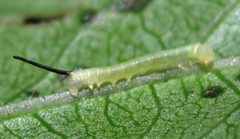
Females lay translucent singly on plant leaves. Larvae consume foliage through five instars, then climb down host plant and burrow underground to pupate. Pupa remains underground for two weeks if multiple per year, or over winter in final brood or . Pupa wiggles to surface prior to . emerge, climb on vegetation, and pump haemolymph into wings to extend them.
Behavior
fly at dusk. Females emit at night; males fly into wind to track pheromone plumes, casting about at right angles to wind to locate plumes.
Ecological Role
pollination of tubular flowers. Larval herbivory on grape plants.
Similar Taxa
- Eumorpha intermediaOverlaps in southern range; distinguished by wing-shaped (vs. rectangular) basal spot and scalloped (vs. straight/sinusoidal) subterminal line on forewing
More Details
Etymology
Specific epithet 'pandorus' refers to Pandora from Greek mythology.
Taxonomic history
Originally described as Daphnis pandorus by Jacob Hübner in 1821.