
Darapsa myron
Cramer, 1779
Virginia creeper sphinx, Green Grapevine Sphinx
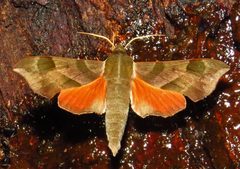
Darapsa myron is a sphinx moth native to central and eastern North America. have a wingspan of 2–3 inches, with green-brown striped forewings and orange hindwings. Larvae, known as hornworms, feed on Virginia creeper and grape plants. The produces multiple annually, with larvae capable of maturing in as few as three weeks. Adults are , visiting lights and sugar baits, and are most active from sunset to midnight.
Pronunciation
How to pronounce Darapsa myron: //dəˈræpsə ˈmaɪrɒn//
These audio files are automatically generated. While they are not always 100% accurate, they are a good starting point.
Identification
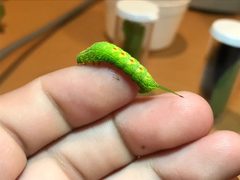
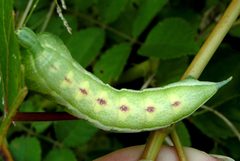
Distinguished from similar sphinx moths by the combination of orange hindwing and green-brown striped forewing with central dark dot. Separated from Darapsa choerilus (Azalea Sphinx) by forewing pattern and larval association. Differs from Eumorpha pandorus (Pandorus Sphinx) in wing coloration and pattern. Larvae identified by blue horn and seven pairs of diagonal stripes merging to black line.
Images
Habitat
Woodland and brush . Larvae occur on plants in these settings.
Distribution
North America: southern Ontario and Quebec (Canada); United States from Maine south to Florida, west to North Dakota, Nebraska, New Mexico, Oklahoma, and Texas; Mexico. Two recognized: D. m. myron (northern range) and D. m. mexicana (Mexico).
Seasonality
active early May to early September, with peak abundance June–July in Massachusetts and Pennsylvania. Multiple annually (two in Maryland, three or more in Florida). Adults emerge mid-afternoon; peak activity sunset to midnight.
Diet
Larvae feed on Virginia creeper (Parthenocissus quinquefolia), grape vines (Vitis spp.), Viburnums, and raccoon grapes. nectar from tubular flowers including honeysuckle, trumpet vine, and mandevilla; also feed on fluids from rotting fruit.
Host Associations
- Parthenocissus quinquefolia - larval food plantVirginia creeper
- Vitis spp. - larval food plantgrape vines
- Viburnum spp. - larval food plant
- Ampelopsis spp. - larval food plantporcelain berry
- Lonicera spp. - nectar sourcehoneysuckle
- Campsis radicans - nectar sourcetrumpet vine
Life Cycle
: small, green turning yellow within 48 hours when fertile; up to 150 per female. Incubation: approximately six days. Larval stage: as few as three weeks to maturity; five or more annually. Larvae hide on leaf midribs and feed nocturnally. : fully grown larvae spin sparse, wiry cocoons among ground leaves. Pupae: eclose in ~20 days or to emerge late May.
Behavior
emerge mid-afternoon. Females begin calling ( release) shortly after dusk. feeding and movement. Readily attracted to lights and sugar baits. Larvae conceal themselves on leaf midribs during daylight, feeding at night. Pairing in captivity is rapid; adults may refuse food entirely.
Ecological Role
Larval herbivore on grape plants. of tubular flowers. Caterpillars parasitized by .
Human Relevance
occasionally encountered at lights and sugar baits by enthusiasts. Larvae may defoliate ornamental grape vines and Virginia creeper. Captive adults used in behavioral studies; females lay more when fed.
Similar Taxa
- Darapsa choerilusSimilar size and shape; distinguished by forewing pattern and larval on Ericaceae rather than Vitaceae
- Eumorpha pandorusOverlapping range and grape ; Pandorus Sphinx has different wing pattern with more complex markings and greenish base color
- Hemaris thysbeSimilar and flower visitation; hummingbird clearwing has clear wings and different body form
More Details
Subspecies
Darapsa myron myron (northern range); Darapsa myron mexicana Gehlen, 1933 (Mexico)
Captive behavior
do not require feeding in captivity to pair, though fed females produce more . Some individuals refuse food entirely.
Sources and further reading
- BugGuide
- Wikipedia
- GBIF taxonomy match
- iNaturalist taxon
- NCBI Taxonomy
- Catalogue of Life
- Learn About Monarchs at Western Monarch Summit in San Luis Obispo | Bug Squad
- Monarch Sighting, All Day, Every Day | Bug Squad
- Images of sphinxes and hummingbirds - Sphingidae — Bug of the Week
- Myron Zalucki Archives - Entomology Today
- Royal wanderers settle into a far-away home: Monarch butterflies, Danaus plexippus — Bug of the Week
- Fall Armyworm Study Shows Maize, Sorghum as Preferred Host Plants