
Hemaris thysbe
Fabricius, 1775
Hummingbird Clearwing, Hummingbird Clearwing Moth, Hummingbird Sphinx Moth, Common Clearwing
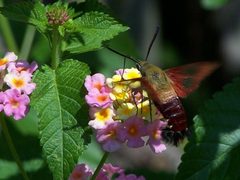
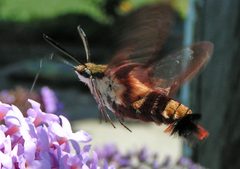
Hemaris thysbe is a hawkmoth known for its hummingbird-like and transparent wings. hover at flowers to feed on nectar using an exceptionally long . The exhibits significant color variation across its range, with northern and western typically showing smooth wing borders and lighter coloration, while southern and eastern populations tend toward darker colors with jagged wing borders. It is a migratory species with one per year in northern regions and two in the south.
Pronunciation
How to pronounce Hemaris thysbe: //hɛˈmɛərɪs ˈθɪzbi//
These audio files are automatically generated. While they are not always 100% accurate, they are a good starting point.
Identification
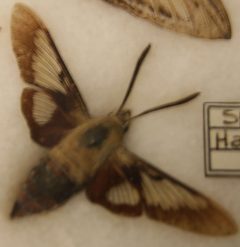
Distinguished from Hemaris gracilis and Hemaris diffinis by pale legs (reddish in H. gracilis, black in H. diffinis) and lack of dark striping on . H. thysbe also lacks the hearing organs () present in most other . Geographic variation in wing border shape provides additional clues: smooth borders in northern and western , jagged borders in southern and eastern populations.
Images
Habitat
Second-growth forest, meadows, and suburban gardens. Frequently associated with flowering plants in open or edge . Larval plants include woody shrubs and trees.
Distribution
North America, from Alaska and Yukon Territory south to Florida and west to Oregon, Texas, and the Great Plains. Most abundant in eastern United States and southern Ontario. Migratory, capable of long-distance movement.
Seasonality
active from late spring through summer in single- regions; March–June and August–October in two-brood southern regions. Most active during hottest parts of day, remaining active until sunset. Peak activity coincides with flowering periods of nectar sources.
Diet
feed on nectar from diverse flowers including honeysuckle, snowberry, lilac, phlox, balm, trumpet vine, vetch, bush, and thistles; shows preference for pink and purple flowers. Larvae feed on leaves of honeysuckle, dogbane, hawthorn, cherry, European cranberry bush, snowberry, and other woody plants.
Host Associations
- Lonicera - larval food planthoneysuckle
- Apocynum - larval food plantdogbane
- Crataegus - larval food planthawthorn
- Prunus - larval food plantcherry
- Viburnum opulus - larval food plantEuropean cranberry bush
- Symphoricarpos - larval food plantsnowberry
- Platanthera lacera - primary of green fringed orchid
Life Cycle
Complete . laid singly on undersides of leaves, hatch in approximately one week. Larval development takes four weeks. Caterpillar spins cocoon at ground level and pupates in soil. Overwinters as pupa. Emerges in late spring. Two per year in southern range, one in north.
Behavior
Rapid wing beating enables sustained hovering while feeding— that closely mimics hummingbirds. Moves rapidly between flowers. are , most active during midday heat. Mating behavior poorly studied. Adults do not produce sounds for defense or communication due to absence of tympanal organs.
Ecological Role
Primary for some orchid including Platanthera lacera. Contributes to pollination of diverse flowering plants. Serves as prey for birds, bats, and other . Larvae function as herbivores on woody shrubs.
Human Relevance
Minimal economic impact; neither significant crop nor pest. Frequently mistaken for hummingbirds or bumblebees due to appearance and , causing public curiosity and occasional alarm. Sometimes attracted to gardens with appropriate nectar sources. Occasionally referenced in conservation discussions regarding prairie management and pollinator preservation.
Similar Taxa
- Hemaris diffinisOverlapping range and similar clearwing ; distinguished by black legs and presence of dark thoracic stripes
- Hemaris gracilisSimilar appearance; distinguished by reddish legs, more restricted range in eastern North America, and larval specialization on blueberries
- Hyles lineataAlso called 'hummingbird moth' but larger (wingspan 6.3–9 cm), with fully scaled wings showing distinct white lines, not transparent
- Bumblebees (Bombus spp.)Behavioral and color mimicry; bees have two pairs of wings (often linked), branched body hairs, and do not hover as persistently
- Ruby-throated Hummingbird (Archilochus colubris)Convergent hovering and size; bird has feathers, beak rather than , and typically perches between feeding bouts
Misconceptions
Often mistakenly described as multiple distinct due to color variation; consolidated as single species by Ronald Hodges in 1971 based on reproductive . Name 'hummingbird moth' sometimes applied to unrelated sphinx moths (e.g., Hyles lineata), causing confusion. Despite mimicry of hummingbirds, evidence suggests actual mimicry target is bumblebees ( of unpalatable model).
More Details
Taxonomic History
First described by Johan Christian Fabricius in 1775 as Sesia thysbe. Specific epithet references Thisbe from Ovid's , associating the blood-stained scarf with the 's reddish-brown coloration. Multiple forms described as separate in 1800s; synonymized by Hodges (1971) after dissection revealed no reproductive differences across color variants.
Sensory Biology
Unusual among Lepidoptera in lacking tympanal organs (hearing structures); adaptive significance unknown. Possesses large and well-developed reproductive organs.
Morphological Variation
Coloration varies clinally: southern and later-season darker; northern and western with smooth wing borders, southern and eastern with jagged borders. Variation historically caused taxonomic confusion.
Conservation Status
Not listed as threatened or endangered. presumably stable though dependent on availability of larval plants and nectar sources. Fire management in prairies may affect local abundance through impacts on floral resources.
Sources and further reading
- BugGuide
- Wikipedia
- GBIF taxonomy match
- iNaturalist taxon
- NCBI Taxonomy
- Catalogue of Life
- Insect FAQs | Entomology Research Museum
- Devils and hummingbirds - Hickory horned devil, Citheronia regalis and hummingbird clearwing moth, Hemaris thysbe — Bug of the Week
- Friday Flower – green fringed orchid | Beetles In The Bush
- Bug Eric: Wasp Wednesday: Not Wasp V
- Bug Eric: White-lined Sphinx ("Hummingbird Moth")
- prairies | Beetles In The Bush | Page 3