
Hemaris gracilis
Grote & Robinson, 1865
slender clearwing, graceful clearwing
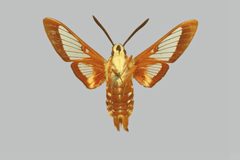
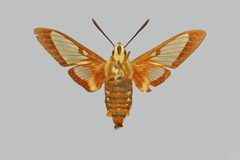
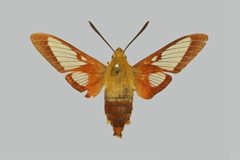
Hemaris gracilis, commonly known as the slender clearwing or graceful clearwing, is a in the Sphingidae. It is distinguished from related clearwing moths by red-brown bands on the and a red . The is considered the rarest of the three North American Hemaris species and is listed as threatened in Connecticut and of Special Concern in Massachusetts. are active from March through August, with likely two per year in its range.
Pronunciation
How to pronounce Hemaris gracilis: /hɛˈmarɪs ˈɡrasɪlɪs/
These audio files are automatically generated. While they are not always 100% accurate, they are a good starting point.
Identification
Distinguished from Hemaris thysbe and Hemaris diffinis by the pair of red-brown bands on the sides of the (the other two lack these bands). The red and even outer edge of the forewing transparent area also aid identification. The forewing has a row of , a feature not present in all similar species.
Images
Appearance
Wingspan 40–45 mm. Wings are transparent with reddish-brown borders. has a pair of red-brown bands on the sides, varying from green to yellow-green dorsally, sometimes brown with white underneath. is red. Outer edge of the forewing transparent area is even. Forewing has a row of .
Distribution
North America from Nova Scotia to central Florida along the East Coast, west through New England to Michigan and Saskatchewan. Canadian provinces include Alberta, Manitoba, and Saskatchewan.
Seasonality
on wing from March to August. Probably two per year.
Diet
feed on nectar of various flowers including Pontederia cordata, Rubus , Taraxacum officinale, Hieracium aurantiacum, and Phlox species. Larvae feed on Vaccinium vacillans and Kalmia species.
Host Associations
- Vaccinium vacillans - larval food plant
- Kalmia - larval food plant
Life Cycle
Larvae feed on plants then pupate in a thin-walled cocoon under leaf litter. Probably two per year.
Behavior
hover at flowers while feeding on nectar, resembling hummingbirds in . This hovering distinguishes them from bumblebees, which must land to feed.
Ecological Role
may act as . The is a bumblebee mimic, which may reduce risk.
Human Relevance
Listed as threatened in Connecticut and of Special Concern in Massachusetts. The is the rarest of the three North American Hemaris species.
Similar Taxa
- Hemaris thysbeLacks the red-brown bands on the sides of the present in H. gracilis; has greenish rather than red
- Hemaris diffinisLacks the red-brown bands on the sides of the ; has black legs compared to pale legs of H. gracilis
More Details
Conservation status
The is listed as threatened in Connecticut and of Special Concern in Massachusetts, making it the most conservation-concerned of the three North American Hemaris species.
Bumblebee mimicry
Like other Hemaris , H. gracilis is considered a bumblebee mimic. Evidence for true mimicry includes geographic variation in color pattern to match local bumblebee species. This mimicry may protect the from that have learned to avoid stinging bumblebees.
Sources and further reading
- BugGuide
- Wikipedia
- GBIF taxonomy match
- iNaturalist taxon
- NCBI Taxonomy
- Catalogue of Life
- Insect FAQs | Entomology Research Museum
- Grasshopper Collections and Survey
- Devils and hummingbirds - Hickory horned devil, Citheronia regalis and hummingbird clearwing moth, Hemaris thysbe — Bug of the Week
- Bichos Argentinos #2 – Pseudomyrmex sp. | Beetles In The Bush
- Traffic Jam Treehoppers | Beetles In The Bush
- Why two prehistoric sharks found in Ohio got new names