
Hemaris
Dalman, 1816
clearwing moths, hummingbird moths, bee hawk-moths
Species Guides
5- Hemaris aethra(Diervilla Clearwing)
- Hemaris diffinis(Snowberry Clearwing)
- Hemaris gracilis(slender clearwing)
- Hemaris thetis(Rocky Mountain Clearwing)
- Hemaris thysbe(Hummingbird Clearwing)
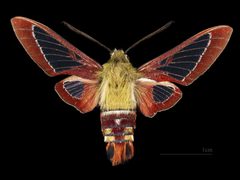
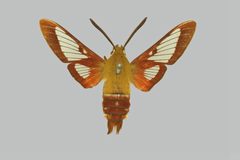
Hemaris is a of sphinx moths in the Sphingidae, native to the Holarctic region. are small, bumblebee mimics with transparent wing patches created by shed , and are often mistaken for hummingbirds in . The genus includes 23 accepted , with five native to North America and three to Europe. Larvae are hornworms that feed primarily on plants in the honeysuckle and teasel families.

Pronunciation
How to pronounce Hemaris: //hɛˈmɛˌrɪs//
These audio files are automatically generated. While they are not always 100% accurate, they are a good starting point.
Identification
Distinguished from similar Macroglossum (hummingbird hawk-) by transparent wing discs— are dropped soon after in Hemaris, while Macroglossum retains scaled wings. Distinguished from Sesiidae (clearwing moths) by wing coupling structure: Hemaris has a -retinaculum system typical of Sphingidae, while Sesiidae have additional interlocking scale series. Distinguished from bumblebees by hovering (bees must land to feed) and single pair of functional wings. -level identification often requires examination of genitalia: males have asymmetrical genitalia with uncus divided into two subequal sclerotized lobes; females have ostium bursae angled to the left.
Images
Habitat
Forest edges, clearings, meadows, and riparian zones with abundant flowering vegetation. In the Russian Far East, occurs in forested areas and meadows. Many associated with supporting their larval plants: shrub and vining honeysuckles, teasels, hawthorn, snowberry, and other woody and herbaceous plants.
Distribution
Holarctic distribution. Five native to North America (including H. diffinis, H. thysbe, H. gracilis, H. thetis, and H. aethra), three to Europe. H. aethra occurs from Manitoba to Nova Scotia and adjacent United States, with strict sympatry with H. diffinis in eastern Ontario. Other species distributed across Asia, including the Russian Far East.
Seasonality
active diurnally and crepuscularly. Multiple per year in southern parts of range (two generations in southern states), single generation in northern range. period varies by and latitude.
Diet
feed on nectar from deep tubular flowers including honeysuckle, snowberry, lilac, phlox, balm, trumpet vine, vetch, bush, and thistles. Long allows access to nectar in deep blossoms. Larvae feed on foliage of plants in Caprifoliaceae (honeysuckles, viburnums), Dipsacaceae (teasels), and other including Rosaceae (hawthorn, brambles) and Ericaceae (blueberries).
Host Associations
- Lonicera - larval food plantshrub and vining honeysuckles
- Dipsacus - larval food plantteasels
- Viburnum - larval food plant
- Symphoricarpos - larval food plantsnowberry
- Crataegus - larval food planthawthorn
- Rubus - larval food plantbrambles
- Vaccinium - larval food plantblueberries; H. gracilis feeds exclusively on this
Life Cycle
laid on plants. Larvae feed externally on foliage, passing through several instars. Mature larvae descend to ground and pupate in loosely spun cocoon in soil or leaf litter. stage varies: some overwinter as pupae, others may have multiple with different overwintering strategies depending on latitude.
Behavior
with rapid, hovering while feeding at flowers—resembling hummingbirds. Hovering allows access to nectar without landing, unlike bumblebees which must land. are strong, agile fliers. Bumblebee mimicry serves as defense: predators that have learned to avoid stinging bumblebees avoid these harmless . Evidence for true mimicry includes geographic variation in color pattern matching local bumblebee .
Ecological Role
Important of flowering plants, especially those with deep tubular corollas. At least one native orchid, Platanthera lacera (green fringed orchid), relies on Hemaris thysbe for pollination. transfer pollen while feeding on nectar. Larvae function as herbivores in forest and meadow .
Human Relevance
Subjects of ecological and evolutionary research due to mimicry systems. H. diffinis featured on UC Davis entomology graduate student t-shirt design titled "Wanna-bees." Some occasionally encountered in gardens where plants grow. No significant economic impact as pests or beneficial species in agriculture, though larvae may occasionally feed on ornamental honeysuckles.
Similar Taxa
- MacroglossumOld World hummingbird hawk- similar in appearance and habits, but retain wing throughout life; Hemaris drops scales to create transparent patches
- SesiidaeClearwing moths also have transparent wings and -like appearance, but have different wing coupling structure (additional interlocking ) and are generally more slender with different wing shape
- BombusBumblebees are the mimicry models; distinguished by two pairs of wings (four total), landing to feed, and stinging capability
More Details
Cryptic species
Hemaris aethra was resurrected as a distinct from H. diffinis in 2018 based on molecular, morphological, and natural history evidence. Despite highly divergent mtDNA and differing larval phenotypes, are externally nearly identical due to in bumblebee mimicry. H. aethra has a more northerly distribution and is more closely related to western H. thetis than to H. diffinis.
Nomenclature
Known as 'clearwing moths' or 'hummingbird moths' in North America, and ' hawk-' in Britain. vary by : H. thysbe is 'hummingbird clearwing' or 'common clearwing'; H. diffinis is 'snowberry clearwing' or 'bumblebee sphinx moth'; H. gracilis is 'slender clearwing' or 'graceful clearwing'.
Sources and further reading
- BugGuide
- Wikipedia
- GBIF taxonomy match
- iNaturalist taxon
- NCBI Taxonomy
- Catalogue of Life
- Insect FAQs | Entomology Research Museum
- Sheep Moths Draw Attention at Bohart Museum of Entomology Open House | Bug Squad
- How to Have a Bugworthy Holiday and Beyond | Bug Squad
- Devils and hummingbirds - Hickory horned devil, Citheronia regalis and hummingbird clearwing moth, Hemaris thysbe — Bug of the Week
- Friday Flower – green fringed orchid | Beetles In The Bush
- Bug Eric: Wasp Wednesday: Not Wasp V
- Cryptic species among bumblebee mimics: an unrecognized Hemaris hawkmoth (Lepidoptera: Sphingidae) in eastern North America
- Diversity and ecology of hawk moths of the genus Hemaris (Lepidoptera, Sphingidae) of the Russian Far East