
Hemaris aethra
Strecker, 1875
Diervilla Clearwing
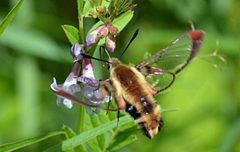
A day-flying hawkmoth native to northern North America. are bumblebee mimics with clear wings and fuzzy bodies, hovering at flowers to feed on nectar. Elevated to status in 2018 after long being considered a of H. diffinis; the two species remain extremely difficult to distinguish visually where they co-occur.


Pronunciation
How to pronounce Hemaris aethra: /hɛˈmɛərɪs ˈaɪθrə/
These audio files are automatically generated. While they are not always 100% accurate, they are a good starting point.
Identification
are extremely difficult to separate from sympatric H. diffinis. H. aethra is generally slightly larger and more robust, with richer orange-brown coloration and more extensive reddish forewing scaling. Larvae are readily distinguished: H. aethra has bright red , yellow prothoracic collar, and caudal horn with black apex fading to pink-purple base; H. diffinis larvae have black spiracles and bright yellow base to caudal horn.
Images
Habitat
Mesic, open deciduous forest, primarily in igneous bedrock plant . limited by distribution of larval plant Diervilla lonicera.
Distribution
Northern United States and southern Canada, from Maine to northern Ontario, with occasional records west to Saskatchewan. Range overlaps with H. diffinis, H. gracilis, and H. thysbe.
Diet
feed on nectar from flowers including Vaccinium, Cichorium, and Lonicera tatarica. Larvae feed on Diervilla lonicera (northern bush honeysuckle); native Lonicera may also serve as .
Host Associations
- Diervilla lonicera - larval only confirmed larval
- Lonicera tatarica - nectar source
- Vaccinium - nectar source
- Cichorium - nectar source
Life Cycle
Larva has multiple color forms, green most common. occurs in soil or leaf litter. emerge and are active during daylight hours.
Behavior
Day-flying that hovers at flowers while feeding on nectar, resembling hummingbirds in . Bumblebee mimicry provides protection from .
Ecological Role
of flowers visited for nectar. Larvae are herbivores on Diervilla lonicera.
Similar Taxa
- Hemaris diffinisExternally nearly identical ; distinguished by larval coloration, subtle adult size and color differences, and preferences. H. diffinis occupies more xeric, savannah-like habitats with Symphoricarpos .
- Hemaris thysbeAnother clearwing hawkmoth with similar and appearance, but with different larval and generally more southerly distribution.
- Hemaris gracilisOverlapping range; distinguished by larval specialization on blueberries and generally more restricted distribution.
More Details
Taxonomic history
Described as Macroglossa aethra by Strecker in 1875 from a Montreal specimen. Treated as H. diffinis aethra (northern ) by Barnes & McDunnough in 1910. Elevated to full status in 2018 by Schmidt based on mitochondrial divergence, genitalic , and larval phenotype differences. Not sister to H. diffinis; more closely related to western H. thetis.
Mimicry
with H. diffinis through co-mimicry of Bombus bumblebee models, not shared ancestry.
Etymology
from Ancient Greek Αἴθρα (Aíthra), meaning 'bright sky'; namesake among several women in Greek mythology is unclear.
Sources and further reading
- BugGuide
- Wikipedia
- GBIF taxonomy match
- iNaturalist taxon
- Catalogue of Life
- Insect FAQs | Entomology Research Museum
- Sheep Moths Draw Attention at Bohart Museum of Entomology Open House | Bug Squad
- How to Have a Bugworthy Holiday and Beyond | Bug Squad
- Devils and hummingbirds - Hickory horned devil, Citheronia regalis and hummingbird clearwing moth, Hemaris thysbe — Bug of the Week
- Friday Flower – green fringed orchid | Beetles In The Bush
- Bug Eric: Wasp Wednesday: Not Wasp V
- Cryptic species among bumblebee mimics: an unrecognized Hemaris hawkmoth (Lepidoptera: Sphingidae) in eastern North America