
Hemaris diffinis
Boisduval, 1836
Snowberry Clearwing, Hummingbird Moth, Flying Lobster, Bumblebee Sphinx Moth
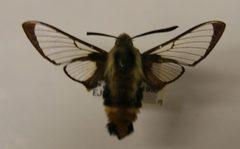
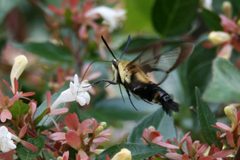
Hemaris diffinis is a day-flying sphinx moth notable for its bumblebee mimicry and clear, -free wing patches. hover at flowers to feed on nectar using an exceptionally long . The was historically confused with the cryptic Hemaris aethra in eastern North America, distinguished only recently through molecular and morphological analysis. Larvae are caterpillars that feed on various plants including honeysuckle and snowberry.

Pronunciation
How to pronounce Hemaris diffinis: /hɛˈmɛərɪs dɪˈfaɪnɪs/
These audio files are automatically generated. While they are not always 100% accurate, they are a good starting point.
Identification
Distinguished from Hemaris thysbe (Hummingbird Clearwing) by the yellow and black abdominal banding versus the greenish of H. thysbe. Distinguished from Hemaris aethra by genitalic and larval associations, though are externally nearly identical. The clear wing patches and hovering pattern separate it from true bumblebees (Bombus), which must land to feed.
Images
Appearance
measure 32–51 mm in length. The has distinct yellow and black banding resembling bumblebees. Wings lack in central regions, creating transparent patches; these scales are lost early after due to active . The body is covered in hair that contributes to its -like appearance.
Habitat
Found in diverse environments including open woodlands, forest edges, meadows, gardens, and urban areas with flowering plants. Associated with containing larval plants such as honeysuckle, snowberry, and dogbane.
Distribution
North America: Canada from Northwest Territories, British Columbia, southern Ontario, eastern Manitoba, and western Quebec; United States from southern California and Baja California Norte east through most of the country from Maine to Florida, including Illinois and West Virginia. The cryptic sister Hemaris aethra occupies more northerly regions with sympatry in eastern Ontario.
Seasonality
fly during daylight hours and may continue into evening when nectar sources are abundant. Multiple occur in southern regions; fewer in northern range. Active primarily during warmer months when flowering plants are available.
Diet
feed on nectar from tubular flowers including honeysuckle, lilac, phlox, balm, trumpet vine, vetch, bush, and thistles. The long enables access to deep floral nectar repositories.
Host Associations
- Lonicera - larval honeysuckle
- Symphoricarpos - larval snowberry; source of
- Apocynum - larval dogbane
- Viburnum - larval
- Amsonia - larval
- Triosteum - larval
- Diervilla - larval
- Platanthera lacera - pollinationnative orchid; act as
Life Cycle
Complete with , larva, pupa, and stages. Larvae are caterpillars with a terminal horn, feeding on plant leaves before pupating in soil or leaf litter. Pupae overwinter, with adults emerging in spring.
Behavior
with rapid, hovering movement at flowers while feeding—resembling hummingbirds. Highly active flight causes early loss of wing , producing clear patches. Males patrol territories and may be observed flying at passing objects including humans.
Ecological Role
serve as for various flowering plants, including at least one native orchid (Platanthera lacera). Larvae function as herbivores on plants. The participates in mimicry complexes with bumblebees, potentially gaining protection from .
Human Relevance
Considered beneficial due to pollination services. Frequently mistaken for hummingbirds or bumblebees, causing surprise among observers. Sometimes called 'flying lobster' in Appalachia. Subject of citizen science observation through platforms like iNaturalist.
Similar Taxa
- Hemaris thysbeSimilar clearwing appearance and hovering ; distinguished by greenish and different abdominal coloration
- Hemaris aethraCryptic externally identical to H. diffinis; distinguished by genitalic , larval phenotype, and more northerly distribution
- Hemaris gracilisRarer with more restricted range; larvae feed only on blueberries
- Macroglossum stellatarumEuropean hummingbird hawk-moth; not found in North America but frequently confused in common naming
- Bombus speciesBumblebees share color pattern and buzz; distinguished by landing to feed and two pairs of wings (four total) versus wing structure
Misconceptions
Frequently misidentified as hummingbirds due to hovering and size. The 'hummingbird moth' is applied to multiple Hemaris , causing confusion. Historical lumping with Hemaris aethra means older records may not distinguish the two species. Not a lobster or crustacean despite the 'flying lobster' nickname.
More Details
Mimicry and Convergence
Hemaris diffinis exhibits of bumblebees (Bombus), with geographic variation in color pattern matching local bumblebee . with Hemaris aethra, driven by co-mimicry of the same bumblebee models, produced externally identical despite significant genetic divergence and different larval .
Taxonomic History
The was described by Boisduval in 1836 as Macroglossa diffinis. A 2018 study revealed that nominal H. diffinis in eastern North America comprised two cryptic species, with H. aethra resurrected from synonymy. This has implications for distribution records and plant associations previously attributed to H. diffinis in the northeastern range.
Sources and further reading
- BugGuide
- Wikipedia
- GBIF taxonomy match
- iNaturalist taxon
- NCBI Taxonomy
- Catalogue of Life
- Insect FAQs | Entomology Research Museum
- How to Have a Bugworthy Holiday and Beyond | Bug Squad
- Sheep Moths Draw Attention at Bohart Museum of Entomology Open House | Bug Squad
- Devils and hummingbirds - Hickory horned devil, Citheronia regalis and hummingbird clearwing moth, Hemaris thysbe — Bug of the Week
- Bug Eric: Scientific Illustration
- Bug Eric: February 2010
- Cryptic species among bumblebee mimics: an unrecognized Hemaris hawkmoth (Lepidoptera: Sphingidae) in eastern North America