
Macroglossum stellatarum
Linnaeus, 1758
Hummingbird Hawk-moth, Hummingbird Hawkmoth, Eurasian Hummingbird Hawkmoth
Macroglossum stellatarum is a hawkmoth renowned for its hovering and long-distance migratory . feed on nectar from diverse flowers using an exceptionally long , and are significant across their range. The exhibits complex visual learning capabilities and innate color preferences that guide foraging decisions. in southern Europe may be resident and multivoltine, while northern populations depend on immigration from the south.
Pronunciation
How to pronounce Macroglossum stellatarum: /ˌmækroʊˈɡlɒsəm ˌstɛləˈtɛərəm/
These audio files are automatically generated. While they are not always 100% accurate, they are a good starting point.
Identification
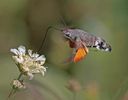
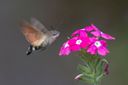
Distinguished from other European sphingids by activity, sustained hovering , and orange hindwings visible during hovering. Resembles hummingbirds in flight but smaller with visible . Macroglossum pyrrhosticta has more uniformly dark hindwings and restricted Asian distribution. Other hovering lack the combination of orange hindwings and extremely long .
Images
Appearance
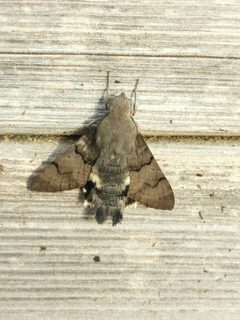
Medium-sized with streamlined, bullet-shaped body and narrow, pointed forewings. Forewings brown with dark markings; hindwings orange with dark base. Very long, thin often visible as a fine thread when feeding. thickened and clubbed at tip. In , rapid wingbeats create audible hum and blurred wing appearance.
Habitat
Open, flower-rich including gardens, meadows, coastal areas, and mountain valleys. In Mediterranean regions, associated with lavender and other Lamiaceae. Requires abundant nectar sources during period. Larval habitat includes areas with Galium and other Rubiaceae plants.
Distribution
Palearctic distribution across Europe, North Africa, and Asia. Resident in southern Europe, North Africa, and parts of Asia. migrants reach northern Europe including British Isles and Scandinavia. Records from Atlantic islands (Azores: Corvo, Faial, Flores, Graciosa, Pico). routes cross Pyrenees via mountain passes and continue to sub-Saharan Africa.
Seasonality
active year-round in southern Mediterranean regions with peaks in May, July, and February-March indicating trivoltine . In northern Europe, adults present mainly June-September following spring northward. Autumn migration southward occurs September-October triggered by temperature decline and day length changes.
Diet
feed exclusively on nectar from flowers. length allows access to deep corolla tubes. Observed feeding on diverse plant including Lamiaceae (Lavandula), Rubiaceae, and ornamental . Larvae feed on Rubiaceae, primarily Galium species (bedstraws).
Host Associations
- Galium - larval food plantbedstraws (Rubiaceae)
- Lavandula latifolia - nectar sourceMediterranean region
- Oenothera speciosa - negative interactionnon-native plant; become trapped with stuck to flowers
Life Cycle
Complete with , larva, pupa, and stages. Trivoltine in southern Spain with overlapping . Eggs laid on plants. Larvae feed on Galium and related Rubiaceae. in loose soil or leaf litter. Adults emerge and may migrate or establish local depending on latitude.
Behavior
foraging with peak activity in evening (18:00-20:00 GMT) in Mediterranean summer. Sustained hovering while feeding, with rapid wingbeats enabling stationary position at flowers. Endothermic maintains thoracic temperature 39-46°C across ambient temperatures 19-36°C. Innate visual preferences for blue (440 nm) and yellow-green (540 nm) colors, and radial patterns over concentric patterns. Capable of associative color learning to optimize foraging. Visual position stabilization during hovering mediated by independent translational and rotational control systems with different visual field sensitivities. Long-distance using wind assistance while maintaining directional control; crosses mountain passes rather than flying over peaks.
Ecological Role
Important for diverse flowering plants, including with deep corolla tubes inaccessible to shorter-tongued insects. contributes to nutrient transport between and pollen transfer across large distances. In southern Spain, documented pollinator of Viola cazorlensis, enabling between isolated . Serves as food source for insectivorous birds and bats, including Tadarida teniotis in Pyrenees which times breeding to match autumn migration.
Human Relevance
Popular with naturalists and gardeners due to accessible daytime activity and hummingbird-like appearance. Valued as in gardens and agricultural settings. Subject of extensive research on insect vision, learning, and mechanics. Negative interaction with Oenothera speciosa in Europe poses conservation concern due to entrapment.
Similar Taxa
- Macroglossum pyrrhostictaSimilar size and hovering , but has uniformly dark hindwings without orange coloration; Asian distribution
- Eristalis tenaxHovering and activity, but smaller, true fly (Diptera) with single pair of wings and shorter mouthparts
- Deilephila elpenorAnother sphingid with hovering capability, but /, larger, with pink and olive green coloration rather than orange hindwings
More Details
Visual Physiology
Possesses trichromatic color vision with innate preferences for specific wavelengths and pattern types. Color discrimination abilities vary across color space and can be modelled using sigmoidal functions. Visual learning enables rapid optimization of foraging in novel environments.
Migration Ecology
Part of a broader insect system through Pyrenees passes first documented by bird researchers David and Elizabeth Lack in the 1950s. Migration strategy involves low-altitude passage through mountain cols rather than high-altitude overflight, concentrating individuals and facilitating exploitation.
Sources and further reading
- BugGuide
- GBIF taxonomy match
- iNaturalist taxon
- NCBI Taxonomy
- Catalogue of Life
- A story of a migration out of Wales (Part 2) - Buglife Blog - Buglife
- Stori am fudo allan o Gymru (Rhan 2) - Buglife Blog - Buglife
- Meet six unsung heroes of the pollination world - Buglife Blog - Buglife
- Colour Learning in the Hawkmoth Macroglossum Stellatarum
- Visual position stabilization in the hummingbird hawk moth, Macroglossum stellatarum L. I. Behavioural analysis
- Innate Preferences for Flower Features in the Hawkmoth Macroglossum Stellatarum
- " INFORMATION ON THE BIOLOGY OF THE BUTTERFLY (LEPIDOPTERA, SPHINGIDAE) MACROGLOSSUM STELLATARUM (LINNAEUS, 1758) IN THE CONDITIONS OF SOUTH FERGANA"
- Activity pattern and thermal biology of a day‐flying hawkmoth (Macroglossum stellatarum) under Mediterranean summer conditions
- The year-round phenology of Macroglossum stellatarum (Linnaeus, 1758) at a Mediterranean area of South of Spain (Lepidoptera: Sphingidae)
- The Spreading in Europe of the Non-Indigenous Species Oenothera speciosa Nutt. Might Be a Threat to the Autochthonous Moth Macroglossum stellatarum (Linnaeus, 1758)? A New Case Study from Italy
- Colour Discrimination Functions of the Humming Bird Hawkmoth (Macroglosum Stellatarum) Modelled From Behavioural Choices