
Deilephila elpenor
(Linnaeus, 1758)
Elephant Hawk-moth, Large Elephant Hawk-moth
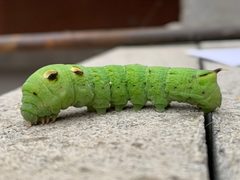
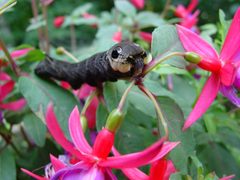
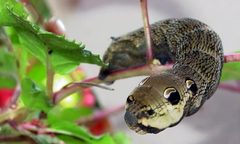
A medium-sized hawkmoth distinguished by olive-brown forewings with pink markings and pink hindwings with black bases. The caterpillar has a distinctive trunk-like appearance with large eyespots used for deterrence. Notable as the first animal documented with colour vision, which supports its specialized hovering while feeding on nectar at night.
Pronunciation
How to pronounce Deilephila elpenor: //ˌdaɪlɪˈfaɪlə ˈɛlpənɔr//
These audio files are automatically generated. While they are not always 100% accurate, they are a good starting point.
Identification
Distinguished from Deilephila porcellus (small elephant hawk-) by larger size, more extensive pink coloration, and a thick pink stripe running the length of the . D. porcellus has more yellow coloration and lacks the abdominal pink stripe. The two rarely co-occur in the same trap due to preferences.
Images
Habitat
Rough grassland, heathland, sand dunes, hedgerows, woodland edges, open countryside, and urban gardens. Occupies diverse environments across its range.
Distribution
Palearctic region from Europe through Asia to Japan. Common in central Europe, England, Wales, and Ireland. Range expanding northward in Scotland since 1980s. Introduced to British Columbia, Canada.
Seasonality
active May to early August, peaking June–September. Usually single-brooded; rare partial second in late summer. Overwinters as pupa.
Diet
feed on nectar from night-flowering plants including honeysuckle (Lonicera), rosebay willowherb (Chamaenerion angustifolium), and garden plants such as fuchsia. Larvae feed on leaves of rosebay willowherb, bedstraws (Galium), and garden plants including fuchsia, dahlia, and lavender.
Host Associations
- Chamaenerion angustifolium - larval food plantrosebay willowherb
- Galium - larval food plantbedstraws
- Lonicera - nectar sourcehoneysuckle
- Fuchsia - larval food plant and nectar sourcegarden plant
Life Cycle
Females lay whitish-green singly or in pairs on plant leaves; eggs hatch in approximately 10 days. Larval development to takes around 27 days. Larvae pupate in plant debris or underground, as pupae. emerge in spring.
Behavior
, flying from dusk until morning and resting at food sources during daylight. Feeds by hovering in front of flowers rather than landing, extending the to reach nectar. Wingbeat frequency high during hovering to maintain stability against wind. Ceases flower visitation at wind speeds above 3.0 m/s. Maximum speed 4.5–5.1 m/s. Larvae adopt defensive posture when threatened, expanding segments to display eyespots resembling a snake.
Ecological Role
of night-flowering plants. Studies indicate hawkmoths can pollinate 5–10% of tree and shrub in their .
Human Relevance
Attracted to garden plants, making it observable in urban settings. Caterpillar's distinctive appearance generates public interest. Subject of research on vision and insect learning.
Similar Taxa
- Deilephila porcellusSmaller size, more yellow coloration, lacks thick pink abdominal stripe; prefers more open
More Details
Nocturnal colour vision
First in which colour vision was documented in animals. Possesses three functional photoreceptor types (ultraviolet, blue, green) that remain active in dim light, supporting visually demanding tasks of locating flowers and maintaining hovering in darkness.
Sex pheromone
Major components identified as (E)-11-hexadecenal and (E,E)-bombykal [(10E,12E)-10,12-hexadecadienal], most active during female calling behaviour.
Learning ability
Can discriminate between visual stimuli and associate colours with food rewards, modifying foraging behaviour based on experience to minimize energy expenditure.