
Eristalis tenax
(Linnaeus, 1758)
Common Drone Fly, Drone Fly, Rat-tailed Maggot
Eristalis tenax is a hoverfly (Syrphidae) and the most widely distributed syrphid globally, occurring on every continent except Antarctica. are striking mimics of honey bees, exhibiting that provides protection from . The larval stage, known as the rat-tailed maggot, is aquatic and inhabits polluted water containing organic matter, using an elongated siphon for respiration. Adults are important , particularly of Asteraceae flowers. The species exhibits strong territorial in males and has been documented to cause rare cases of accidental myiasis in humans.
Pronunciation
How to pronounce Eristalis tenax: //ɛrɪˈstɑːlɪs ˈtinæks//
These audio files are automatically generated. While they are not always 100% accurate, they are a good starting point.
Identification
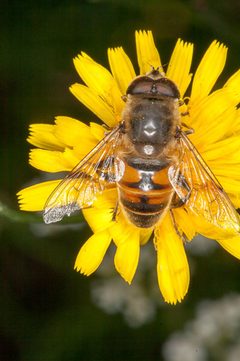
Distinguished from honey bees (Apis mellifera) by the absence of a constricted petiole (' waist') and presence of only one pair of wings (bees have two pairs). Distinguished from other Eristalis by the rounded shape of orange-to-brown spots on the second abdominal segment and all-black or brown hind tibiae thickened medially. The 'H' marking on the is diagnostic. Larvae are unmistakable due to the extremely long, telescopic respiratory siphon (tail), which can exceed body length.
Images
Appearance
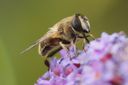
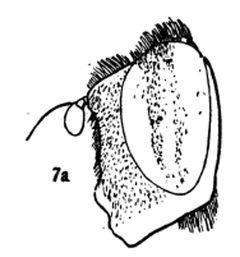
are large, stocky flies with average wing length 9.75–13 mm and wingspan approximately 15 mm. Coloration is highly variable: ranges from dark brown to orange with yellow-orange lateral spots on the second abdominal segment and a transverse yellow-orange band on the third segment. The bears short brownish-yellow hairs. are marbled in black; males have large eyes that nearly touch at the top of the , while females have smaller, more widely separated eyes. The single pair of wings (characteristic of Diptera) distinguishes it from bees. Hind tibiae are black or brown and thickened medially. Setae above the antennal base are dark. The 'H' pattern on the abdomen is a distinctive marking.
Habitat
frequent gardens, fields, and urban areas with flowering vegetation. Larvae are aquatic and require water polluted with organic matter: drainage ditches, manure lagoons, sewage pools, liquid , and stagnant water . occurs in drier terrestrial , often below the soil surface. Adults overwinter in sheltered locations including caves and rocky crevices.
Distribution
; native to Europe, introduced and established in North America, Australia, and elsewhere. Present on all continents except Antarctica. Range extends from Alaska to Florida in North America, and to high elevations in the Himalayas. Absent from extremely arid regions of Europe, Asia, and Africa and from the southernmost latitudes.
Seasonality
Active from March through December in temperate regions. Most abundant in late summer and autumn. Males are rare in spring; fertilized females emerge from hibernation. may exceed abundance in urban areas during autumn.
Diet
feed primarily on nectar and pollen. Pollen is consumed as a protein source for development; nectar provides energy. Adults show particular affinity for flowers of Asteraceae (daisies, asters, chrysanthemums, zinnias) and also visit carrot, fennel, and ceanothus. Larvae are saprophagous, filtering bacteria and microbes from decaying organic matter in aquatic .
Life Cycle
are white, elongated, and covered with sticky substance, deposited in clusters of approximately 10 near the surface of foul water or decaying organic matter, laid perpendicular to the substrate. Larvae pass through three instars; they are aquatic, cylindrical, with horizontal body folds and two rows of flexible hairs per segment. The siphon functions as a breathing tube, remaining at the water surface while the body forages below. Larvae may reproduce by (observed once). Mature larvae exit water to pupate in drier locations; pupae are 10–12 mm, grey-brown, oval, with two pairs of cornua (horn-like bumps) on the and the siphon locked in curved position over the back. lasts 8–10 days. emerge and females require pollen feeding to complete . occurs as adults in sheltered microhabitats.
Behavior
Males exhibit strong territoriality during summer, defending flowerbeds or bushes for mating opportunities. Territorial males hover motionless and dart at intruders to expel them. Males in horizontal territories (flowerbeds) show higher aggression than those in vertical territories (shrubs). Males may remain in the same territory throughout life, performing all activities within it. Aggression increases when weather prevents leaving territory. Males attack including bees, , and butterflies when on territory, but rarely respond to insects when away from territory. Mating occurs in (male uppermost) or on ground with female resting on foliage. demonstrate learning : feeding improves over successive sessions at sublethal conditions.
Ecological Role
Important , particularly effective for open flowers rather than tubular ones. Contributes to pollination of wildflowers and agricultural crops. Larvae perform service of organic waste recycling in aquatic . Serves as model organism for toxicological studies of effects on non-target pollinators. Provides food source for including spiders, birds, and other insects.
Human Relevance
Beneficial as in gardens and agriculture. Larval stage occasionally causes accidental myiasis in humans through ingestion of contaminated food or water, or direct -laying on body openings; documented cases include intestinal and urinary myiasis, primarily in regions with poor . include abdominal pain, nausea, vomiting, and presence of larvae in excreta. Rarely contaminates livestock feed or enters electrical equipment causing short circuits. Used in research on , learning , and pollinator conservation. Mass rearing protocols under development for use as alternative managed pollinator.
Similar Taxa
- Apis mellifera (European Honey Bee) E. tenax is a Batesian mimic of the ; distinguished by single pair of wings, lack of constricted waist, short , and 'H' abdominal marking
- Other Eristalis speciesE. tenax has more rounded spots on abdominal segment 2 and all-black/brown hind tibiae; other such as E. arbustorum and E. pertinax have different leg coloration and abdominal pattern
- Volucella bombylansAnother syrphid mimic; differs in body shape, color pattern, and lacks the 'H' marking characteristic of E. tenax
Misconceptions
Frequently misidentified as a or '' due to of coloration and body form; this is a fly (Diptera), not a (Hymenoptera), and cannot sting. The name 'drone fly' refers to resemblance to male honey bees (drones), not to unmanned aerial vehicles. Biblical accounts of bees spontaneously generating from rotting animal carcasses likely refer to rat-tailed maggots emerging from decomposing matter.
More Details
Physiological Resilience
exhibit remarkable toughness: decapitated individuals may survive three days; removal allows thoracic musculature to continue functioning for over an hour; wing removal does not prevent immediate resumption of feeding . is insoluble in strong alkaline solutions.
Neonicotinoid Tolerance
E. tenax possesses substantially higher to imidacloprid than its hymenopteran model, the . Chronic exposure LD50 is 0.41 ng/mg, with locomotive impairment occurring at lower doses (ED50 0.17 ng/mg acute, 7.82 ng/mg chronic). This tolerance resembles that of other dipterans (Drosophila, Musca), suggesting phylogenetic components to sensitivity.
Learning and Memory
Contrary to earlier assumptions, E. tenax can extinguish innate extension responses through aversive conditioning and acquire responses to innately unattractive objects through appetitive training. Memories persist for days, with aversive memories lasting longer than appetitive ones. This capacity requires multimodal sensory contexts.
Target Pursuit Behavior
Males pursue artificial and biological targets in two-stage sequences: initial high-speed interception attempt, followed by speed-matched shadowing resembling 'motion camouflage'. Pursuit initiation is not strictly determined by target angular size or velocity.
Sources and further reading
- BugGuide
- Wikipedia
- GBIF taxonomy match
- iNaturalist taxon
- NCBI Taxonomy
- Catalogue of Life
- To Bee or Not to Bee | Bug Squad
- Honey Bee Impostor | Bug Squad
- A friendlier type of drone: Common Drone Fly, Eristalis tenax — Bug of the Week
- B-Lines: Building the Insect Super-highway - Buglife Blog - Buglife
- Archive — Bug of the Week
- Bug Eric: Fly Day Friday: Rat-tailed Maggots
- Human Urinary Myiasis Caused by Eristalis tenax in Palestine: A Case Report
- Acute and chronic toxicity of imidacloprid in the pollinator fly, Eristalis tenax
- Drone fly, rat-tailed maggot Eristalis tenax (Linnaeus) (Insecta: Diptera: Syrphidae)
- Extinction of innate floral preferences in the pollinator Eristalis tenax
- Hoverfly ( Eristalis tenax ) pursuit of artificial targets
- SEM studies on immature stages of the drone flies (diptera, syrphidae): Eristalis similis (Fallen, 1817) and Eristalis tenax (Linnaeus, 1758)
- The Formal Model for the hoverfly Eristalis tenax (Diptera, Syrphidae) agent-based model in the Animal Landscape and Man Simulation System (ALMaSS)
- Surviving in the mountains: temperature and elevation have contrasting physiological effects and no effect on morphology of the hoverfly Eristalis tenax in the Himalayas.