
Hemaris thetis
Boisduval, 1855
Rocky Mountain Clearwing, California Clearwing
Hemaris thetis is a day-flying sphinx moth in the Sphingidae, commonly known as the Rocky Mountain clearwing or California clearwing. The exhibits clearwing with reduced wing scaling, resembling a bumblebee in . are active from May to August and feed on nectar from various flowers. The species was first described by Jean Baptiste Boisduval in 1855 and occurs in mountainous regions of western North America.
Pronunciation
How to pronounce Hemaris thetis: /hɛˈmɛərɪs ˈθiːtɪs/
These audio files are automatically generated. While they are not always 100% accurate, they are a good starting point.
Identification
Distinguished from other Hemaris by geographic range and subtle morphological differences. Hemaris thetis overlaps with H. diffinis (snowberry clearwing) in some areas but tends to occur at higher elevations and more western localities. H. thysbe (hummingbird clearwing) is generally more eastern and has different wing scaling patterns. Accurate identification often requires examination of geographic provenance combined with wing venation and body coloration details. The species lacks the extensive dark scaling on the wings seen in some other clearwing moths.
Images
Appearance
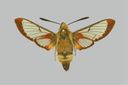
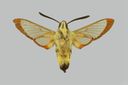
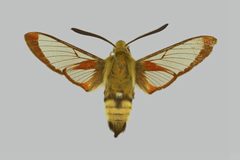
have partially transparent wings with reduced scaling, dark borders along the wing edges, and a robust, furry body. The clearwing appearance results from sparse scaling on the central wing . Body coloration typically includes greenish or brownish tones with pale or yellowish markings. The wingspan is moderate for the . Like other Hemaris , the has a streamlined body adapted for rapid, hovering .
Habitat
Streamsides and meadows in mountainous areas. Occurs in montane and subalpine zones, often associated with riparian corridors and open grassy at elevation.
Distribution
Western North America from Colorado, New Mexico, Montana, Idaho, Wyoming and Utah westward to California, and north to British Columbia. The range spans the Rocky Mountains and associated ranges west to the Pacific Coast.
Seasonality
are on wing from May to August. The probably has one per year.
Diet
feed on nectar of various flowers including Arctostaphylos uva-ursi (bearberry) and Lupinus . Larvae feed on Symphoricarpos species (snowberries and related shrubs).
Host Associations
- Symphoricarpos - larval food plantLarvae feed on in this
- Arctostaphylos uva-ursi - nectar source visit for nectar
- Lupinus - nectar source visit for nectar
Life Cycle
Probably one per year. are laid on plants. Larvae are caterpillars, typical of Sphingidae, feeding on Symphoricarpos. occurs in soil or leaf litter. emerge in spring and summer.
Behavior
are and hover at flowers while feeding on nectar, resembling hummingbirds or bumblebees in . This hovering and rapid wing movement are characteristic of the . The clearwing and coloration likely serve as protective mimicry of stinging Hymenoptera.
Ecological Role
may act as of the flowers they visit. The is part of the montane pollinator in western North America. Larvae are herbivores that consume leaves of Symphoricarpos shrubs.
Human Relevance
Not a significant pest or beneficial from a human perspective. are sometimes mistaken for hummingbirds or bees due to their and appearance. The species may be encountered by hikers and naturalists in mountain meadows and along streams.
Similar Taxa
- Hemaris diffinisOverlapping range in western areas; H. diffinis (snowberry clearwing) tends to occur at lower elevations and has different wing scaling patterns
- Hemaris thysbeSimilar appearance and ; H. thysbe (hummingbird clearwing) is generally more eastern in distribution with different wing scaling details
- Sesiidae (clearwing moths) of with similar clearwing and -mimicry, but belong to different superfamily and have different wing venation and body structure
More Details
Taxonomic history
Originally described as Macroglossa thetis by Boisduval in 1855, later transferred to Hemaris. The has been subject to taxonomic revision along with other members of the .
Conservation status
Not formally assessed; appears to be locally common within its range but dependent on montane meadow and riparian that may be affected by climate change and land use.
Sources and further reading
- BugGuide
- Wikipedia
- GBIF taxonomy match
- iNaturalist taxon
- NCBI Taxonomy
- Catalogue of Life
- Insect FAQs | Entomology Research Museum
- Sheep Moths Draw Attention at Bohart Museum of Entomology Open House | Bug Squad
- How to Have a Bugworthy Holiday and Beyond | Bug Squad
- Devils and hummingbirds - Hickory horned devil, Citheronia regalis and hummingbird clearwing moth, Hemaris thysbe — Bug of the Week
- Friday Flower – green fringed orchid | Beetles In The Bush
- Bug Eric: Wasp Wednesday: Not Wasp V