
Hyles lineata
Fabricius, 1775
white-lined sphinx, hummingbird moth
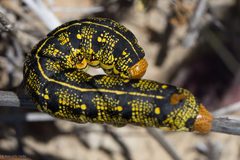
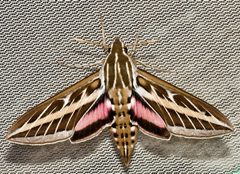
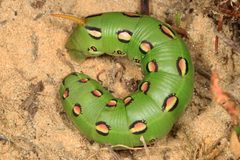
Hyles lineata is a large, abundant sphinx moth native to North and Central America, recognized for its distinctive hovering and striking wing pattern. display a 2–3 inch wingspan with dark brown forewings marked by white longitudinal lines and black hindwings bearing a broad pink band. The exhibits unusual flexibility in activity patterns, flying at dusk, dawn, and occasionally during daylight hours to feed on nectar. Caterpillars show extreme color , ranging from black with orange spots to lime green with black markings, and possess a characteristic horn. This feeder has been documented on over a dozen plant and serves as a significant and occasional agricultural pest.
Pronunciation
How to pronounce Hyles lineata: //ˈhaɪliːz lɪˈneɪətə//
These audio files are automatically generated. While they are not always 100% accurate, they are a good starting point.
Identification
distinguished from other sphinx moths by combination of large size, hovering , and distinctive wing pattern: dark forewings with white longitudinal venation lines and black hindwings with pink band. Similar Hyles euphorbiae (spurge hawk-moth) has more greenish forewings and different banding pattern. Hemaris species (clearwing hummingbird moths) are smaller with transparent wings and lack the bold patterning. Caterpillars may be confused with other sphingid larvae but identified by horn and variable but consistent spot patterns; black-and-orange form resembles some Manduca species but with different coloration.
Images
Habitat
Occupies diverse across its range including desert scrub, chaparral, gardens, suburban areas, and montane regions. Documented from sea level to high elevations in the Rocky Mountains. Presence and abundance vary significantly from year to year in many locations.
Distribution
North America from southern Canada through the United States and Mexico to Central America; occasionally recorded in the West Indies. Disjunct reported in South Asia (Sindh, Pakistan). Rare vagrant records from Eurasia and Africa. One of the most widespread and abundant sphinx moths in North America.
Seasonality
active primarily from mid-May through September, with peak activity varying by latitude and elevation. Typically two per year in temperate regions; more generations in warmer climates. Larvae may be found February through November depending on location; overwinter as larvae in northern parts of range.
Diet
feed on nectar from diverse flowers including columbines, larkspurs, four o'clocks, petunias, honeysuckle, moonvine, lilac, clovers, thistles, jimson weed, trumpet vine, and zinnia. Flower color preference varies with time of day: pale or white flowers selected at night, brighter colors during daylight. Caterpillars feed on leaves of willow weed, four o'clock, apple, evening primrose, elm, grape, tomato, purslane, fuchsia, and Clarkia.
Host Associations
- Epilobium - larval food plantwillow weed
- Mirabilis - larval food plantfour o'clock; also visited by
- Malus - larval food plantapple
- Oenothera - larval food plantevening primrose
- Ulmus - larval food plantelm
- Vitis - larval food plantgrape
- Solanum - larval food planttomato
- Portulaca - larval food plantpurslane
- Fuchsia - larval food plant
- Clarkia - larval food plant
- Aquilegia - nectar sourcecolumbines; includes documented pollination studies
- Delphinium - nectar sourcelarkspurs
- Lonicera - nectar sourcehoneysuckle
- Ipomoea - nectar sourcemoonvine
- Campsis - nectar sourcetrumpet vine
Life Cycle
Complete with four stages. Females lay hundreds of on plants in spring. Larvae feed gregariously or solitarily, showing extreme color . Late instar larvae dig shallow burrows in soil to pupate, remaining 2–3 weeks. emerge and may produce second in late summer in temperate regions, or multiple generations in warmer areas. Larvae overwinter in northern range; adults do not survive cold winters.
Behavior
exhibit hovering while feeding, resembling hummingbirds. Active at dusk and dawn, with occasional daytime flight—unusual among sphinx moths which are typically strictly . Adults use both visual and olfactory cues to locate flowers; vision sensitive to blue, green, and ultraviolet wavelengths. Larvae are powerful feeders and may form massive that move en masse in search of food. Caterpillars are not harmful to humans; horn is not a stinger.
Ecological Role
Significant of diverse flowering plants; tongue length variation within affects pollination effectiveness, with shorter-tongued individuals carrying more pollen on and . abundance fluctuations have been proposed as on flower phenotypes, particularly flower color. Serves as prey for bats, birds, and other . Larvae function as herbivores, occasionally reaching pest densities in agricultural settings.
Human Relevance
Caterpillars collected and consumed as food by peoples including the Tohono O'odham (known as 'makkum'), prepared roasted or dried and ground. Nutritional analysis shows high protein, fat, and calorie content comparable to or exceeding hamburger meat with lower saturated fat. Occasional agricultural pest: reported in Utah damaging grapes, tomatoes, and garden crops. popular among naturalists and photographers for their accessible daytime activity and striking appearance.
Similar Taxa
- Hyles euphorbiaeSimilar size and pattern; distinguished by greener forewing coloration and different hindwing banding
- Hemaris thysbeAlso called 'hummingbird moth' due to hovering , but smaller with clear wings and different body form
- Hemaris diffinisClearwing hummingbird moth, smaller, with transparent wings and bumblebee-like appearance
- Manduca sextaSimilar large sphinx moth with hovering ; distinguished by different wing patterns (gray forewings with black markings, no pink hindwing band) and more uniform green caterpillar coloration
- Sphinx vashtiOverlapping range, similar size; distinguished by different wing pattern and longer correlation with flower spur length
Misconceptions
The 'hummingbird moth' is applied to multiple unrelated , causing confusion; Hyles lineata is specifically the white-lined sphinx, while Hemaris species are the clearwing hummingbird moths. The caterpillar's horn is sometimes mistaken for a stinger, but it is harmless and not venomous. The species is sometimes assumed to be strictly like most sphinx moths, but it regularly flies during daylight hours.
Sources and further reading
- BugGuide
- Wikipedia
- GBIF taxonomy match
- iNaturalist taxon
- NCBI Taxonomy
- Catalogue of Life
- Ready for Moth Night at UC Davis? | Bug Squad
- A Buggy New Year! | Bug Squad
- Oh, What a (Moth) Night This Will Be! A Conversation With Bohart's Lepidoptera Curator Jeff Smith | Bug Squad
- Don't Miss Bohart Museum Open House on Nov. 2 | Bug Squad
- 'A Night at the Bohart Museum' to Celebrate Moths and Other Insects | Bug Squad
- Oklahoma is More than OK for Burying Beetles
- Hyles lineata . [Distribution map].
- Sex-specific chemosensory gene expression in the whitelined sphinx moth (Lepidoptera: Hyles lineata ) suggests a role for odorant-binding proteins in host plant choice
- A high-quality, long-read genome assembly of the whitelined sphinx moth (Lepidoptera: Sphingidae: Hyles lineata) shows highly conserved melanin synthesis pathway genes
- The Dangers of Growing Old: Adult Moths Face Higher Predation Pressures than Caterpillars in Hyles lineata.