
Manduca
Hübner, 1807
hornworms, hawkmoths, sphinx moths
Species Guides
9- Manduca brontes
- Manduca florestan(Florestan sphinx)
- Manduca jasminearum(Ash Sphinx)
- Manduca lanuginosa
- Manduca muscosa(Muscosa Sphinx)
- Manduca occulta(Occult Sphinx)
- Manduca quinquemaculatus(Five-spotted Hawk Moth)
- Manduca rustica(Rustic Sphinx)
- Manduca sexta(Carolina sphinx moth)
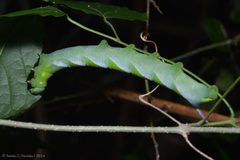
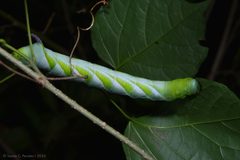
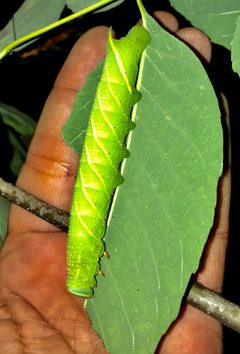
Manduca is a of hawkmoths (Sphingidae) established by Jacob Hübner in 1807. The genus contains approximately 70 distributed primarily in the Americas. Several species, notably Manduca sexta () and M. quinquemaculata (tomato hornworm), are extensively studied as model organisms in biological research due to their large size and ease of laboratory rearing. The larvae, commonly called hornworms, are significant agricultural pests of solanaceous crops.
Pronunciation
How to pronounce Manduca: /ˈmandu.ka/
These audio files are automatically generated. While they are not always 100% accurate, they are a good starting point.
Identification
Distinguished from other Sphingidae by combination of: heavy body with narrow pointed forewings; presence of horn on larval ; loss of silk production in later larval instars; in soil without cocoon. Manduca sexta versus M. quinquemaculata: M. sexta has seven diagonal white lines with black borders and red terminal horn; M. quinquemaculata has eight V-shaped white markings without borders and dark blue or black horn. Distinguished from Hemaris (hummingbird moths) by larger size, more robust build, and lack of transparent wing areas.
Images
Habitat
Larval include agricultural fields, gardens, and natural areas with plants in Solanaceae. frequent areas with nectar sources, particularly plants with tubular flowers such as honeysuckle, trumpet vines, phlox, petunia, and tobacco. Some occur in arid regions where solanaceous weeds grow.
Distribution
Primarily distributed in the Americas, from southern Canada through the United States, Mexico, Central America, and South America. Some occur in the Caribbean. Manduca sexta naturally occurs in North, Central, and South America. Distribution closely follows availability of solanaceous plants.
Seasonality
Multiple per year in warmer regions; typically two generations in temperate areas. Larvae most abundant in midsummer, with possible secondary peak in late summer. are and active throughout the warm season. Pupae overwinter in soil or leaf litter in temperate regions, with development resuming in spring.
Diet
Larvae feed on plants in Solanaceae, including tomato, tobacco, potato, pepper, eggplant, and various solanaceous weeds. Manduca sexta has evolved to nicotine and other solanaceous defensive compounds. feed on nectar from tubular flowers, particularly honeysuckle, trumpet vines, phlox, petunia, and tobacco.
Host Associations
- Solanum lycopersicum - larval food planttomato
- Nicotiana tabacum - larval food planttobacco
- Solanum tuberosum - larval food plantpotato
- Capsicum spp. - larval food plantpepper
- Solanum melongena - larval food planteggplant
- Lonicera spp. - nectar sourcehoneysuckle
- Campsis radicans - nectar sourcetrumpet vine
Life Cycle
Complete with , five to six larval instars, pupa, and . Eggs laid on undersurface of leaves. First instar produces silk for molting pad and rappelling; silk production lost in later instars. Larval development takes approximately three weeks. Final instar burrows into soil or leaf litter to pupate without forming cocoon. Pupal stage lasts two weeks to several months depending on season; winter occurs in temperate regions. Adult lifespan several weeks.
Behavior
Larvae are cryptic, remaining near plant stems during daylight and moving to outer foliage at dusk and dawn. When disturbed, larvae rear and into 'sphinx-like' defensive posture. Larvae may regurgitate gut contents when attacked. are strong fliers with rapid wingbeat; some hover at flowers while feeding. Adults are primarily . Males of some species exhibit territorial patrolling .
Ecological Role
Larvae function as significant herbivores in natural and agricultural , capable of substantial defoliation. serve as for tubular flowers. Larvae are important prey for , particularly Cotesia congregata (Braconidae), which provides natural . Parasitoid wasp cocoons visible on larva indicate imminent death.
Human Relevance
Major agricultural pests of tomato, tobacco, and other solanaceous crops; can cause extensive defoliation and fruit damage. Manduca sexta is a premier model organism for research in neurobiology, physiology, biochemistry, , antimicrobial defenses, and mechanics; sequenced in 2016. Large size facilitates tissue sampling and experimental manipulation. Used in educational settings for insect instruction. Control in gardens often relies on hand-picking or by .
Similar Taxa
- HemarisAlso called 'hummingbird moths' and 'clearwing moths'; distinguished by smaller size, activity, transparent wing areas, and more slender build. Hemaris larvae also have horns but are smaller and feed on different plants (honeysuckle, snowberry, hawthorn, blueberry).
- SphingonaepiopsisSmall sphingid with similar overall shape but much smaller size and different wing venation; larvae lack prominent caudal horn.
Misconceptions
The 'tomato hornworm' is frequently applied to both Manduca sexta and M. quinquemaculata, though M. sexta is more commonly encountered on tomatoes despite being named '.' The two are often confused; they can be distinguished by larval markings and horn color. are sometimes mistaken for hummingbirds due to size, hovering , and rapid wingbeat, though this confusion is more common with Hemaris species.
More Details
Model Organism Status
Manduca sexta has been used as a model organism since the 1950s. The was sequenced by an international consortium of 114 researchers from 50 institutions and 11 countries, published in 2016. The name derives from Latin 'manducare' (to chew), referring to the voracious feeding of larvae.
Silk Production Loss
A 2019 study using confocal laser scanning microscopy and transcriptome analysis revealed that first instar M. sexta larvae possess functional silk-producing anatomy (spigot and Lyonet's glands) that is subsequently lost through remodeling in later instars. This represents a rare case of developmental loss of a functional trait, likely associated with the transition from cocoon-less .
Sources and further reading
- BugGuide
- Wikipedia
- GBIF taxonomy match
- iNaturalist taxon
- NCBI Taxonomy
- Catalogue of Life
- The Hornworms Are Not Your Friends | Bug Squad
- California Dogface Butterfly Steals the Show | Bug Squad
- Insect FAQs | Entomology Research Museum
- Tough to be a hornworm: Tomato and tobacco hornworms, Manduca quinquemaculata and M. sexta — Bug of the Week
- Advanced Morphology Techniques Reveal Tobacco Hornworm's Secrets
- Scientists Sequence the Genome of the Tobacco Hornworm