
Hyles euphorbiae
Linnaeus, 1758
spurge hawk-moth, Leafy Spurge Hawkmoth
Hyles euphorbiae, the spurge hawk-, is a European hawkmoth in the Sphingidae. First described by Linnaeus in 1758, this is notable for its use in biological pest control against leafy spurge (Euphorbia esula). The species comprises a complex with multiple showing variation in cold and larval pattern across its range. are strong fliers with distinctive wing patterns, while larvae feed on spurge plants and display conspicuous black, white, and red coloration.
Pronunciation
How to pronounce Hyles euphorbiae: //ˈhaɪliːz juːˈfɔrbi.aɪ//
These audio files are automatically generated. While they are not always 100% accurate, they are a good starting point.
Identification
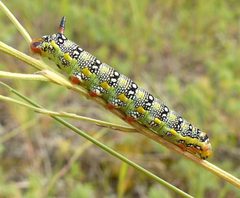
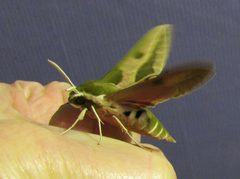
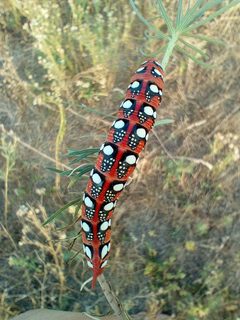
distinguished from similar Hyles by the combination of grey forewings with olive-brown square and oblique band markings, pink hindwings with black and white pattern elements, and the distinctive white facial lines meeting at the nose. Larvae are unmistakable due to the bold black ground color with white dots, paired white and coral-red lateral spots, and red-and-black horn. The includes 'euphorbiae' and 'tithymali' which differ in cold and may show overlapping larval , making precise identification of some challenging without geographic context.
Images
Habitat
Coastal and inland sandy where spurge plants grow. Larvae associated with sea spurge (Euphorbia paralias) and related Euphorbia in coastal dunes and sandy soils. found in open habitats including coastal areas, grasslands, and disturbed sites where larval host plants occur.
Distribution
Native to Europe and the Western Palaearctic, including North Africa, the Canary Islands, Madeira, Iberia, Italy, Germany, Eastern Europe, Malta, Greece, and extending to Yemen and the Middle East. Introduced to North America as a agent for leafy spurge. Distribution encompasses diverse climatic zones from Mediterranean to temperate regions.
Seasonality
active during warmer months; exact period varies by region and climate. In temperate zones, typically or partially . Pupae are the stage, with some capable of entering under short daylight and cold conditions.
Diet
Larvae are feeders on Euphorbia (spurges), consuming leaves and bracts. Documented on sea spurge (Euphorbia paralias) and leafy spurge (Euphorbia esula). feed on nectar from flowers using a long .
Host Associations
- Euphorbia paralias - larval food plantSea spurge, primary native on coasts
- Euphorbia esula - larval food plantLeafy spurge, introduced in North America for biocontrol
Life Cycle
laid on small leaves of spurge plants, adhering via liquid gum coating. Larvae hatch in approximately two weeks, progressing through instars with increasing conspicuousness of white and red pattern elements. Larvae burrow into loose dry sand to pupate. Pupae may enter (paused development, cold-hardy) or develop directly (subitan) depending on and temperature cues. emerge from pupae; multiple possible in favorable conditions.
Behavior
are strong, rapid fliers capable of sustained hovering . Larvae are conspicuous and , potentially attracting by birds. Pupae demonstrate remarkable cold , with some capable of surviving freezing conditions through supercooling and strategies.
Ecological Role
Herbivore specializing on Euphorbia plants; significant role in of leafy spurge in North America. Larval feeding can substantially reduce spurge . Serves as prey for birds, particularly gulls and terns on coastal dunes. function as while nectaring.
Human Relevance
Used as a agent against leafy spurge (Euphorbia esula), a noxious weed in North America, though typically deployed in conjunction with other control agents. Subject of scientific research on cold , mechanisms, and climate change . Occasionally encountered by naturalists and entomologists in coastal dune .
Similar Taxa
- Hyles tithymaliMember of same with overlapping larval and hybrid zones; distinguished by geographic origin (more southern distribution) and higher cold sensitivity producing opportunistic rather than pupae
- Hyles lineataSimilar appearance and 'hummingbird moth', but with white-lined forewings and different larval coloration; North American native with different plant associations
- Hyles livornicaSimilar and ; occurs in Eurasia and Africa with overlapping range in Mediterranean region
More Details
Taxonomic Complexity
Hyles euphorbiae comprises a with unresolved , including 'euphorbiae' and 'tithymali' that show significant differences in cold strategies and may represent incipient speciation. Hybridization zones exist across the Mediterranean Basin.
Cold Tolerance Mechanisms
show phenotypic plasticity in pupal development: 'euphorbiae' produces pupae under short daylength and cold, with enhanced cold hardiness and supercooling capacity; 'tithymali' ecotype shows opportunistic short-term cold hardiness without true diapause.
Biological Control History
Introduced to North America specifically for leafy spurge control; establishment and efficacy variable, leading to typical use in integrated management with other agents rather than as standalone control.
Sources and further reading
- BugGuide
- Wikipedia
- GBIF taxonomy match
- iNaturalist taxon
- NCBI Taxonomy
- Catalogue of Life
- Bembicid Holdings | Entomology Research Museum
- Sustainable Entomology: How Insect Scientists Can Protect Our Planet
- ID Challenge #16 | Beetles In The Bush
- Uncategorized | Blog - Part 54
- Bug Eric: White-lined Sphinx ("Hummingbird Moth")
- Catch a Glimpse of Caterpillars During National Moth Week
- Larval pattern morphotypes in the Western Palaearctic Hyles euphorbiae complex (Lepidoptera: Sphingidae: Macroglossinae)
- Super Cooling Point Phenotypes and Cold Resistance in Hyles euphorbiae Hawk Moths from Different Climate Zones