
Manduca sexta
Linnaeus, 1763
Carolina sphinx moth, tobacco hawk moth, tobacco hornworm, Goliath worm
Manduca sexta is a large sphinx moth native to the Americas, widely recognized as both a significant agricultural pest and a premier model organism in biological research. The exhibits marked in and undergoes complete through five larval instars. Larvae are notable for their ability to sequester and metabolize nicotine from tobacco plants, using it as a chemical defense against . The species has been extensively studied in neurobiology, developmental , and immunology due to its large size, short , and accessible .
Pronunciation
How to pronounce Manduca sexta: //ˈmæn.djʊ.kə ˈsɛks.tə//
These audio files are automatically generated. While they are not always 100% accurate, they are a good starting point.
Identification
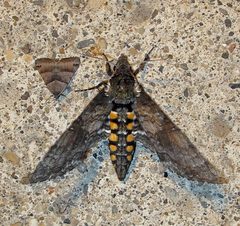
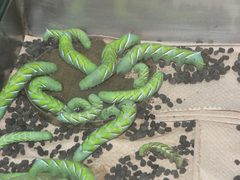
Larvae distinguished from the closely related tomato hornworm (Manduca quinquemaculata) by seven white diagonal lines with black borders (versus eight V-shaped white markings without borders) and red-tipped horn (versus dark blue or black horn). can be separated from M. quinquemaculata by hindwing pattern and geographic overlap. First instar larvae possess a tubular silk-producing spigot and well-developed Lyonet's glands, which are lost in later instars—a unique developmental trajectory among sphingids.
Images
Habitat
Agricultural and natural areas supporting plants in Solanaceae; larvae prefer humid microenvironments and will actively seek water sources when dehydrated. frequent flowering plants for nectar.
Distribution
Widespread through much of the Americas: North America, Central America, South America, and Caribbean. Multiple recognized including M. s. sexta (North and Central America), M. s. caestri (Chile), M. s. jamaicensis (Caribbean), M. s. leucoptera (Galápagos Islands), M. s. paphus (South America), M. s. saliensis (Argentina), and M. s. garapa (Saipan). Natural show genetic differentiation across the United States, with Arizona populations particularly distinct.
Seasonality
Two per year in most areas; three to four generations possible in Florida. Larvae most abundant in midsummer with possible secondary peak in late summer. Winter passed in pupal stage. Total 30–50 days under favorable conditions.
Diet
Larvae are facultative preferring Solanaceae, principally tobacco (Nicotiana), tomato (Solanum lycopersicum), and Datura ; can develop on alternative but with reduced growth rates. Larvae use lateral and medial styloconia on mouthparts to identify solanaceous plants via detection of indioside D, a steroidal glycoside. are nectarivorous, feeding on flowers while hovering.
Host Associations
- Nicotiana - primary plantlarvae sequester nicotine as defense
- Solanum lycopersicum - primary plantcommonly known as tomato
- Datura - primary plantincludes jimsonweed
- Capsicum - plantpepper
- Solanum melongena - planteggplant
- Solanum tuberosum - plantpotato
- Cotesia congregata - braconid that lays in larvae; parasitizes 31–57% of field
- Polistes erythrocephalus - paper wasp that feeds on larvae
Life Cycle
Complete with five larval instars separated by ; additional instars may occur under poor nutrient conditions. Final instar larvae enter "wandering" phase to seek site, then burrow underground to pupate. Pre-pupa stage involves considerable shrinkage. eclose from pupal case; females mate once, males multiple times. Mating occurs on vertical surfaces at night with pairs in opposite-facing position.
Behavior
Larvae exhibit "wandering" before , leaving plants to burrow underground. When attacked, larvae emit clicking sounds (5–50 kHz) from as acoustic aposematism, followed by thrashing and biting. Larvae demonstrate humidity-seeking behavior using to locate water. are strong fliers capable of sustained hovering while feeding. Spatial odor discrimination between antennae (>70% ) enables tracking of turbulent odor plumes.
Ecological Role
Significant herbivore in agricultural ; serves as for contributing to dynamics. Larvae bioaccumulate plant secondary compounds, influencing tri-trophic interactions. may contribute to pollination while nectaring.
Human Relevance
Major agricultural pest of tobacco, tomato, and other solanaceous crops; larvae cause defoliation and fruit damage. Widely used as model organism in neurobiology, developmental , immunology, and medical imaging research due to large size and accessible anatomy. sequenced and publicly available. Commercially reared as food for captive insectivorous animals. Subject of extensive efforts using Cotesia congregata.
Similar Taxa
- Manduca quinquemaculataLarvae nearly identical but distinguished by eight V-shaped white markings without borders (versus seven diagonal lines with black borders) and dark blue or black horn (versus red); separable by hindwing pattern
- Manduca rusticaOverlapping distribution and similar ; larvae have different plant preferences and patterning
Misconceptions
The "" is often applied indiscriminately to both M. sexta and M. quinquemaculata larvae found on tomatoes. The white cocoons of Cotesia congregata on parasitized hornworms are frequently mistaken for large rather than emergent pupae. The pre-pupal stage, during which larvae shrink considerably, is often misidentified as a dead or dying caterpillar.
Sources and further reading
- BugGuide
- Wikipedia
- GBIF taxonomy match
- iNaturalist taxon
- NCBI Taxonomy
- Catalogue of Life
- The Hornworms Are Not Your Friends | Bug Squad
- National Moth Week Ended But... | Bug Squad
- Insect FAQs | Entomology Research Museum
- News Flash: Don't Miss 'Current Techniques in Morphology' | Bug Squad
- Advanced Morphology Techniques Reveal Tobacco Hornworm's Secrets
- Scientists Sequence the Genome of the Tobacco Hornworm
- Discovery of a Manduca sexta Allatotropin Antagonist from a Manduca sexta Allatotropin Receptor Homology Model
- Spatial odor discrimination in hawkmoth, Manduca sexta (L.)
- Linking brain activity to odor-guided behavior inManduca sexta
- Population differentiation and structural variation in the Manduca sexta genome across the United States
- Manduca sexta experience high parasitoid pressures in the field but minor fitness costs of consuming plant secondary compounds