
Manduca quinquemaculatus
Haworth, 1803
Five-spotted Hawk Moth, Tomato Hornworm
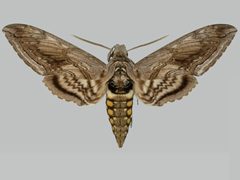
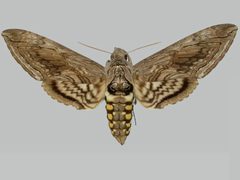
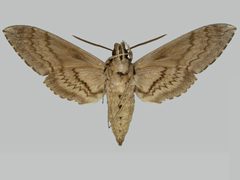
Manduca quinquemaculatus, commonly known as the five-spotted hawk moth or , is a large sphinx moth whose caterpillar is a significant agricultural pest. The has a wingspan up to 5 inches (12 cm) and is a strong flier active at night. The larval stage feeds primarily on tomatoes and other Solanaceae plants, causing extensive defoliation when are high. The is closely related to and often confused with the (Manduca sexta).
Pronunciation
How to pronounce Manduca quinquemaculatus: /ˈmændʊkə ˌkwɪŋkweɪmækjʊˈleɪtəs/
These audio files are automatically generated. While they are not always 100% accurate, they are a good starting point.
Identification
Distinguished from the similar (Manduca sexta) by: eight V-shaped white lateral markings without black borders (versus seven diagonal white lines with black borders in M. sexta); dark blue or black terminal horn (versus red horn in M. sexta). can be separated from other Manduca by the five spotted pattern on the hindwing. (droppings) around plant base often reveals presence before caterpillars are seen.
Images
Habitat
Gardens, agricultural fields, and natural areas with plants. Larvae found on Solanaceae plants, particularly tomato, where they remain near the main stem during daylight hours. attracted to artificial lights at night. Distribution extends across North America including southern Canada (Alberta, Manitoba, Saskatchewan) and the United States.
Distribution
North America: present throughout much of the United States and southern Canada. Specific records from Alberta, Manitoba, and Saskatchewan in Canada. Doubtful record from Belgium.
Seasonality
Two per year in most areas. Larvae most common in midsummer, with possible smaller peak in late summer. active from late spring through summer; observed at lights in July in Colorado. Winter passed in pupal stage.
Diet
Larva feeds on Solanaceae: primarily tomato, also eggplant, pepper, potato, and tobacco. Feeds on upper leaf portions, new stems, and occasionally fruit. feeds on nectar from tubular flowers including honeysuckle, trumpet vines, phlox, and petunia.
Life Cycle
laid on undersurface of leaves. Five to six larval instars over approximately three weeks. First instar has been observed to possess silk-producing structures (spigot and Lyonet's glands) used for creating molting pads and rappelling threads, though this capability is lost in later instars. Final instar burrows into soil or leaf litter to pupate. Development takes about two months in summer; pupa overwinters, with development suspended until spring warmth triggers .
Behavior
is a strong flier. Larva is cryptic, remaining near main stems during daylight and moving to outer plant portions at dusk and dawn. When disturbed, larva rears into a sphinx-like pose. Larva has been observed to regurgitate plant fluid when attacked.
Ecological Role
serves as for tubular flowers. Larva acts as significant herbivore, capable of extensive defoliation. Subject to by braconid wasps (Cotesia spp.), which can effectively control .
Human Relevance
Major pest of tomato gardens and commercial tomato production. Caterpillars cause extensive defoliation and fruit damage. Often used in educational settings and museum displays due to large size and dramatic appearance. Closely related to M. sexta, which is a widely used model organism in neurobiology and developmental research.
Similar Taxa
- Manduca sexta; distinguished by seven diagonal white lines with black borders (versus eight V-shaped marks without borders), red terminal horn (versus dark blue/black), and different hindwing pattern.
Sources and further reading
- BugGuide
- GBIF taxonomy match
- iNaturalist taxon
- Catalogue of Life
- The Hornworms Are Not Your Friends | Bug Squad
- California Dogface Butterfly Steals the Show | Bug Squad
- Bug Eric: Remembering National Moth Week 2018
- Bug Eric: October 2018
- Tough to be a hornworm: Tomato and tobacco hornworms, Manduca quinquemaculata and M. sexta — Bug of the Week
- Advanced Morphology Techniques Reveal Tobacco Hornworm's Secrets