
Cotesia congregata
(Say, 1836)
Hornworm Parasitoid Wasp
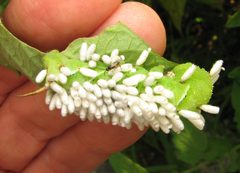
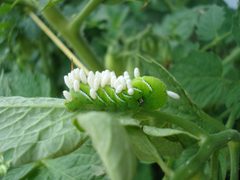
Cotesia congregata is a gregarious endoparasitoid and a model organism in insect physiology research. Females oviposit into caterpillar , primarily tobacco hornworm (Manduca sexta) and tomato hornworm (Manduca quinquemaculata), simultaneously injecting a symbiotic (CcBV) and venom. The virus suppresses host immune defenses and disrupts development, allowing wasp larvae to complete their growth inside the living host. Mature larvae emerge through the host and spin white silk cocoons on the exterior surface. The wasp exhibits post- learning of host plant cues, with a critical learning window of 0–4 hours after emergence.

Pronunciation
How to pronounce Cotesia congregata: /kəˈtiːziə ˌkɑnɡrɪˈɡeɪtə/
These audio files are automatically generated. While they are not always 100% accurate, they are a good starting point.
Identification
Distinguished from other Cotesia by association with Manduca hornworms and documented . Field identification relies on observing clusters of white silk cocoons on the surface of living or caterpillars. Distinguished from Cotesia flavipes (sugarcane borer ) by host range and geographic distribution. Distinguished from Cotesia vanessae by host preference for Noctuidae versus Sphingidae. Molecular identification possible through bracovirus sequences; CcBV has one of the largest known viral genomes (567,670 ) arranged in 30 circular segments.
Images
Habitat
Agricultural and natural environments where Solanaceae plants occur, including tobacco fields, tomato gardens, and areas with native nightshades. Associated with vegetation supporting caterpillar hosts in the Sphingidae and Noctuidae.
Distribution
North America (primary range), with records from the United States and Canada. GBIF records indicate presence in Middle America, Caribbean, and South America (Brazil), though these may represent related or misidentifications; iNaturalist treats C. congregata as a .
Seasonality
Activity coincides with availability of 2nd–3rd instar caterpillars. In temperate regions, multiple per year are possible; host caterpillars overwinter as pupae, and resumes with spring host availability. Laboratory studies indicate wasps live 4–8 days after emergence from cocoons.
Diet
feed on floral nectar and honeydew; larvae are obligate endoparasitoids feeding on and tissues. Adult feeding specifically observed on organic honey in laboratory conditions and implied from floral visitation .
Host Associations
- Manduca sexta - primary tobacco hornworm; 2nd–3rd instar larvae parasitized
- Manduca quinquemaculata - primary tomato hornworm
- Acharia stimulea - saddleback caterpillar; documented in field observations
- Hypercompe muzina - documented in Panama with 296 cocoons from single larva
- Ceratomia catalpae - catalpa sphinx
- Spodoptera frugiperda - fall armyworm; listed in inventory reference
Life Cycle
Females locate 2nd–3rd instar caterpillars and oviposit multiple while injecting and venom. Eggs hatch in host hemocoel within 2–3 days, releasing teratocytes that grow to visible size. Larvae undergo two within host over 12–16 days. Third instar larvae emerge through host and spin white silk cocoons on host exterior. eclipse from cocoons after 4–8 days. Not all larvae successfully emerge; some are encapsulated by recovering host immune system, while others exhibit reduced growth. Sex ratio highly female-biased (documented 277:3 in one ).
Behavior
Females exhibit rapid location and oviposition, delivering multiple stings with ovipositor upon encountering suitable hosts. Post- learning occurs in critical window of 0–4 hours after emergence; females exposed to host larvae on specific plants develop positive searching responses to those plants and inhibited responses to otherwise attractive plants. Learned plant associations persist 6–7 days. exploit herbivore-induced plant volatiles for host location. Parasitized hosts exhibit permanently reduced feeding and locomotion approximately 8 hours before wasp emergence, potentially preventing destruction of wasp cocoons.
Ecological Role
Important agent of lepidopteran pests, particularly hornworms damaging Solanaceae crops. of Manduca spp. in both agricultural and natural . Hyperparasitism documented: pupae may be attacked by chalcid wasps (Hypopteromalus, Conura sp.).
Human Relevance
Used as model organism in insect physiology, - interactions, and research. Significant natural enemy in home gardens and commercial tomato/tobacco production; presence indicated by white cocoons on hornworms. Not a stinging threat to humans—venom is host-specific and negligible effect on non-host organisms.
Similar Taxa
- Cotesia flavipesBoth are gregarious braconid with ; distinguished by preference (Diatraea saccharalis, sugarcane borer vs. Manduca spp.) and distribution (tropical/subtropical vs. temperate North America)
- Cotesia vanessaeBoth in Cotesia; distinguished by preference (Noctuidae vs. Sphingidae) and geographic range
- Cotesia glomerataGregarious of Pieridae caterpillars; distinguished by and cocoon arrangement (tight cluster vs. scattered on host)
Misconceptions
White objects on backs are often misidentified as of the ; they are actually silk cocoons of emerged larvae. The is not an independent but an obligate integrated into , incapable of replication outside wasp calyx .
More Details
Polydnavirus Symbiosis
Cotesia congregata bracovirus (CcBV) has one of the largest known viral at 567,670 arranged in 30 circular segments. The virus cannot replicate independently; are produced in female calyx from genomic sequences. Viral gene products include protein tyrosine phosphatases (interfering with cytoskeleton dynamics), ankyrin repeat proteins (immune inhibition), cysteine-rich proteins (similar to teratocyte secretions), and cystatins ( inhibitors). Only 0.1 ng viral DNA injected per , but female produces >600 ng per ovary, sufficient for lifetime egg production averaging 1757 eggs.
Host Manipulation
Virus and teratocytes synergistically disrupt endocrine system: esterase activity reduced causing elevated JH titers, levels suppressed, blocked. Host reaches sixth instar with high loads, or parasites may emerge in fourth instar with low loads. Host immune suppression occurs within 24 hours of oviposition via apoptosis; partial recovery after 8–10 days, but larvae develop independent resistance by this point. Brain proteomic changes include altered synaptic transmission and antimicrobial upregulation correlating with bodyguard .
Genetic Differentiation
show genetic differentiation associated with -foodplant complexes, with documented asymmetric hybrid dysgenesis between populations from different host sources. Differential bracovirus observed among host-foodplant sources, likely reflecting adaptations to specific host and diets.
Spermatozoa
Possesses the shortest known flagellated spermatozoa in animals at 6.6 μm ( plus ), approximately 8,800 times shorter than the longest known (Drosophila bifurca).
Sources and further reading
- BugGuide
- Wikipedia
- GBIF taxonomy match
- iNaturalist taxon
- NCBI Taxonomy
- Catalogue of Life
- To sting a stinger: Saddleback caterpillar, Acharia stimulae, and brachonid wasp, Cotesia — Bug of the Week
- Weeding can turn spicy when saddlebacks are around: Saddleback caterpillar, Acharia stimulae — Bug of the Week
- Stinging caterpillars - White flannel moth, Norape ovina, and Saddleback caterpillar, Archaria stimulea — Bug of the Week
- Tough to be a hornworm: Tomato and tobacco hornworms, Manduca quinquemaculata and M. sexta — Bug of the Week
- This Artificial Diet May Make Insect Rearing Easier
- Biological Control in Brazil is Used on an Area that is Larger than Belgium
- Parasitoid Wasp Cotesia congregata (Say) (Insecta: Hymenoptera: Braconidae)
- Postemergence learning in the insect parasitoid,Cotesia congregata (Say) (Hymenoptera: Braconidae)
- Disruptive endocrine effects of parasitism by Cotesia congregata in host Manduca sexta larvae
- The few virus‐like genes of Cotesia congregata bracovirus
- Caterpillar Chemical Defense and Parasitoid Success: Cotesia congregata Parasitism of Ceratomia catalpae
- Influence of Plant Allelochemicals on the Tobacco Hornworm and its Parasitoid, Cotesia Congregata
- Manipulation of fifth-instar host (Manduca sexta) ecdysteroid levels by the parasitoid wasp Cotesia congregata
- Inhibitory effects of parasitism by the gregarious endoparasitoid Cotesia congregata on host testicular development
- Behavioral responses to host foodplants of two populations of the insect parasitoid Cotesia congregata (Say)
- Genetic Differentiation of Two Host–Foodplant Complex Sources ofCotesia congregata(Hymenoptera: Braconidae)
- Hiperparasitismo de Conura sp. (Ceratomiscra) (Hymenoptera: Chalcididae) sobre pupas de Cotesia congregata (Hymenoptera: Braconidae) en larva de Hypercompe muzina (Lepidoptera: Erebidae)
- Asymmetric hybrid dysgenesis in crosses of different host-food plant complex sources of the parasitic wasp,Cotesia congregata
- Differential bracovirus gene expression among host-foodplant complex sources of the braconid parasitoid wasp,Cotesia congregata, likely reflects adaptations to host species and diet
- The multiple effects of the wasp Cotesia congregata, a parasitic manipulator, on the brain of its host, the caterpillar Manduca sexta.
- Parasitism-induced Effects on Host Growth and Metabolic Efficiency in Tobacco Hornworm Larvae Parasitized by Cotesia congregata