
Diatraea
Guilding, 1828
sugarcane borer, stalk borer
Species Guides
5- Diatraea crambidoides(southern cornstalk borer moth)
- Diatraea evanescens(Black-dot Diatraea)
- Diatraea grandiosella(Southwestern Corn Borer Moth)
- Diatraea lisetta(Dotted Diatraea)
- Diatraea saccharalis(sugarcane borer)
Diatraea is a of in the Crambidae comprising approximately 40 described . The genus is best known for several economically important stalk-boring pests of grass crops, particularly sugarcane, corn, sorghum, and rice. Larvae tunnel within plant stems, causing reduced yield, lodging, and increased susceptibility to . Several species have been the focus of extensive programs, notably using such as Cotesia flavipes and Trichogramma galloi. The genus is distributed throughout the Americas from the southern United States to Argentina.
Pronunciation
How to pronounce Diatraea: //daɪəˈtriːə//
These audio files are automatically generated. While they are not always 100% accurate, they are a good starting point.
Identification
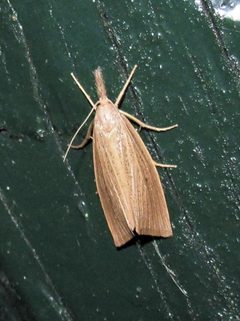
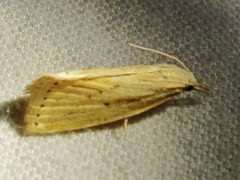
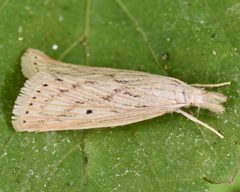
-level identification within Diatraea requires examination of genitalia ; external appearance is often cryptic and similar across species. Larvae are creamy white, approximately 25 mm long when fully grown, with conspicuous round brown or black spots on most body segments; spots may be lighter or absent in mature larvae. Adults are white to buff-colored . are laid in clusters of 10–20, flattened and elliptical to oval, overlapping like fish in a shingle-like arrangement on plant leaves.
Images
Habitat
Agricultural fields and natural grasslands; primarily associated with cultivated grasses including sugarcane, corn, sorghum, and rice. Larvae develop inside plant stalks.
Distribution
Widespread in the Americas: North America (southern United States: Florida, Louisiana, Mississippi, Texas), Central America and Caribbean (Mexico, Guatemala, Honduras, Rica, Panama, Cuba, Puerto Rico, and other islands), and South America (Argentina, Brazil, Colombia, Venezuela, Ecuador, Peru, Bolivia, Paraguay, Uruguay, Guyana, Suriname, French Guiana). Individual have more restricted ranges; for example, D. nayaritella is known only from Nayarit, Mexico, and D. magnifactella from Veracruz, Mexico.
Seasonality
Two to three per year in most regions. occurs as fully grown larvae in inside harvested stalks or stubble. activity and oviposition coincide with plant growth stages; late-planted crops typically experience higher levels.
Diet
Larvae feed internally on the pith of grass stems. Young larvae feed briefly on leaves or leaf axes before tunneling into stalks. Documented include sugarcane (Saccharum officinarum), corn (Zea mays), sorghum (Sorghum bicolor), rice (Oryza sativa), and various wild grasses.
Host Associations
- Saccharum officinarum - primary sugarcane, major economic
- Zea mays - corn, significant for several
- Sorghum bicolor - grain sorghum
- Oryza sativa - rice
- Echinochloa colona - johnsongrass, wild facilitating buildup
Life Cycle
hatch in 3–7 days. Larval stage lasts approximately 25 days; young larvae feed externally before boring into stems, then tunnel up and down the pith. occurs within the stalk, lasting about 10 days. Most pass winter as fully grown larvae in inside remaining stalks.
Behavior
Larvae are internal feeders, tunneling within stems and causing characteristic damage: stalk diameter reduction, lodging, and grain breakage when tunneling occurs just below the head. are . Females deposit clusters on leaves.
Ecological Role
Agricultural pest; significant economic impact on grass crop production. Larval tunneling increases plant susceptibility to stalk rot . Serves as for agents including Cotesia flavipes (larval parasitoid) and Trichogramma galloi ( parasitoid).
Human Relevance
Major pest of sugarcane, corn, sorghum, and rice throughout the Americas. D. saccharalis is the primary sugarcane borer in Brazil, where programs release over more than 30,000 km². D. grandiosella (southwestern corn borer) and D. lineolata (neotropical borer) are significant corn and sorghum pests in the United States and Latin America. Management relies on early planting, stalk destruction to kill larvae, varieties, and application before larvae bore into stalks.
Similar Taxa
- Eoreuma loftiniMexican rice borer, also a crambine stalk borer of grasses; similar and damage but distinct ; lack the characteristic wing pattern of Diatraea
- Ostrinia nubilalisEuropean corn borer, similar stalk-boring habit in corn but in Crambidae (formerly Pyralidae); distinguished by different and larval spotting pattern
- Elasmopalpus lignosellusLesser cornstalk borer, feeds on similar but larvae are light bluish green with prominent transverse reddish-brown bands and feed in silken tunnels covered with soil particles at or below ground level
- Busseola fuscaAfrican maize stalk borer, similar ecological role in Africa but geographically separated and in Noctuidae
Sources and further reading
- BugGuide
- Wikipedia
- GBIF taxonomy match
- iNaturalist taxon
- NCBI Taxonomy
- Catalogue of Life
- Stalk-boring insect pests - AgriLife Extension Entomology
- Insects that feed on developing grain in the head - AgriLife Extension Entomology
- “Picudo negro” (black weevil) on soybean in Argentina | Beetles In The Bush
- Biological Control in Brazil is Used on an Area that is Larger than Belgium
- A New Resource for Fighting the Mexican Rice Borer
- Argentina | Beetles In The Bush | Page 7
- Diatraea saccharalis . [Distribution map].
- A new species of Diatraea Guilding, 1828, feeding on sugarcane from Nayarit, Mexico, and a lectotype designation for Diatraea magnifactella Dyar, 1911 (Lepidoptera, Crambidae, Crambinae)
- Genetic Behavior of Resistance in Sugarcane to the Sugarcane Borer, Diatraea Saccharalis (F.).