
Diatraea grandiosella
Dyar, 1911
Southwestern Corn Borer Moth, Southwestern Corn Borer
Diatraea grandiosella is a stalk-boring native to Mexico that has expanded its range into the southern United States since 1913. The is or trivoltine over most of its range and survives winter through facultative larval . Mature pre-diapausing larvae prepare in the stalk crown of plants, frequently girdling the plant near soil level beforehand—a that causes significant economic losses by preventing mechanical harvest of ears. The species is a major pest of corn and sorghum, with diapause induction regulated by and temperature.
Pronunciation
How to pronounce Diatraea grandiosella: //ˌdaɪəˈtriːə ˌɡrændiˈoʊsɛlə//
These audio files are automatically generated. While they are not always 100% accurate, they are a good starting point.
Identification
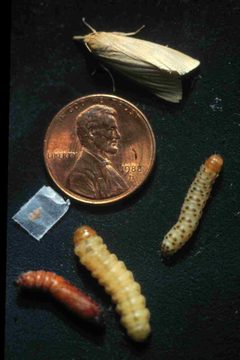
Larvae are creamy white and approximately 1 inch long when fully grown, with most body segments bearing conspicuous round brown or black spots. Spots on mature larvae are lighter or absent. Diapausing larvae lack pigmented cuticular pinacula and appear (spot-free), distinguishing them from active summer- larvae which have segmentally-arranged sclerotized pinacula. are white to buff colored. are deposited in clusters of 10–20 that overlap like fish in a shingle-like arrangement on plant leaves.
Images
Habitat
Agricultural areas; specifically corn and sorghum fields. larvae occupy prepared in the root crown or stalk crown of plants. are more severe in late-planted sorghum.
Distribution
Native to Mexico; expanded into the United States from Mexico around 1913. Currently established in 13 U.S. states from Arizona to Alabama, ranging from approximately 18°N to 38°N latitude. Northern distribution limits appear stable around 38°N latitude in south-central Kansas and southern Missouri due to winter mortality of diapausing larvae.
Seasonality
or trivoltine over most of range. from emerge in mid-May. occurs in late summer; occurs the following spring.
Diet
Larvae feed on corn (Zea mays) and sorghum. Young larvae feed on leaves or leaf axils for several days before tunneling into stalks. Older larvae bore up and down the pith of stalks. Requires sterols for growth and development; cholesterol and phytosterols (β-sitosterol, stigmasterol, campesterol) support larval growth, with cholesterol specifically required for .
Life Cycle
Females deposit clusters on plant leaves; eggs hatch in 3–7 days. Larval stage lasts approximately 25 days; pupal stage approximately 10 days. Two to three per year. Most borers overwinter as fully grown larvae in inside stalks remaining after harvest. Pre-diapausing larvae prepare cells in stalk crown and frequently girdle stalk near ground level. induction controlled by and temperature; chilling not required for diapause termination.
Behavior
Pre-diapausing larvae exhibit stalk-girdling , cutting through stalk tissue a few inches above soil level before entering . This causes lodging and prevents mechanical harvest. Larvae feed in silken tunnels when young. Diapausing larvae show reduced locomotory activity, absence of feeding, and lower metabolic rate compared to active larvae.
Ecological Role
Human Relevance
Major economic pest of corn and sorghum in the southern United States. Yield losses result from dead , stalk tunneling, ear damage, and lodging due to girdling. Management includes early planting, destruction of larvae through stalk shredding or plowing, and application before larvae bore into stalks. using Cotesia flavipes has been implemented in related ' management programs.
Similar Taxa
- Diatraea saccharalis (Sugarcane Borer)Closely related with similar —both tunnel in stalks of grasses and have white to buff colored . D. grandiosella distinguished by geographical distribution (more western and northern in U.S.) and girdling of pre-diapausing larvae.
- Diatraea lineolata (Neotropical Borer)Related stalk-boring Diatraea with similar larval appearance and range. D. grandiosella distinguished by distribution and specific characteristics.
- Eoreuma loftini (Mexican Rice Borer)Related crambid stalk borer with similar damage . Distinguished by more recent U.S. invasion history (1980), faster spread rate, and lack of girdling .
- Ostrinia nubilalis (European Corn Borer)Stalk-boring pest with similar tunneling damage. Distinguished by different geographical origin, coloration, and larval spotting pattern.
Sources and further reading
- BugGuide
- GBIF taxonomy match
- iNaturalist taxon
- NCBI Taxonomy
- Catalogue of Life
- Stalk-boring insect pests - AgriLife Extension Entomology
- Insects that feed on developing grain in the head - AgriLife Extension Entomology
- “Picudo negro” (black weevil) on soybean in Argentina | Beetles In The Bush
- Biological Control in Brazil is Used on an Area that is Larger than Belgium
- A New Resource for Fighting the Mexican Rice Borer
- Argentina | Beetles In The Bush | Page 7
- Diatraea grandiosella Dyar as a Host of Chelonus annulipesWesm1
- Seasonal Life History Adaptations of a Neotropical Corn Borer, Diatraea Grandiosella
- Dietary sterol utilization during development and reproduction of the corn borer, Diatraea grandiosella
- Environmental regulation of the larval diapause of the southwestern corn borer, Diatraea grandiosella Dyar (Lepidoptera : pyralidae)
- Nutrition and feeding behavior of the southwestern corn borer Diatraea grandiosella Dyar (Lepidoptera : pyralidae)
- Photoperiodic time measurement and seasonal adaptation of the southwestern corn borer, Diatraea grandiosella Dyar (Lepidoptera : Pyralidae)
- Development and behavior of a braconid ectoparasite, Iphiaulax kimballi Kirkland (Hymenoptera: braconidae), of the southwestern corn borer, Diatraea grandiosella dyar (Lepidoptera: pyralidae)
- Esterase and lipase activity in the midgut of Diatraea grandiosella: Digestive functions and distribution
- Dietary sterols: Role in larval feeding behaviour of the Southwestern Corn Borer,Diatraea grandiosella
- Comparative study of the ultrastructure and metabolism of the fat body of diapausing and nondiapausing larvae of the southwestern corn borer, Diatraea grandiosella Dyar (lepidoptera : pyralidae)
- Dietary carbohydrates: Role in feeding behaviour and growth of the Southwestern corn borer, Diatraea grandiosella
- Diapause of the Southwestern Corn Borer, Diatraea grandiosella:1 Low Temperature Mortality and Geographical Distribution2
- Juvenile hormone and a protein associated with the larval diapause of the southwestern corn borer, Diatraea grandiosella
- Effects of dietary sterols on development and reproduction of southwestern corn borer Diatraea grandiosella Dyar