
Iphiaulax
Förster, 1862
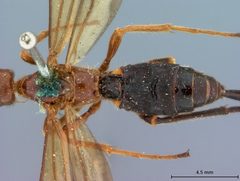
Iphiaulax is a of braconid wasps in the Braconidae. The genus includes ectoparasitic that attack lepidopteran larvae. Iphiaulax kimballi, described in 1982, is known to parasitize mature larvae of the southwestern corn borer (Diatraea grandiosella) in Mexico. Females inject venom to paralyze larvae before ovipositing on the host . Multiple larvae can develop on a single host.

Pronunciation
How to pronounce Iphiaulax: /ˌɪfiˈɑːlæks/
These audio files are automatically generated. While they are not always 100% accurate, they are a good starting point.
Images
Distribution
Native to Mexico, with I. kimballi originally described from collections in Morelos and Veracruz. GBIF records indicate presence in Denmark, Norway, and Sweden, though these may represent other within the or data artifacts.
Host Associations
- Diatraea grandiosella - mature larvae parasitized; southwestern corn borer
Life Cycle
Several larvae can complete development on a single . Development is temperature-dependent.
Behavior
Females inject venom to paralyze larvae before ovipositing on the host . Host selection and host searching have been studied in I. kimballi.
Ecological Role
Natural enemy of lepidopteran pests. I. kimballi has been evaluated as a candidate for of the southwestern corn borer in the United States and may significantly impact levels in some areas of Mexico.
Human Relevance
I. kimballi has been investigated for potential use in programs targeting the southwestern corn borer, a destructive pest of corn and sorghum.
More Details
Research history
Iphiaulax kimballi was newly described by Kirkland in 1982. Fundamental studies on its development, venom function, and were conducted to evaluate its potential as a agent.