
Diatraea saccharalis
(Fabricius, 1794)
sugarcane borer, sugar-cane borer
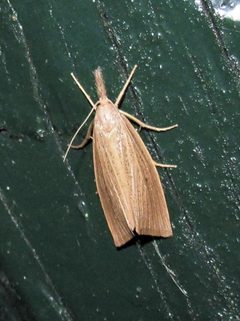
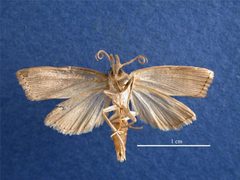
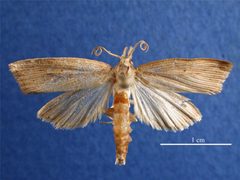
Diatraea saccharalis, commonly known as the sugarcane borer, is a in the Crambidae native to tropical and subtropical regions of the Western Hemisphere. The was first described by Johan Christian Fabricius in 1794 and has since become a significant agricultural pest. It was introduced to Louisiana around 1855 and has subsequently spread throughout the Gulf Coast states of the United States. The larvae are particularly destructive to sugarcane, but also attack corn, rice, sorghum, and various grass species.
Pronunciation
How to pronounce Diatraea saccharalis: //daɪəˈtriːə sæˌkæɹəˈrælɪs//
These audio files are automatically generated. While they are not always 100% accurate, they are a good starting point.
Identification
can be distinguished from similar stalk-boring by their white to buff coloration and relatively small size. Females deposit in distinctive clusters of 10–20 flattened, elliptical to oval eggs that overlap like fish in a shingle-like arrangement on plant leaves. Larvae are identified by the combination of creamy white color with conspicuous round brown or black spots on most body segments, and their presence tunneling within stalks. Similar include the southwestern corn borer (Diatraea grandiosella), Mexican rice borer (Eoreuma loftini), European corn borer (Ostrinia nubilalis), and neotropical borer (Diatraea lineolata); these require careful examination of adult genitalia or larval spot patterns for definitive identification.
Images
Habitat
Agricultural fields and natural grasslands in tropical and subtropical regions. Larvae develop inside the stalks of plants, particularly sugarcane, corn, rice, sorghum, and various wild grasses including johnsongrass (Sorghum halepense), Paspalum, Panicum, Holcus, and Andropogon.
Distribution
Native to the Caribbean, Central America, and warmer parts of South America south to northern Argentina. Introduced to the United States: first detected in Louisiana around 1855, subsequently spread to other Gulf Coast states including Texas, Mississippi, and Florida. Also present in the Galápagos Islands.
Seasonality
Two to three per year in most regions. are active during warmer months. In temperate regions, occurs as fully grown larvae in inside harvested stalk stubble. Activity patterns vary with latitude and local climate conditions.
Diet
Larvae feed internally on the pith of plant stalks. Young larvae initially feed on leaves or leaf axes before tunneling into stalks. Older larvae bore up and down the pith. Documented host plants include sugarcane (Saccharum spp.), corn (Zea mays), rice (Oryza sativa), sorghum (Sorghum bicolor), Sudangrass, johnsongrass (Sorghum halepense), and various wild grasses including Paspalum, Panicum, Holcus, and Andropogon .
Host Associations
- Saccharum spp. - primary sugarcane, main economic
- Zea mays - corn/maize
- Oryza sativa - rice
- Sorghum bicolor - grain sorghum
- Sorghum halepense - johnsongrass, wild
- Paspalum spp. - wild grasses
- Panicum spp. - wild grasses
- Holcus spp. - wild grasses
- Andropogon spp. - wild grasses
Life Cycle
hatch in 3–7 days. Larval stage lasts approximately 25 days; young larvae feed externally on leaves or leaf axes for a few days before boring into stalks. Larvae tunnel through the pith, completing development in 2–3 weeks after entering stalks. occurs in approximately 10 days within inside stalks. Two to three occur per year. occurs as fully grown larvae in cells inside stalk stubble remaining after harvest.
Behavior
Females deposit in shingle-like overlapping clusters on plant leaves. Larvae are obligate stalk borers, tunneling through plant pith and feeding internally. Older larvae bore up and down stalks, potentially causing stalk breakage below grain . Larval tunneling increases host susceptibility to stalk rot and lodging.
Ecological Role
As a herbivore, D. saccharalis functions as a significant pest in agricultural , reducing yield and plant vigor through stalk tunneling. The serves as for agents including the larval Cotesia flavipes and parasitoid Trichogramma galloi, which have been deployed in large- biological control programs.
Human Relevance
Major agricultural pest causing substantial economic damage to sugarcane, corn, rice, and sorghum. In Brazil, programs using Cotesia flavipes cover over 30,000 km² and Trichogramma galloi over 5,000 km². Insecticidal control is only effective when applied before larvae bore into stalks. Cultural management includes early planting, destruction of to kill larvae, and elimination of alternate such as johnsongrass. The is subject to resistance monitoring in transgenic crop programs.
Similar Taxa
- Diatraea grandiosellaSouthwestern corn borer; similar and appearance, overlapping distribution in North America, requires genitalia examination for definitive separation
- Eoreuma loftiniMexican rice borer; similar stalk-boring habit and range, but has spread more recently in the United States and may tolerate colder temperatures
- Ostrinia nubilalisEuropean corn borer; similar stalk-boring but in Crambidae (formerly Pyralidae), different mass (not shingle-like)
- Diatraea lineolataNeotropical borer; closely related with similar and appearance, overlapping range in the Americas
More Details
Taxonomic history
Originally described as Phalaena saccharalis by Fabricius in 1794. Later transferred to Diatraea. Some sources list authorship as Guenée, 1862, though Fabricius, 1794 is the accepted original description.
Biological control success
Brazil operates one of the world's largest programs against this pest, with releases covering an area larger than Belgium.
Invasion dynamics
Introduction to Louisiana around 1855 represents one of the earliest documented lepidopteran invasions in North American agriculture. The has continued to expand its range in the United States over 150+ years.
Sources and further reading
- BugGuide
- Wikipedia
- GBIF taxonomy match
- iNaturalist taxon
- NCBI Taxonomy
- Catalogue of Life
- Stalk-boring insect pests - AgriLife Extension Entomology
- Insects that feed on developing grain in the head - AgriLife Extension Entomology
- “Picudo negro” (black weevil) on soybean in Argentina | Beetles In The Bush
- Biological Control in Brazil is Used on an Area that is Larger than Belgium
- A New Resource for Fighting the Mexican Rice Borer
- Argentina | Beetles In The Bush | Page 7
- Diatraea saccharalis . [Distribution map].
- Diatraea saccharalis . [Distribution map].
- Genetic Behavior of Resistance in Sugarcane to the Sugarcane Borer, Diatraea Saccharalis (F.).
- Host Resistance to Diatraea Saccharalis (F.)--Evaluation of Entries in Louisiana Sugarcane Varietal Trials, 1969-71.
- Methyl jasmonate modulates non-enzymatic antioxidant defenses in sugarcane under Diatraea saccharalis (Fabricius, 1794) infestation.