
Elasmopalpus lignosella
Zeller, 1848
lesser cornstalk borer
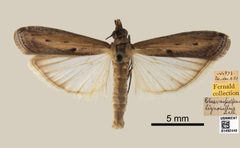
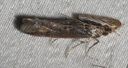
Elasmopalpus lignosella, commonly known as the lesser cornstalk borer, is a whose larvae are pests of young agricultural crops including sorghum, corn, peanuts, and soybeans. The species is widely distributed, with records from North America, Europe, and Hawaii. Larvae bore into stems near ground level, causing wilting, lodging, and plant death. are more severe during hot, dry conditions and in sandy soils. While capable of significant damage in soybeans and other crops, damaging infestations in sorghum are rare.

Pronunciation
How to pronounce Elasmopalpus lignosella: /ɪˌlæzməˈpælpəs lɪgˌnəʊˈsɛlə/
These audio files are automatically generated. While they are not always 100% accurate, they are a good starting point.
Identification
Larvae are distinguished by their light bluish green coloration with prominent transverse reddish-brown bands and their habit of feeding in silken tunnels covered with soil particles. Damage include wilting, lodging, and plant death, often with affected plants grouped in the same or adjacent rows. In soybeans, dead plants may appear teepee-shaped. Larvae can be found in silken tubes at the base of plants. Distinguished from cutworms by the presence of soil-covered silken tunnels rather than subterranean feeding without such structures, and from other stalk borers by the distinctive banded coloration and tunneling near ground level.
Images
Habitat
Agricultural fields, particularly those with sandy soils. Larval consists of silken tunnels in soil attached to plant stems. are more severe in dry conditions and where soil organic matter is low. Occurs in crop fields including sorghum, corn, peanut, and soybean plantings.
Distribution
Recorded from North America (including Texas and Hawaii), Europe (Belgium), and Norway. Within North America, known from agricultural regions where crops are cultivated.
Seasonality
Activity corresponds to early growth stages of crops. In soybeans, damage occurs from through approximately V8 growth stage. Multiple per year are possible; emerge in spring and develop through the growing season.
Diet
Larvae feed on roots and bore into stems of young plants. Known include sorghum, corn, peanuts, soybeans, and other crops. Larvae can survive on decaying vegetation.
Host Associations
- Sorghum - larval Damaging rare in sorghum
- Corn - larval
- Peanut - larval
- Soybean - larval Significant pest in early growth stages
- Johnsongrass - possible wild Inferred from related pest ; not explicitly confirmed in sources
Life Cycle
Complete . Larvae are the damaging stage, attacking roots and boring into stems of young plants. Larvae feed in silken tunnels covered with soil particles. occurs in silken cocoons under crop debris. Multiple per year. stage not explicitly described in sources but likely as larvae or pupae in soil or crop debris.
Behavior
Larvae construct silken tunnels in soil attached to plants, covering these tunnels with soil particles. Individual larvae can attack multiple plants, resulting in grouped damage patterns in fields. Larvae feed near or below ground level. are or ; specific adult not described in sources.
Ecological Role
Herbivore and agricultural pest. Larval feeding can reduce plant stands and crop yields. Can survive on decaying vegetation, potentially contributing to nutrient cycling in agricultural systems, though this role is minor compared to economic impact.
Human Relevance
Economic pest of agricultural crops, particularly soybeans, peanuts, corn, and sorghum. In soybeans, sparse non-uniform stands are more vulnerable to economic damage than dense uniform stands. Management includes early planting, crop with non- crops, preservation of soil moisture, increasing soil organic matter, and seed or post- applications. Insecticidal control rarely justified in sorghum. Specific not established, but scouting recommended during early crop growth. Labeled insecticides for sorghum include lambda-cyhalothrin, gamma-cyhalothrin, deltamethrin, and chlorpyrifos .
Similar Taxa
- Cutworms (various Noctuidae species)Both feed below or near ground level on roots and stems of seedlings and cause plant cutting or lodging. Distinguished by lesser cornstalk borer's construction of soil-covered silken tunnels and distinctive bluish-green coloration with reddish-brown bands; cutworms lack silken tunnels and typically curl into C-shape when disturbed.
- Other stalk borers (Diatraea spp., Ostrinia nubilalis)All are Lepidoptera larvae that tunnel in stalks of sorghum and corn. Distinguished by lesser cornstalk borer's feeding near ground level in young plants, light bluish-green coloration with transverse reddish-brown bands, and soil-covered silken tunnels; other borers typically tunnel in stalk pith above ground level, are creamy white with brown or black spots, and lack external silken tunnels.
More Details
Damage Pattern
In soybean fields, affected plants often occur in groups in the same or adjacent rows because individual larvae can attack more than one plant. Dead plants may appear teepee-shaped.
Soil Preferences
Soybeans grown on sandy soils are more vulnerable to attack than those on finer soils. Damage usually occurs during hot, dry weather.
Management Timing
Early field preparation can help prevent damaging by reducing larval survival on decaying vegetation. Irrigating soybeans can help prevent injury during dry periods.