
Elasmopalpus
Blanchard, 1852
lesser cornstalk borer (for E. lignosellus)
Species Guides
1- Elasmopalpus lignosella(lesser cornstalk borer)
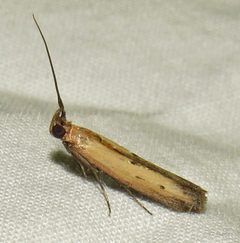
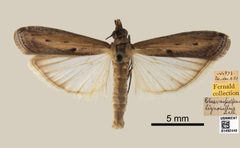
Elasmopalpus is a of snout moths in the Pyralidae, Phycitinae, described by Émile Blanchard in 1852. The genus is restricted to the Americas and currently comprises three . The type species E. angustellus was described with the genus, while E. corrientellus was added in 1888 and E. lignosellus in 1848. The genus is considered closely related to Ufa. The most well-known species, E. lignosellus (lesser cornstalk borer), is a significant agricultural pest of Poaceae and Fabaceae crops throughout the Americas.

Pronunciation
How to pronounce Elasmopalpus: /ɛˌlæzmoʊˈpælpəs/
These audio files are automatically generated. While they are not always 100% accurate, they are a good starting point.
Images
Habitat
Sandy soils; coastal plain regions. are more severe during dry periods and in sandy soils. The is restricted to the Americas.
Distribution
Americas: southern United States (South Carolina to Texas), Mexico, Central America ( Rica, El Salvador, Guatemala, Nicaragua, Panama), West Indies, and South America (Argentina, Brazil, Chile, Colombia, French Guiana, Paraguay, Peru, Uruguay, Venezuela). Also recorded from the Bahamas and Juan Fernández Island.
Diet
Larvae feed on Poaceae and Fabaceae crops. Specific include maize, sugarcane, other Gramineae, legumes, peanuts, and soybeans. One (E. jasminphagus) has been recorded feeding on jasmine (Jasminum sambac) flowers, buds, shoots, and leaves in India.
Host Associations
- Zea mays - larval maize, primary
- Saccharum officinarum - larval sugarcane
- Poaceae - larval grasses, Gramineae
- Fabaceae - larval legumes
- Arachis hypogaea - larval peanut
- Glycine max - larval soybean
- Asparagus officinalis - larval asparagus
- Jasminum sambac - larval jasmine (E. jasminphagus only)
Life Cycle
Complete with , larva, pupa, and stages. Larvae are light bluish green with prominent transverse reddish-brown bands, feeding in silken tunnels covered with soil particles. occurs in silken cocoons under crop debris. For E. lignosellus, larvae attack roots and bore into stems of young plants. Adult lifespan is approximately 25–27 days with around 54 eggs per female (based on E. jasminphagus study).
Behavior
Larvae construct silken tunnels in soil attached to plants, covered with soil particles. When disturbed, larvae may suspend themselves by spinning a thin silken thread. Larvae can attack multiple plants sequentially, causing grouped damage in same or adjacent rows. are weak fliers that rely on wind currents for .
Ecological Role
Agricultural pest . research has identified (particularly Heterorhabditis amazonensis GL) as effective against pupae. relationships include Orgilus elasmopalpi (Braconidae). Plant damage by E. lignosellus induces volatile organic compound release (including (Z)-3-hexenyl acetate, β-pinene, β-myrcene, (E)-4,8-dimethylnona-1,3,7-triene, and benzothiazole) that attracts the parasitoid Trichogramma pretiosum, suggesting an indirect plant defense mechanism.
Human Relevance
Significant economic pest of grain and legume crops. E. lignosellus causes stem boring damage leading to wilting, lodging, and plant death in maize, sorghum, peanuts, and soybeans. Damage is most severe in sandy soils and during hot, dry conditions. Management strategies include early planting, crop with non- crops, moisture preservation, and elimination of weed hosts such as johnsongrass. Insecticidal control is rarely justified for most crops, though several and are labeled for control in grain sorghum and other crops. Non-destructive detection methods using VIS-NIR hyperspectral imaging have been developed for asparagus .
Similar Taxa
- UfaConsidered closely related within Phycitinae based on phylogenetic relationships
- Stenodiplosis sorghicolaBoth are pests of sorghum , but Stenodiplosis is a (Cecidomyiidae) with orange-red , while Elasmopalpus is a (Pyralidae) with bluish-green banded larvae that bore in stems
- Diatraea saccharalisBoth are stalk-boring Lepidoptera in Poaceae, but Diatraea larvae are creamy white with conspicuous round brown or black spots, while Elasmopalpus larvae are bluish-green with transverse reddish-brown bands and construct soil-covered silken tunnels
More Details
Taxonomic Note
The was long considered with only E. lignosellus, but currently comprises three recognized : E. angustellus (type species), E. corrientellus, and E. lignosellus. A fourth species, E. jasminphagus, has been described from India but its taxonomic placement may warrant verification.
Research Significance
E. lignosellus serves as a model organism for studying plant-insect- tritrophic interactions, particularly the role of herbivore-induced plant volatiles in attracting agents.
Sources and further reading
- BugGuide
- Wikipedia
- GBIF taxonomy match
- iNaturalist taxon
- NCBI Taxonomy
- Catalogue of Life
- Stalk-boring insect pests - AgriLife Extension Entomology
- Soybean Insects: Early-Season Pests (Emergence to V8) - AgriLife Extension Entomology
- Insects that feed on developing grain in the head - AgriLife Extension Entomology
- Elasmopalpus lignosellus . [Distribution map].
- Lesser Cornstalk Borer, Elasmopalpus lignosellus (Zeller) (Insecta: Lepidoptera: Pyralidae)
- SUSCEPTIBILITY OF Elasmopalpus lignosellus PUPAE TO ENTOMOPATHOGENIC NEMATODES IN MAIZE
- Ecology of Elasmopalpus lignosellus1 Parasite Complex on Peanuts in Texas2
- Trichogramma pretiosum attraction due to the Elasmopalpus lignosellus damage in maize
- Reproductive biology of the lesser cornstalk borer, Elasmopalpus Lignosellus (Zeller) (Lepidoptera: Phycitidae) / by Karl Johnson Stone.
- Bioecology and distribution of gallery worm (Elasmopalpus jasminphagus Hampson) of jasmine (Jasminum sambac L.) in Tamil Nadu, India
- Biology of Orgilus elasmopalpi [Hym.: Braconidae] with Elasmopalpus lignosellus [Lep.: Pyralidae] as Host1
- Non-Destructive Detection of Elasmopalpus lignosellus Infestation in Fresh Asparagus Using VIS-NIR Hyperspectral Imaging and Machine Learning.