
Diatraea crambidoides
Grote, 1880
southern cornstalk borer moth, southern corn stalk borer
Diatraea crambidoides is a in the Crambidae whose larvae are significant agricultural pests of corn, sorghum, and sugarcane. The was described by Augustus Radcliffe Grote in 1880 and occurs in eastern North America from Alabama and northern Florida to Ohio and Maryland. are straw-colored to dull white with wingspans of 15–40 mm. The species has two per year, with larvae boring into stalks and damaging internodes, reducing crop yield. It has been evaluated as a target for using the Aprostocetus esurus.
Pronunciation
How to pronounce Diatraea crambidoides: //ˌdaɪəˈtriːə ˌkræmˌbɪˈdɔɪdiːz//
These audio files are automatically generated. While they are not always 100% accurate, they are a good starting point.
Identification
Diatraea crambidoides can be distinguished from similar stalk-boring by its eastern North American distribution and pale straw-colored to white coloration. It is smaller than some related Diatraea such as D. saccharalis. Accurate identification typically requires examination of genitalia or molecular markers. The species has two per year, which may help distinguish it from some relatives.
Images
Appearance
are straw-colored to dull white with wingspans of 15–40 mm. The forewings are slightly darker than the hindwings. The overall coloration is pale and nondescript, typical of many crambid moths.
Habitat
Agricultural fields and adjacent areas where grasses grow, including cornfields, sorghum fields, and sugarcane plantations. The is associated with cultivated crops rather than natural .
Distribution
Eastern North America, from Alabama and northern Florida northward to Ohio and Maryland. Records also exist from Guatemala where it has been studied as a sugarcane pest.
Seasonality
Two per year. activity and larval damage occur during the growing season of crops.
Diet
Larvae feed on Zea mays (corn), Sorghum (including grain sorghum), Tripsacum dactyloides (eastern gamagrass), and Saccharum officinarum (sugarcane). Larvae bore into stalks and feed on pith tissue, damaging internodes.
Host Associations
- Zea mays - larval food plantPrimary in North America
- Sorghum bicolor - larval food plantGrain sorghum
- Tripsacum dactyloides - larval food plantWild grass
- Saccharum officinarum - larval food plantSugarcane in Central America
- Aprostocetus esurus - Chalcid that attacks pupal stage; evaluated for in Guatemala
Life Cycle
Two per year. are laid on plant leaves. Larvae feed initially on leaves or leaf axils, then bore into stalks and tunnel through pith tissue. Larval development takes approximately 25 days. occurs within the stalk. emerge to produce the second generation. In Guatemala, the pupal stage was observed 36–39 days after adult release in experimental conditions.
Behavior
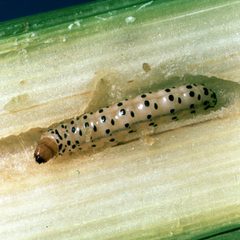
Larvae are stalk borers that tunnel up and down the pith of plant stalks. Feeding near the base of the grain can cause the head to break off. Larval tunneling increases plant susceptibility to stalk rot and lodging.
Ecological Role
Agricultural pest that reduces yield in corn, sorghum, and sugarcane by damaging stalks and interfering with nutrient transport. Serves as for including Aprostocetus esurus. Injury to stalks creates entry points for fungal .
Human Relevance
Significant pest of corn and sorghum in the eastern United States, and of sugarcane in Central America. Economic damage results from reduced yields, stalk breakage, and increased lodging. Management includes early planting, crop , destruction of to kill larvae, and applications targeting larvae before they enter stalks. using Aprostocetus esurus has been evaluated in Guatemala, with releases of at least 5 per projected pupa showing significant increases in sugar yield.
Similar Taxa
- Diatraea saccharalisSimilar sugarcane borer with overlapping range; D. saccharalis is generally larger and has a broader distribution including South America and the southern United States
- Diatraea grandiosellaSouthwestern corn borer with similar and appearance; distinguished by western distribution and different markings
- Eoreuma loftiniMexican rice borer with similar stalk-boring habit; distinguished by more western and southern distribution in the United States
- Ostrinia nubilalisEuropean corn borer with similar larval ; distinguished by different coloration (usually brown with darker markings) and different genitalia
More Details
Biological Control Research
In Guatemala, Aprostocetus esurus has been evaluated as a agent against D. crambidoides in sugarcane. Field cage studies at Finca Belén found that releasing the at a ratio of at least 5 per projected pupa significantly increased sugar yield and reduced damaged internodes. This represents one of the few documented biological control programs specifically targeting this .
Sources and further reading
- BugGuide
- Wikipedia
- GBIF taxonomy match
- iNaturalist taxon
- NCBI Taxonomy
- Catalogue of Life
- Stalk-boring insect pests - AgriLife Extension Entomology
- Insects that feed on developing grain in the head - AgriLife Extension Entomology
- “Picudo negro” (black weevil) on soybean in Argentina | Beetles In The Bush
- Biological Control in Brazil is Used on an Area that is Larger than Belgium
- A New Resource for Fighting the Mexican Rice Borer
- Argentina | Beetles In The Bush | Page 7
- Evaluación del parasitoide Aprostecetus esurus como controlador biológico del barrenador de la caña (Diatraea crambidoides) en jaulas bajo las condicones de la granja de Belén