
Ceratomia catalpae
(Boisduval, 1875)
Catalpa Sphinx, Catawba worm
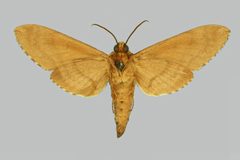
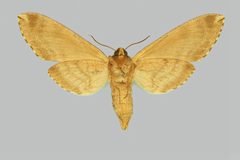
Ceratomia catalpae, the catalpa sphinx, is a hawk moth in the Sphingidae native to southeastern North America. The is notable for its close association with catalpa trees (Catalpa spp.), which serve as the exclusive plants for its larvae. The caterpillars, known as "catawba worms," are highly valued as fishing and sequester defensive iridoid glycosides from their host plants. are dull brown with distinctive wing markings and a wingspan of 65–95 mm. The species has been extensively studied for its chemical , particularly the of catalpol and its interactions with the Cotesia congregata.
Pronunciation
How to pronounce Ceratomia catalpae: /sɛrəˈtoʊmiə kəˈtælp.i/
These audio files are automatically generated. While they are not always 100% accurate, they are a good starting point.
Identification
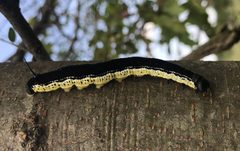
distinguished from other Ceratomia by the combination of dull brown coloration, circular dark band on , and small dark forewing mark with white dot. Larvae recognized by yellow ground color with black stripe and lateral dots, though pale phase individuals may lack dark markings. Exclusive association with Catalpa plants provides strong clue. Similar to other sphinx moths in general body plan but specific wing pattern and host plant specificity aid identification.
Images
Habitat
Strictly associated with catalpa trees (Catalpa bignonioides, C. speciosa, and related ). Found in varied environments where trees grow, including urban plantings, riparian areas, and open woodlands. Not limited by specific type beyond presence of host plant.
Distribution
Native to southeastern North America. Range extends from Maine west to Iowa, south to Florida, the Gulf States, and Texas. Distribution closely tracks that of native and planted Catalpa trees.
Seasonality
Multiple occur where climate permits. From oviposition to requires approximately four weeks. Pupae eclose in approximately two weeks when conditions are suitable, or may overwinter. active during warmer months; specific periods vary geographically.
Diet
Larvae feed exclusively on leaves of Catalpa , primarily Catalpa bignonioides (southern catalpa) and Catalpa speciosa (northern catalpa). likely feed on nectar, though specific adult food sources are not well documented.
Host Associations
- Catalpa bignonioides - larval plantSouthern catalpa; preferred
- Catalpa speciosa - larval plantNorthern catalpa
- Catalpa bungeii - larval plantSuitable in experimental conditions
- Catalpa fargeseii - larval plantSuitable in experimental conditions
- Catalpa ovata - larval plantSuitable in experimental conditions
- Cotesia congregata - Endoparasitoid ; survival exceeds 90% despite chemical defense
Life Cycle
deposited in masses of 100–1000 on undersurface of Catalpa leaves; smaller masses deposited on branches. Incubation 5–7 days. Larvae pass through five instars, feeding on leaves and sequestering iridoid glycosides. Final instar larvae enter "wandering" stage, leaving host tree to burrow into ground and pupate. occurs in soil. Where multiple occur, emerge in approximately two weeks; otherwise pupae may overwinter. Total development from egg to pupation approximately four weeks under favorable conditions.
Behavior
Larvae regurgitate when disturbed, a hypothesized to serve as defense. Regurgitation incurs a growth cost: mechanically disturbed (pinched) larvae that regurgitate grow significantly more slowly than undisturbed controls. Final instar larvae exhibit pre-pupal wandering behavior, descending from trees to search for suitable soil sites.
Ecological Role
Herbivore specializing on Catalpa trees; can cause complete defoliation of trees during , though trees typically recover. Serves as host for Cotesia congregata, which achieves high survival rates despite host chemical defenses. Sequestered iridoid glycosides (catalpol) deter vertebrate and , potentially creating "safe havens" for parasitoids. Catalpol is negatively correlated with larval immune response and respiration rate, indicating physiological trade-offs of chemical defense.
Human Relevance
Caterpillars highly valued as fishing for bass, bream, and catfish, commonly sold as "catawba worms." Subject of first aerial crop dusting trial in attempted pest control, though later research suggests defoliation is less harmful to trees than initially believed. Used extensively in research on insect-plant chemical interactions, of defensive compounds, and tritrophic chemical .
Similar Taxa
- Ceratomia undulosaSimilar appearance and ; distinguished by wing pattern details and plant specificity (walnut and hickory vs. catalpa)
- Amorpha juglandisAnother sphinx moth with brown coloration; distinguished by association (walnut) and different larval appearance
Misconceptions
Historically considered a serious pest of catalpa trees warranting chemical control; more recent research indicates trees can survive and recover from complete defoliation multiple times in a single season, suggesting a possible mutualistic or commensal relationship rather than strictly parasitic one.
More Details
Chemical Ecology
Larvae sequester iridoid glycosides catalpol and catalposide from plants, concentrating them above leaf levels. Catalpol is retained through larval and pupal stages but absent in . is positively correlated with nutritional measures but negatively correlated with immune response and respiration rate, indicating complex physiological trade-offs.
Historical Note
First described by Jean Baptiste Boisduval in 1875. First aerial crop dusting attempt targeted this in catalpa plantations.
Sources and further reading
- BugGuide
- Wikipedia
- GBIF taxonomy match
- iNaturalist taxon
- NCBI Taxonomy
- Catalogue of Life
- Bug Eric: National Moth Week 2021 Review
- Megalopygidae | Beetles In The Bush
- Bug Eric: 2021
- Hostplant Suitability and Defensive Chemistry of the Catalpa Sphinx, Ceratomia catalpae
- Caterpillar Chemical Defense and Parasitoid Success: Cotesia congregata Parasitism of Ceratomia catalpae
- The Chemical Basis of the Host Selection in the Catalpa Sphinx, Ceratomia catalpae (Lepidoptera, Sphingitlae)1
- Chemical Defense Across Three Trophic Levels: Catalpa bignonioides, the Caterpillar Ceratomia catalpae, and its Endoparasitoid Cotesia congregata
- Relationships among catalpol sequestration, metabolism and nutritional efficiencies of the catalpa sphinx, Ceratomia catalpae (Lepidoptera: Sphingidae)