
Ceratomia undulosa
Walker, 1856
Waved Sphinx, Scorpion Moth
Ceratomia undulosa, commonly known as the waved sphinx, is a North American hawk moth ( Sphingidae) first described by Francis Walker in 1856. The is notable for its specialized relationship with ash trees (Fraxinus) as a primary larval , making it vulnerable to declines following the spread of the emerald ash borer. are strictly and hide before dawn. The alternative " " stems from a misconception: the Guiana Striped Scorpion commonly preys on the moth's clusters, leading to erroneous beliefs that the moths give birth to scorpions.
Pronunciation
How to pronounce Ceratomia undulosa: /kɛrəˈtoʊmiə ˌʌndjəˈloʊsə/
These audio files are automatically generated. While they are not always 100% accurate, they are a good starting point.
Identification
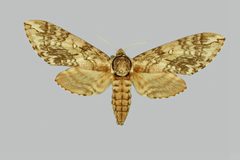
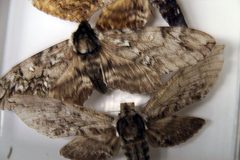
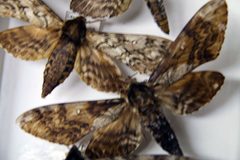
Best distinguished from similar Ceratomia by the wavy, undulating pattern on the forewings. Accurate identification requires examination of wing pattern details and, for caterpillars, plant association with ash. When found on or near ash trees in eastern North America, this species is strongly indicated.
Images
Appearance
A medium-sized hawk moth with characteristic undulating or wavy patterns on the forewings, from which the derives. possess the robust, streamlined body typical of sphingid , with narrow forewings and broader hindwings. The specific wing pattern details and coloration are not described in available sources.
Habitat
Associated with deciduous woodlands and suburban areas where plants (ash, privet, oak, hawthorn, fringe tree) occur. Larvae require access to specific host trees for development.
Distribution
Eastern North America from Prince Edward Island and Nova Scotia west to eastern Alberta, and from Maine south to Florida, the Gulf Coast, and Texas. Also occurs in Mexico ( C. u. polingi). East of the Rocky Mountains throughout the United States and southern Canada.
Seasonality
are strictly , hiding away as dawn approaches. Specific period timing is not documented in available sources.
Diet
Larvae feed on ash (Fraxinus), privet (Ligustrum), oak (Quercus), hawthorn (Crataegus), and fringe tree (Chionanthus virginicus). are presumed to feed on nectar, though this is not explicitly documented.
Host Associations
- Fraxinus - primary Ash trees are the primary native ; larval development is optimal on this
- Ligustrum - secondary Non-native privet can support development but may constitute an ecological trap; privet-reared pupae often exhibit malformed wing buds
- Quercus - secondary Oak is a recorded food plant
- Crataegus - secondary Hawthorn is a recorded food plant
- Chionanthus virginicus - secondary Fringe tree is a recorded food plant
Life Cycle
Complete with , larva, pupa, and stages. Larvae feed on plant foliage before burrowing underground to pupate. occurs in soil.
Behavior
are strictly , hiding away as dawn approaches. The most common of is the Guiana Striped , which feeds on egg clusters; this predator's proximity to ovipositing females has generated the erroneous "Scorpion ."
Ecological Role
herbivore dependent on ash and related Oleaceae. Serves as prey for at the stage. As an ash specialist, the is part of a of nearly 300 arthropods associated with ash trees, making it vulnerable to cascading effects from emerald ash borer-induced ash decline.
Human Relevance
Subject of ecological research regarding plant and conservation implications of ash tree decline. Used in studies demonstrating that non-native host plants (particularly privet) can serve as ecological traps, with larvae developing successfully but producing non-viable with wing malformations. The illustrates challenges in managing landscapes for insect conservation when native hosts become scarce.
Similar Taxa
- Sphinx kalmiaeAnother ash- hawk moth with overlapping range; can be distinguished by wing pattern and larval , though specific diagnostic features are not detailed in sources
- Sphinx chersisGreat ash sphinx, also an ash ; similar ecological requirements but with different plant tolerances (S. chersis perishes entirely on lilac while S. kalmiae develops successfully)
- Other Ceratomia species share similar body plan and preferences; C. undulosa specifically distinguished by wavy forewing patterns
Misconceptions
The " " reflects a persistent misconception that these moths give birth to scorpions. This arose from observations of Guiana Striped Scorpions preying on moth clusters; the scorpions' common proximity to ovipositing females led to erroneous conclusions about reproductive relationships.
More Details
Conservation concern
As an ash , C. undulosa significant conservation challenges from emerald ash borer (Agrilus planipennis) devastation of ash trees across eastern North America. Research indicates that while some alternative plants can support larval development, they often result in suboptimal outcomes including delayed development, higher mortality, and pupal malformations that prevent successful . This makes preservation of remaining ash critical for persistence.
Subspecies
Two recognized: C. u. undulosa (eastern North America from Prince Edward Island to Texas) and C. u. polingi Clark, 1929 (Mexico).
Sources and further reading
- BugGuide
- Wikipedia
- GBIF taxonomy match
- iNaturalist taxon
- NCBI Taxonomy
- Catalogue of Life
- Ready for a Saturday Night of Bioblitz at the UC Davis Arboretum? | Bug Squad
- For Ash-Dependent Insects, Some Plants Make Good Alternatives—But Others Don't
- Sphingidae | Beetles In The Bush | Page 2
- The Moth and Me | Beetles In The Bush
- Noctuidae | Beetles In The Bush | Page 3
- Saturniidae | Beetles In The Bush | Page 2