
Ceratomia
Harris, 1839
Species Guides
6- Ceratomia amyntor(Elm Sphinx)
- Ceratomia catalpae(Catalpa Sphinx)
- Ceratomia hageni(Hagen's Sphinx)
- Ceratomia igualana
- Ceratomia sonorensis(Sonoran sphinx)
- Ceratomia undulosa(Waved Sphinx)
Ceratomia is a of hawkmoths ( Sphingidae) erected by Thaddeus William Harris in 1839. The genus contains seven recognized distributed primarily in North America. Several species are notable for their specialized plant associations, particularly with Catalpa and Fraxinus (ash). Ceratomia catalpae, the catalpa sphinx, is among the best-studied species due to its chemical of the iridoid glycoside catalpol from host plants, which provides defense against but not against its Cotesia congregata. Ceratomia undulosa, the waved sphinx, is an ash specialist whose are threatened by emerald ash borer-induced host decline.
Pronunciation
How to pronounce Ceratomia: /ˌsɛrəˈtoʊmiə/
These audio files are automatically generated. While they are not always 100% accurate, they are a good starting point.
Identification
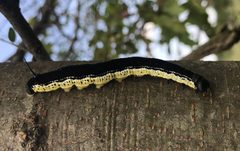
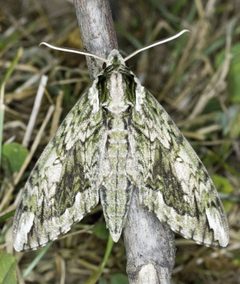
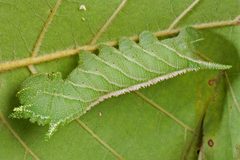
Ceratomia can be distinguished from other North American sphinx moth by a combination of forewing pattern and abdominal markings. typically exhibit undulating or wavy transverse lines on the forewings (especially pronounced in C. undulosa). The hindwings often show contrasting bands or patches. Examination of genitalia is required for definitive species identification. Larvae are generally green with diagonal lateral stripes and a horn; C. catalpae larvae have distinctive black spots on a pale green background. Species within the genus are distinguished by plant association, geographic range, and subtle differences in wing pattern and size.
Images
Habitat
Associated with deciduous woodlands and suburban areas containing trees. Ceratomia catalpae is found wherever Catalpa trees (C. bignonioides, C. speciosa, and related ) occur, including naturalized and ornamental plantings. Ceratomia undulosa is associated with ash forests and woodlands. Other species occupy varied matching their host plant distributions.
Distribution
North America. occur across the eastern and central United States, with some extending into Canada and south into Mexico. Specific ranges vary by species: C. catalpae is widespread in the eastern US where Catalpa is present; C. undulosa occurs across much of eastern North America; C. amyntor ranges from the northeastern US to Florida and west to Texas; C. hageni is found in the southwestern US and Mexico; C. sonorensis is restricted to Arizona and northern Mexico; C. igualana occurs in Mexico; C. hoffmanni is found in Mexico.
Seasonality
fly primarily from late spring through summer, with peak activity varying by latitude and . Most species have one or two per year. In the northern parts of their range, adults are typically on the wing from May through August.
Diet
Larvae are folivores with varying degrees of specificity. Ceratomia catalpae is a on Catalpa (C. bignonioides, C. bungeii, C. fargeseii, C. ovata, C. speciosa). Ceratomia undulosa is a specialist on Fraxinus (ash). Ceratomia amyntor feeds on ash and other Oleaceae including Syringa (lilac) and Forsythia. do not feed; they rely on larval energy reserves.
Host Associations
- Catalpa bignonioides - larval food plantprimary for C. catalpae
- Catalpa speciosa - larval food plantprimary for C. catalpae
- Catalpa bungeii - larval food plant for C. catalpae
- Catalpa fargeseii - larval food plant for C. catalpae
- Catalpa ovata - larval food plant for C. catalpae
- Fraxinus - larval food plantprimary for C. undulosa and C. amyntor
- Syringa vulgaris - larval food plantalternative for C. amyntor; performance varies
- Forsythia suspensa - larval food plantalternative for C. amyntor
- Ligustrum vulgare - larval food plantalternative for some ; may constitute ecological trap
- Cotesia congregata - endoparasitoid of C. catalpae; not deterred by chemical defenses
Life Cycle
Complete with , larva, pupa, and stages. Larvae typically have five instars. occurs in a subterranean . stage varies by and latitude; most overwinter as pupae. Some species may have partial second in southern portions of range. Larval development time varies significantly with plant quality and species.
Behavior
Larvae of C. catalpae exhibit regurgitation when disturbed, expelling gut contents containing sequestered catalpol as a defense against . This behavior incurs measurable growth costs—larvae induced to regurgitate grow significantly more slowly than undisturbed larvae. are and attracted to light. Larvae are solitary feeders.
Ecological Role
Herbivore that transfers plant secondary metabolites across . The sequestered iridoid glycosides in C. catalpae larvae deter , creating a "safe haven" that facilitates high survival (exceeding 90%) of its Cotesia congregata. The parasitoid acquires catalpol from and incorporates it into its own tissues and cocoons. Ash-feeding (particularly C. undulosa) are among numerous lepidopterans dependent on Fraxinus, making them vulnerable to cascading effects of emerald ash borer invasion and ash decline.
Human Relevance
Ceratomia catalpae larvae are conspicuous on ornamental Catalpa trees and are sometimes noticed by homeowners, though they rarely cause significant defoliation. The has been extensively studied as a model for chemical , tritrophic interactions, and the costs of chemical defense. Ash-feeding species have become subjects of conservation concern due to emerald ash borer-induced loss, prompting research into alternative host plants for conservation purposes. Some alternative hosts (particularly privet) may constitute ecological traps, supporting larval growth but producing non-viable .
Similar Taxa
- SphinxSimilar large sphinx moth with overlapping geographic range and some shared plants (Fraxinus); distinguished by forewing pattern details and larval coloration
- LaparaAnother North American sphinx moth associated with woody ; lack the characteristic undulating forewing lines of Ceratomia
- AmorphaWalnut sphinx and related ; larvae feed on Juglans and related woody plants rather than Catalpa or ash
More Details
Chemical sequestration and parasitoid interactions
Ceratomia catalpae has been extensively studied for its of the iridoid glycoside catalpol from Catalpa plants. Larvae concentrate catalpol at levels exceeding those in host leaves, reaching over 50% dry weight in . Despite this potent chemical defense against , the braconid Cotesia congregata successfully parasitizes C. catalpae at high rates across . Wasp survival exceeds 90% regardless of host catalpol levels, and the wasp acquires catalpol from host hemolymph, incorporating it into tissues and cocoons. This system exemplifies the "safe haven" hypothesis, where chemically defended hosts provide enemy-free space for specialized .
Conservation implications of ash decline
Ceratomia undulosa and related ash-feeding significant conservation challenges due to emerald ash borer (Agrilus planipennis) invasion and associated ash tree mortality. Research demonstrates that alternative plants vary dramatically in their suitability: lilac (Syringa vulgaris) supports development of some species but not others, while European privet (Ligustrum vulgare) can produce malformed, non-viable pupae despite supporting normal larval growth. These findings underscore the importance of preserving native ash and removing privet to support ash-dependent lepidopteran .
Sources and further reading
- BugGuide
- Wikipedia
- GBIF taxonomy match
- iNaturalist taxon
- NCBI Taxonomy
- Catalogue of Life
- Ready for a Saturday Night of Bioblitz at the UC Davis Arboretum? | Bug Squad
- For Ash-Dependent Insects, Some Plants Make Good Alternatives—But Others Don't
- Bug Eric: National Moth Week 2021 Review
- Bug Eric: Wasp Wednesday: Wasp Workshop
- Megalopygidae | Beetles In The Bush
- Notodontidae | Beetles In The Bush
- Hostplant Suitability and Defensive Chemistry of the Catalpa Sphinx, Ceratomia catalpae
- Caterpillar Chemical Defense and Parasitoid Success: Cotesia congregata Parasitism of Ceratomia catalpae
- The Chemical Basis of the Host Selection in the Catalpa Sphinx, Ceratomia catalpae (Lepidoptera, Sphingitlae)1
- Chemical Defense Across Three Trophic Levels: Catalpa bignonioides, the Caterpillar Ceratomia catalpae, and its Endoparasitoid Cotesia congregata
- Relationships among catalpol sequestration, metabolism and nutritional efficiencies of the catalpa sphinx, Ceratomia catalpae (Lepidoptera: Sphingidae)