
Ceratomia amyntor
(Geyer, 1835)
Elm Sphinx, Four-horned Sphinx
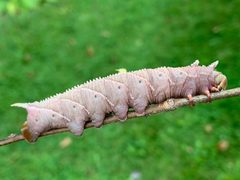
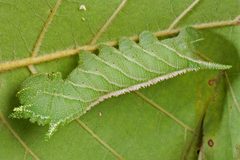
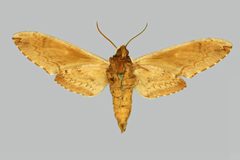
Ceratomia amyntor is a North American hawkmoth with a wingspan of 8.2–11.5 cm. Larvae feed primarily on elm but also use birch, basswood, and cherry. The is notable for its four horns—additional to the caudal horn typical of sphingids—giving rise to the "four-horned sphinx." are gray-brown with wavy forewing markings and a small white dot characteristic of the . The species has one in northern regions and up to five in the southern United States.
Pronunciation
How to pronounce Ceratomia amyntor: /ˌsɛrəˈtoʊmiə əˈmɪntɔr/
These audio files are automatically generated. While they are not always 100% accurate, they are a good starting point.
Identification
Distinguished from similar Ceratomia by four horns on larvae (vs. two in C. undulosa). recognized by gray-brown wavy forewings with small white dot; combination of broken body bands and plain gray hindwings with dark marginal band separates from . Larger size and more pronounced white head marking in some specimens may cause confusion with C. undulosa, but wing pattern details differ.
Images
Habitat
Deciduous forests and woodlands, suburban areas with trees present. Associated with elm, birch, basswood, and cherry stands.
Distribution
North America: Nova Scotia west to Alberta, western North Dakota, and Colorado; south to Florida, Gulf Coast, Georgia, Texas, Louisiana, and New Mexico.
Seasonality
Northern range: single , June–July. Southern range: two broods flying later in season; Louisiana records five broods March–October.
Diet
Larvae feed on leaves of Ulmus (elm), Betula (birch), Tilia (basswood), and Prunus (cherry). Has been observed on tomato and pepper plants.
Host Associations
- Ulmus - primary
- Betula - secondary
- Tilia - secondary
- Prunus - secondary
- Solanum lycopersicum - occasional tomato
- Capsicum - occasional pepper
Life Cycle
Complete with five larval instars completed in approximately one month. Larvae descend tree and burrow underground to pupate; may overwinter as pupae if late in season. Multiple in southern portion of range.
Behavior
Larvae exhibit "wandering" phase prior to , ceasing feeding and descending tree. , attracted to light.
Ecological Role
Herbivore in deciduous forest ; larval defoliation can be substantial on trees. Serves as prey for and other natural enemies.
Human Relevance
Occasional pest of vegetable crops (tomato, pepper) due to larval feeding. Otherwise not economically significant. Not threatened.
Similar Taxa
- Ceratomia undulosaSimilar size and coloration; distinguished by larval horn count (two horns vs. four in C. amyntor) and subtle wing pattern differences
- Ceratomia catalpaeShared and general ; C. catalpae specialized on Catalpa, lacks four horns as larva
- Smerinthus spp.Similar gray-brown hawkmoth appearance; distinguished by eyespot patterns on hindwings and lack of broken body bands
Sources and further reading
- BugGuide
- Wikipedia
- GBIF taxonomy match
- iNaturalist taxon
- NCBI Taxonomy
- Catalogue of Life
- Ready for a Saturday Night of Bioblitz at the UC Davis Arboretum? | Bug Squad
- For Ash-Dependent Insects, Some Plants Make Good Alternatives—But Others Don't
- Bug Eric: National Moth Week 2021 Review
- Bug Eric: Wasp Wednesday: Wasp Workshop
- Megalopygidae | Beetles In The Bush
- Notodontidae | Beetles In The Bush