
Ceratomia hageni
Grote, 1874
Hagen's Sphinx, Osage Orange Sphinx
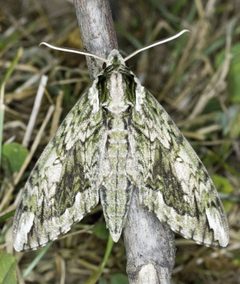
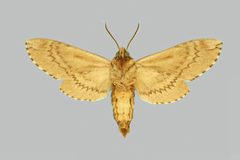
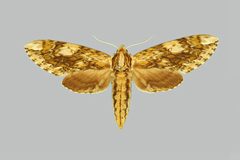
Ceratomia hageni is a hawk moth ( Sphingidae) native to the midwestern United States. The is notable for its extreme dietary specialization, feeding exclusively on Maclura pomifera (Osage orange). display grayish-green forewings with wavy lines and browner gray hindwings. The species was first described by Augustus Radcliffe Grote in 1874 and completes its from to in approximately four weeks under favorable conditions.
Pronunciation
How to pronounce Ceratomia hageni: /sɛrəˈtoʊmiə ˈhɑːdʒənaɪ/
These audio files are automatically generated. While they are not always 100% accurate, they are a good starting point.
Identification
can be distinguished from other Ceratomia by the combination of grayish-green forewings with wavy lines and browner gray hindwings with lighter outer margins. The species' strong association with Maclura pomifera provides a clue, though this is not definitive for identification. Close examination of wing pattern is necessary for reliable separation from .
Images
Habitat
Associated with stands of Maclura pomifera (Osage orange), the sole known plant. The occurs in midwestern North American where this tree is present, including open woodlands, fencerows, and planted ornamental settings.
Distribution
Native to midwestern North America, ranging from Michigan to Georgia and from Nebraska to Texas. Distribution is constrained by the presence of its plant, Maclura pomifera.
Seasonality
Where multiple occur, pupae eclose in approximately two weeks. In cooler climates, is delayed until conditions become suitable. The complete cycle from oviposition to requires approximately four weeks.
Diet
Larvae feed exclusively on Maclura pomifera (Osage orange). No other food plants have been documented for this .
Host Associations
- Maclura pomifera - obligate larval Only known food plant. Larvae feed on leaves; laid on leaf undersurfaces and branches.
Life Cycle
incubate and hatch five to seven days after oviposition. Larvae progress through five instars. Following the fifth instar, larvae enter a 'wandering' stage, leaving the tree to burrow into soil for . The larva sheds its fifth instar skin to reveal the pupal skin. Total development from oviposition to pupation requires approximately four weeks. Where multiple occur, emerge in approximately two weeks; in cooler climates, is delayed until suitable conditions return.
Behavior
Fifth instar larvae exhibit a wandering , descending from the tree to search for suitable soil in which to burrow and pupate. This pre-pupal is characteristic of the .
Ecological Role
As a herbivore on Maclura pomifera, the participates in energy transfer from primary producer to higher . Its extreme specificity makes it dependent on the persistence of this plant species.
Human Relevance
The ' association with Osage orange, a tree historically planted for hedgerows and fence posts in the Midwest, has likely influenced its distribution. No significant economic or agricultural impacts have been documented.
Similar Taxa
- Ceratomia undulosaSimilar wing pattern with wavy transverse lines, but C. undulosa feeds on Fraxinus (ash) and other Oleaceae rather than Maclura pomifera. Wing coloration and association provide separation.
- Other Ceratomia speciesShare similar forewing pattern elements with wavy lines, but differ in hindwing coloration and, critically, in plant associations. Close examination of wing patterns and knowledge of local host plants aid identification.
More Details
Taxonomic history
First described by Augustus Radcliffe Grote in 1874. The specific epithet 'hageni' honors Hermann August Hagen, a German-American entomologist known for his work on Odonata and neuropteroid insects.
Conservation considerations
The extreme dietary specialization on a single plant makes this vulnerable to changes in Maclura pomifera distribution, though the tree remains widely planted and naturalized in its range.
Sources and further reading
- BugGuide
- Wikipedia
- GBIF taxonomy match
- iNaturalist taxon
- NCBI Taxonomy
- Catalogue of Life
- Don't Miss the Dragonfly Open House Nov. 6 at Bohart Museum of Entomology | Bug Squad
- Dragonfly Enthusiasts, Unite! Open House Set Nov. 6 at Bohart Museum | Bug Squad
- Bohart Museum Open House: Dragonflies Rule! | Bug Squad
- Ready for a Saturday Night of Bioblitz at the UC Davis Arboretum? | Bug Squad
- For Ash-Dependent Insects, Some Plants Make Good Alternatives—But Others Don't
- When pearly-eye meets dragonfly: Northern pearly-eye, Enodia anthedon, and clubtail dragonflies, Gomphidae spp. — Bug of the Week