
Ceratomia sonorensis
Hodges, 1971
Sonoran sphinx
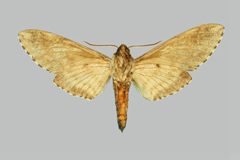
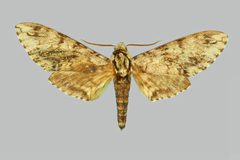
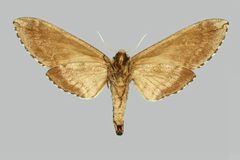
Ceratomia sonorensis, known as the Sonoran sphinx, is a hawkmoth in the Sphingidae. The inhabits high-elevation Madrean woodland in Sonora, Mexico and southeastern Arizona. are active during summer months, with larvae feeding on Fraxinus (ash) species. The species was described by Ronald Hodges in 1971.
Pronunciation
How to pronounce Ceratomia sonorensis: /sɛɹəˈtoʊmiə ˌsɒnəˈrɛnsɪs/
These audio files are automatically generated. While they are not always 100% accurate, they are a good starting point.
Identification
Distinguished from other Ceratomia by geographic restriction to Madrean sky island in Sonora and Arizona. Distinguished from the more widespread Ceratomia catalpae (catalpa sphinx) and Ceratomia undulosa (waved sphinx) by range and plant association with Fraxinus rather than Catalpa or other . The specific epithet 'sonorensis' refers to the Mexican state of Sonora, the type locality.
Images
Appearance
Wingspan measures 84–89 mm. As a member of the Ceratomia, the likely exhibits typical sphingid with robust body, narrow forewings, and relatively broad hindwings. Specific coloration and pattern details are not documented in available sources.
Habitat
High-altitude Madrean woodland characterized by oak and oak-pine associations. This montane forest occurs in isolated mountain ranges (sky islands) of the Sonoran Desert region.
Distribution
Known from Sonora, Mexico and southeastern Arizona, USA. Records are restricted to high-elevation localities within the Madrean sky island archipelago.
Seasonality
are on wing from July to August. One per year ().
Diet
Larvae feed on Fraxinus (ash). feeding habits are not documented.
Host Associations
- Fraxinus - larval food plant-level association; specific Fraxinus not identified in sources.
Life Cycle
Holometabolous with one per year. Larvae develop on ash foliage, pupate, and emerge as in mid-summer. Detailed descriptions of , larval, and pupal stages are not available.
Behavior
are attracted to light. activity typical of sphingid .
Ecological Role
As a herbivore, larvae contribute to nutrient cycling in Madrean woodland . The is part of the ash-associated lepidopteran , which includes multiple feeders on Fraxinus.
Human Relevance
No direct economic or medical significance documented. The may be affected by emerald ash borer (Agrilus planipennis) that reduce plant availability, though this has not been specifically studied.
Similar Taxa
- Ceratomia catalpaeSimilar size and , but associated with Catalpa trees rather than Fraxinus; more widespread across eastern and central North America.
- Ceratomia undulosaSimilar size and , but with broader distribution across eastern North America; larvae feed on ash but also other Oleaceae including lilac and privet with variable success.
More Details
Taxonomic history
Described by Ronald B. Hodges in 1971, representing one of several Ceratomia with restricted southwestern distributions.
Conservation context
Restricted to Madrean sky island , which are vulnerable to climate change, fire, and land use conversion. plant availability may be impacted by emerald ash borer, though this has not been documented specifically for this .
Sources and further reading
- BugGuide
- Wikipedia
- GBIF taxonomy match
- iNaturalist taxon
- NCBI Taxonomy
- Catalogue of Life
- Ready for a Saturday Night of Bioblitz at the UC Davis Arboretum? | Bug Squad
- Could Silver Nanoparticles Be a New Tool to Manage Biting Midges?
- Biting Midges' Overwintering Activity Offers Clues to Persistence of Bluetongue Virus
- For Ash-Dependent Insects, Some Plants Make Good Alternatives—But Others Don't
- Another Study Confirms Mosquitoes, Midges Don't Transmit Coronavirus
- Bug Eric: National Moth Week 2021 Review