
Sphinx chersis
Hübner
Great Ash Sphinx, Northern Ash Sphinx
Sphinx chersis is a large sphinx moth commonly known as the great ash sphinx or northern ash sphinx. are active from May to August in southern regions and June to July in northern areas. The is an ash whose larvae feed on plants in the olive (Oleaceae), particularly ash (Fraxinus), lilac (Syringa), and privet (Ligustrum). Research indicates that while larvae can develop on some non-native plants, survival and development rates vary significantly compared to native ash.


Pronunciation
How to pronounce Sphinx chersis: /ˈsfɪŋks ˈkɛrsɪs/
These audio files are automatically generated. While they are not always 100% accurate, they are a good starting point.
Identification
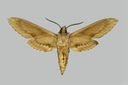
Distinguished from similar sphinx moths by the combination of large size (90–130 mm wingspan), soft dark gray to blue-gray forewings with black dashes reaching the wing tip, and black hindwings with blurry pale gray bands. Similar to other Sphinginae but specific wing pattern and coloration help separate it from like Sphinx kalmiae. Larvae resemble other sphinx moth caterpillars but are associated with ash and related .
Images
Habitat
Found wherever larval plants in the olive (Oleaceae) are present. Associated with wooded and suburban areas containing ash, lilac, and privet.
Distribution
Northern Mexico throughout most of the United States; uncommon in the Gulf States. Canadian records include Alberta, Manitoba, and Saskatchewan.
Seasonality
emerge May to August in southern regions; restricted to June to July in northern parts of range. Single brooded in north, potentially more in south.
Diet
Larvae feed on plants in the olive (Oleaceae), specifically ash (Fraxinus spp.), lilac (Syringa spp.), and privet (Ligustrum vulgare). feed at dusk on nectar from deep-throated flowers including honeysuckle (Lonicera spp.), evening primrose (Onagraceae), dogbane (Apocynum spp.), phlox (Phlox spp.), and bouncing bet (Saponaria officinalis).
Host Associations
- Fraxinus spp. - larval Primary native ; ash trees
- Syringa spp. - larval Lilacs; non-native alternative with variable larval success
- Ligustrum vulgare - larval European privet; in eastern North America. Research shows high larval mortality and pupal malformations on this
- Lonicera spp. - nectar sourceHoneysuckles
- Oenothera spp. - nectar sourceEvening primroses
- Apocynum spp. - nectar sourceDogbane
- Phlox spp. - nectar source
- Saponaria officinalis - nectar sourceBouncing bet
Life Cycle
laid on plants. Larvae feed and grow, then mature caterpillars descend to pupate in subterranean chambers. Pupae remain until the following year, in the soil. emerge in late spring to mid-summer depending on latitude.
Behavior
are , feeding at dusk. Strong fliers. Larvae feed on foliage of plants, typically remaining on upper portions of leaves and new stems.
Ecological Role
Larval stage functions as a herbivore on ash and related Oleaceae. serves as a of deep-throated flowers. The is one of approximately 300 arthropods (including 100 lepidopterans) associated with ash trees in North America, making it vulnerable to ash decline from emerald ash borer.
Human Relevance
Occasionally encountered by gardeners and naturalists due to its large size and conspicuous . Not considered an agricultural or garden pest. Used in research on plant and impacts of non-native plants on native insect . Conservation concern due to dependence on ash trees threatened by emerald ash borer (Agrilus planipennis).
Similar Taxa
- Sphinx kalmiae with similar appearance and ; both are ash . Sphinx kalmiae shows better larval development on lilac compared to S. chersis, which perishes on that .
- Ceratomia undulosaAnother ash-dependent sphinx moth; studied alongside S. chersis in plant research. Differing larval performance on alternative hosts.
- Smerinthus ophthalmicaSimilar large sphinx moth in same region; distinguished by different wing patterns and plant associations.
More Details
Conservation significance
Research by Horne et al. (2024) demonstrated that S. chersis shows high mortality on privet (Ligustrum vulgare) and complete mortality on lilac (Syringa vulgaris), unlike the S. kalmiae which tolerates lilac. This finding challenges anecdotal reports of success rearing S. chersis on privet and highlights the ecological risks of non-native plants for ash-dependent .
Subspecies
Two recognized: S. c. chersis (Mexico north through most of United States) and S. c. mexicanus Rothschild & Jordan, 1903 (Mexico).
Sources and further reading
- BugGuide
- Wikipedia
- GBIF taxonomy match
- iNaturalist taxon
- NCBI Taxonomy
- Catalogue of Life
- The Hornworms Are Not Your Friends | Bug Squad
- Don't Miss Bohart Museum Open House on Nov. 2 | Bug Squad
- For Ash-Dependent Insects, Some Plants Make Good Alternatives—But Others Don't
- Bug Eric: White-lined Sphinx ("Hummingbird Moth")
- Bug Eric: Moth Week and "Mothapalooza"
- Bug Eric: National Moth Week Recap, 2015