
Sphinx vashti
Strecker, 1878
Vashti Sphinx
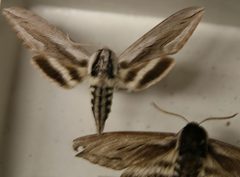
Sphinx vashti, the Vashti sphinx, is a in the Sphingidae. It is found in western North America from British Columbia to Manitoba and south to southern California, Nevada, Arizona, New Mexico, and western Texas. The exhibits highly variable forewing coloration ranging from pale to very dark gray, with distinctive black dashes and a black hindwing featuring white bands. It has one per year.
Pronunciation
How to pronounce Sphinx vashti: /sfɪŋks ˈvæʃtaɪ/
These audio files are automatically generated. While they are not always 100% accurate, they are a good starting point.
Identification
The Vashti sphinx can be distinguished from similar sphinx moths by the combination of highly variable forewing coloration (pale to very dark gray) with a consistent pattern of black dashes ending with the topmost dash at the wing tip, and the contrasting black hindwing with white bands. The single and specific western North American distribution also aid identification. Similar in the Sphinx may share general pattern elements but differ in geographic range and specific wing markings.
Images
Appearance
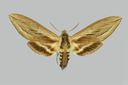
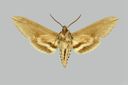
Forewing highly variable in color, ranging from pale to very dark gray with paler gray at the base of the , wing tip, and outer margin. A series of black dashes runs across the forewing, with the topmost dash reaching the wing tip. Hindwing is black with white bands. Wing length varies considerably among individuals.
Habitat
Specific preferences are not well documented in available sources.
Distribution
Western North America from British Columbia east to Manitoba, south to southern California, Nevada, central Arizona, New Mexico, and western Texas. Records also include Alberta and Saskatchewan in Canada.
Seasonality
One per year. activity period not explicitly documented in available sources.
Diet
Larvae feed on snowberry (Symphoricarpos albus) and coralberry (Symphoricarpos orbiculatus). feeding habits not documented.
Host Associations
- Symphoricarpos albus - larval snowberry
- Symphoricarpos orbiculatus - larval coralberry
Life Cycle
One per year. Complete with , larva, pupa, and stages. Larvae feed on snowberry and coralberry. details not documented.
Behavior
No specific behavioral observations documented in available sources.
Ecological Role
Larval herbivore on Symphoricarpos . ecological role not documented. Specific functions not described in available sources.
Human Relevance
Not documented as an agricultural pest or otherwise significant to human activities. Occasionally observed during bioblitz events and surveys.
Similar Taxa
- Sphinx chersisSimilar size and general sphinx moth , but S. chersis is an ash with different wing pattern and more eastern distribution
- Sphinx kalmiaeCongeneric sphinx moth with similar body plan, but differs in plant associations (lilac and olive ) and specific wing markings
- Sphinx drupiferarumAnother member of Sphinx with overlapping range, but distinct wing pattern and plant preferences
More Details
Taxonomic Note
Described by Strecker in 1878. The specific epithet 'vashti' refers to the biblical figure Vashti, wife of King Ahasuerus in the Book of Esther, following a pattern of classical and biblical references common in Strecker's .
Population Biology
The ' single () contrasts with some related sphinx moths that have multiple per year, suggesting to the seasonal availability of its plants or climatic constraints in its western North American range.
Sources and further reading
- BugGuide
- Wikipedia
- GBIF taxonomy match
- iNaturalist taxon
- NCBI Taxonomy
- Catalogue of Life
- The Hornworms Are Not Your Friends | Bug Squad
- Don't Miss Bohart Museum Open House on Nov. 2 | Bug Squad
- Bug Eric: Blodgett Peak Bioblitz Report
- Bug Eric: White-lined Sphinx ("Hummingbird Moth")
- For Ash-Dependent Insects, Some Plants Make Good Alternatives—But Others Don't
- Bug Eric: Moth Week and "Mothapalooza"