
Eumorpha satellitia
Linnaeus, 1771
Satellite Sphinx
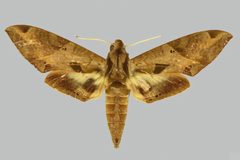
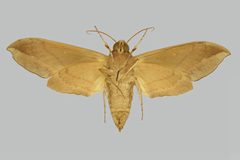
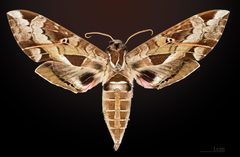
Eumorpha satellitia, commonly known as the satellite sphinx, is a large hawkmoth in the Sphingidae. It ranges from Brazil and northern Argentina northward through Central America, Mexico, and the West Indies to southern Texas and southern Arizona. are active primarily from April to August and again in October, feeding on nectar from various flowers. The has four recognized distributed across its range.
Pronunciation
How to pronounce Eumorpha satellitia: /juːˈmɔr.fə sæˈtɛ.lɪ.ti.ə/
These audio files are automatically generated. While they are not always 100% accurate, they are a good starting point.
Identification
Distinguished from by geographic range and subspecific variation. The four (E. s. satellitia, E. s. excessus, E. s. licaon, E. s. posticatus) occupy different regions and may show morphological differences, though specific diagnostic traits are not detailed in available sources. can be separated from similar Eumorpha by period and distribution.
Images
Habitat
Not explicitly described in available sources. Based on distribution, occupies tropical and subtropical environments from South America through Central America and into the southern United States.
Distribution
Brazil and northern Argentina north through Central America, Mexico, and the West Indies to south Texas and southern Arizona. distributions: E. s. satellitia in Jamaica, Mexico, Belize, Guatemala to Ecuador, Bolivia, Brazil, and Uruguay; E. s. excessus in Brazil; E. s. licaon in extreme southern Texas, Mexico, Nicaragua, Rica south to Brazil, Bolivia, and Paraguay; E. s. posticatus in Cuba and the Bahamas.
Seasonality
on wing from April to August and again in October.
Diet
feed on nectar of Petunia hybrida, Saponaria officinalis, and Lychnis alba. Larvae feed on Cissus pseudosicyoides and Cissus rhombifolia (grape , Vitaceae).
Host Associations
- Cissus pseudosicyoides - larval food plant
- Cissus rhombifolia - larval food plant
- Petunia hybrida - nectar source
- Saponaria officinalis - nectar source
- Lychnis alba - nectar source
Life Cycle
Complete . laid on plants. Larvae feed on Cissus . takes place underground.
Behavior
are or flower visitors, using a long to sip nectar. period bimodal within the year.
Ecological Role
function as of visited flowers. Larvae are herbivores on Vitaceae. Serves as prey for various including birds and other insects.
Human Relevance
Not considered an agricultural pest. may visit garden flowers. Larvae feed on Cissus rather than cultivated grapes, reducing economic impact.
Similar Taxa
- Eumorpha pandorusSimilar size and appearance; distinguished by different geographic range (eastern North America from Florida to Nova Scotia) and plant preferences.
- Eumorpha achemonSimilar ; distinguished by different distribution (widespread across U.S. but uncommon in California) and larval on Vitis including native and cultivated grapes.
- Darapsa myronSimilar characteristics; distinguished by different , more northern distribution, and larval on grape and Virginia creeper.
More Details
Subspecies
Four recognized: E. s. satellitia (Jamaica, Mexico to South America), E. s. excessus (Brazil), E. s. licaon (southern Texas to Paraguay), and E. s. posticatus (Cuba and Bahamas). Subspecies differ in geographic distribution; morphological distinctions not detailed in sources.