
Eumorpha fasciatus
Sulzer, 1776
Banded Sphinx, Banded Sphinx Moth
A medium to large hawkmoth with highly variable larval coloration and a broad Neotropical and Nearctic distribution. are strong fliers active during twilight hours, with year-round activity in tropical regions and multiple in temperate zones. The exhibits notable larval and has been documented feeding on nectar from several cultivated and wild flowers.
Pronunciation
How to pronounce Eumorpha fasciatus: /juˈmɔrfə fæˈsi.eɪtəs/
These audio files are automatically generated. While they are not always 100% accurate, they are a good starting point.
Identification
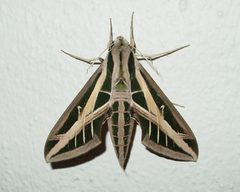
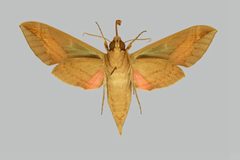
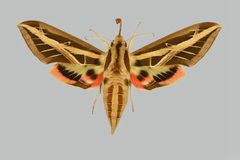
can be distinguished from similar Eumorpha by the combination of a pinkish-brown with darker medial stripe, and forewings with alternating dark and light transverse bands. The typically shows a series of dark spots against a pinkish ground color. Larvae are exceptionally variable, ranging from green with dark dorsal markings to nearly black with orange or pink lateral spots; this can complicate identification within the .
Images
Habitat
Associated with wetland margins, riparian corridors, and disturbed where larval plants in the evening primrose (Onagraceae) and grape family (Vitaceae) occur.
Distribution
Native range extends from northern Argentina, Bolivia, Paraguay, Uruguay, Brazil, Colombia, Ecuador, and Peru north through Central America to southern California, southern Arizona, Texas, and the southeastern United States (Florida, South Carolina, Louisiana, Mississippi). Strays have been recorded as far north as Missouri, Michigan, Indiana, Pennsylvania, New Jersey, New York, and Nova Scotia. Also occurs in the Caribbean and Galápagos Islands (as E. f. tupaci).
Seasonality
Year-round activity in tropical portions of range. In temperate regions, at least two occur: adults on wing from late May to July and late August to October in South Carolina; May to October in Louisiana.
Diet
have been observed feeding on nectar of Crinum, Catharanthus roseus, Petunia, and Saponaria officinalis. Larvae feed on Ludwigia (including L. decurrens, L. erecta, L. leptocarpa, L. octovalvis, L. peruviana, L. repens), Cissus verticillata, Fuchsia hybrida, Magnolia virginiana, Parthenocissus, and Vitis species.
Life Cycle
are laid on larval plants. Larvae develop through multiple instars showing highly variable color patterns and depth of coloration. occurs in burrows in soil or substrate.
Behavior
are or fliers. In temperate regions, adults of final accumulate energy reserves before seasonal decline in plant quality.
Ecological Role
function as of several flowering plants. Larvae serve as herbivores on wetland and riparian vegetation. The is a member of mimicry complexes involving other sphingid larvae.
Human Relevance
Larvae occasionally feed on cultivated grape (Vitis), though economic impact appears limited. are attracted to garden flowers and can be observed at dusk.
Similar Taxa
- Eumorpha pandorusSimilar size and coloration; distinguished by more uniform greenish or brownish forewing coloration without strong banding, and different larval plant preferences.
- Eumorpha achemonOverlapping distribution and similar period; have more contrasting light and dark forewing pattern with less pinkish ground color.
- Eumorpha labruscaSimilar body shape and size; distinguished by more uniform olive-green forewings and different geographic range primarily in South America.
Sources and further reading
- BugGuide
- Wikipedia
- GBIF taxonomy match
- iNaturalist taxon
- NCBI Taxonomy
- Catalogue of Life
- What do insects do in winter? Migrants in the DMV: Common Buckeye, Junonia coenia, Variegated Fritillary, Euptoieta Claudia, Painted Lady, Vanessa cardui, Large Milkweed bug, Oncopeltus fasciatus — Bug of the Week
- Bugs in Orange and Black II: Large milkweed bug, Oncopeltus fasciatus — Bug of the Week
- Orange and Black II: Milkweed leaf beetle, Labidomera clivicollis; Oleander aphid, Aphis nerii; Milkweed Bug, Oncopeltus fasciatus; Monarch, Danaus plexippus — Bug of the Week
- Bugs in orange and black - Monarch butterfly, Danaus plexippus Milkweed Bug - Oncopeltus fasciatus; Milkweed tiger moth, Euchaetes egle — Bug of the Week
- Orange and Black Bugs- Milkweed leaf beetle, Labidomera clivicollis; Oleander aphid, Aphis nerii; Milkweed Bug - Oncopeltus fasciatus; Monarch butterfly, Danaus plexippus — Bug of the Week
- Bugs in orange and black: A spooky Halloween trick or treat for predators - Small and large milkweed bugs, 'Lygaeus kalmii' and 'Oncopeltus fasciatus' — Bug of the Week