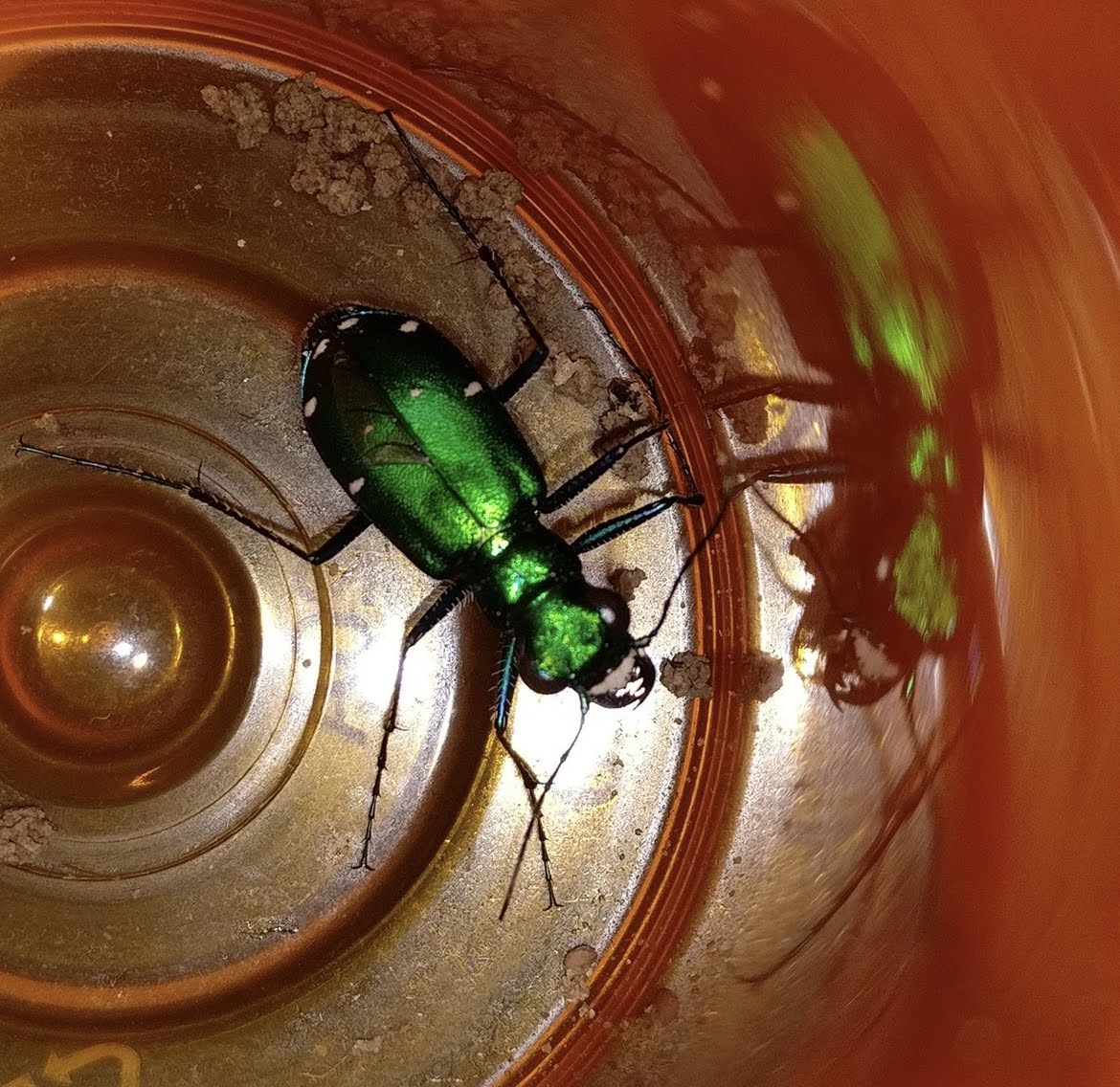
Horistonotus pullatus is a species of click beetle (family Elateridae) in the subfamily Dendrometrinae. Species in the genus Horistonotus are primarily associated with wetland and marsh habitats in North America. The genus is characterized by distinctive morphological features including a pronotum with posterior angles that are typically carinate or spinose. Like other elaterids, H. pullatus possesses the family-defining prosternal process that engages with a mesosternal cavity to enable the characteristic 'clicking' escape mechanism.
Sand Wireworm
Horistonotus uhlerii is a species of click beetle in the family Elateridae, commonly known as the Sand Wireworm. The species is native to North America and is associated with sandy habitats. Adult beetles are typical of the genus in general form, while larvae are wireworms—elongated, hard-bodied larvae that develop in soil. The species has been documented in limited observations, with available records indicating a preference for sandy substrates.
Hormops abducens is a species of true weevil in the family Curculionidae, first described by John Lawrence LeConte in 1876. It is recorded from North America. As a member of the genus Hormops, it belongs to a group of weevils whose biology remains poorly documented.
Hormorini is a tribe of weevils within the subfamily Entiminae, established by Horn in 1876. The tribe comprises approximately 22 genera distributed across multiple continents. Members are classified in the family Curculionidae, the largest family of beetles. The tribe is characterized by morphological features typical of Entiminae, including a broad connection between the rostrum and head.
lily of the valley weevil
Hormorus undulatus, commonly known as the lily of the valley weevil, is a broad-nosed weevil in the family Curculionidae. The species was first described by Uhler in 1856 under the basionym Chlorophanus undulatus. It is distributed across parts of North America, with confirmed records from Alberta, Connecticut, Illinois, Indiana, and Iowa. As a member of the subfamily Entiminae, it possesses the characteristic short, broad rostrum typical of this group.
Hornectes quadrimaculatus is a species of predaceous diving beetle in the family Dytiscidae, subfamily Hydroporinae. Originally described as Hydroporus quadrimaculatus by Horn in 1883, it was later transferred to the genus Hornectes. The species epithet "quadrimaculatus" (four-spotted) refers to its characteristic elytral maculation. It belongs to the tribe Hydroporini within the speciose subfamily Hydroporinae, which contains many small to medium-sized diving beetles.
A dung beetle in the subfamily Aphodiinae, recorded from arid regions of the southwestern United States and northern Mexico. The species is associated with creosote bush (Larrea tridentata) habitats, as indicated by its specific epithet. Little is known of its biology beyond collection records.
Horologion is one of the rarest and most enigmatic carabid beetle genera, containing two known species of troglomorphic ground beetles endemic to the middle Appalachian Mountains. The genus remained monotypic for over 60 years after its description in 1932, with a second species discovered in Virginia in 1991 and described in 2024. Phylogenetic analysis places Horologion in supertribe Trechitae as sister to the Gondwanan tribe Bembidarenini, making tribe Horologionini a relict lineage with no close relatives in the Northern Hemisphere.
tumbling flower beetle
A species of tumbling flower beetle in the family Mordellidae, found in North America. Larvae and pupae develop in rotting oak wood.
Huaca is a genus of weevils in the family Curculionidae, described by Carl Johan Schoenherr in 1833. The genus belongs to the hyperdiverse weevil family, one of the largest families of organisms with over 40,000 described species. As a historically established genus in early coleopteran taxonomy, Huaca represents part of the 19th-century effort to classify the immense diversity of Neotropical weevils. The genus is currently accepted in modern taxonomic catalogs, though specific species-level diversity and biological details remain poorly documented in accessible literature.
Huaca apian is a species of true weevil in the beetle family Curculionidae. It was described by Clark in 1993. The species is known to occur in North America. As a member of Curculionidae, it possesses the characteristic elongated rostrum typical of weevils.
Huleechius marroni is a species of riffle beetle (family Elmidae) described by Brown in 1981. It belongs to the genus Huleechius, a group of aquatic beetles adapted to flowing water habitats. The species is known from Middle America and North America. Like other elmids, it is presumed to inhabit freshwater streams and rivers, though specific ecological details remain poorly documented.
Hybothecus is a genus of ground beetles (Carabidae) established by Chaudoir in 1874. The genus contains seven described species distributed in the Neotropical region. Species have been recorded from Central and South America, with some described from Ecuador. The genus belongs to the subtribe Pterostichina within the tribe Pterostichini.
Hydaticini is a tribe of diving beetles (family Dytiscidae, subfamily Dytiscinae) established by Sharp in 1880. Members of this tribe are aquatic predators found in freshwater habitats. The tribe includes the genus Hydaticus, with species documented from the Neotropics including the Amazon basin and Brazilian highlands.
round fungus beetles
Hydnobius is a genus of round fungus beetles in the family Leiodidae, comprising approximately seven described species. The genus was established by Schmidt in 1841 and is classified within the tribe Sogdini. Species in this genus are small beetles associated with fungal habitats. The genus has been recorded from northern and central Europe, with distributional data available for specific species such as H. punctulatus reaching its northernmost Central European limits in Slovakia.
Hydnobius substriatus is a species of round fungus beetle in the family Leiodidae, described by John Lawrence LeConte in 1863. It is distributed across northern North America, with records from Canada and the northern United States. As a member of the genus Hydnobius, it is likely associated with fungal habitats, though specific ecological details remain poorly documented.
Hydraena americana is a species of minute moss beetle in the family Hydraenidae, described by Manfred Jäch in 1993. It belongs to the subgenus Holcohydraena. The species is known from eastern North America, with records from Canada and the northeastern United States. Like other members of its genus, it is an aquatic beetle inhabiting small freshwater habitats.
Hydraena marginicollis is a species of minute aquatic beetle in the family Hydraenidae. It is the namesake of the marginicollis group and marginicollis subgroup within the genus Hydraena. The species was described by Kiesenwetter in 1849. Distribution records indicate presence in the southeastern United States and the Bahamas.
Hydraena pacifica is a species of minute aquatic beetle in the family Hydraenidae, first described by Perkins in 1980. The species belongs to the genus Hydraena, commonly known as long-palped water beetles, characterized by their enlarged maxillary palps. It is distributed across western North America from Canada through the western United States. The species epithet 'pacifica' refers to its occurrence in the Pacific region of North America.
Hydraena pensylvanica is a species of minute aquatic beetle in the family Hydraenidae, first described by Kiesenwetter in 1849. Despite its specific epithet suggesting a Pennsylvania origin, this species occurs across eastern North America. Like other members of the genus Hydraena, it inhabits shallow freshwater habitats. The species is poorly documented in recent literature, with only a handful of observations recorded on community science platforms.
Hydrocanthus oblongus is a small burrowing water beetle in the family Noteridae. The species inhabits aquatic environments in the Caribbean and North America. Like other noterids, it has been observed in shallow, muddy substrates where it burrows. The species was described by David Sharp in 1882.
Hydrochara obtusata is a species of water scavenger beetle in the family Hydrophilidae, found across northern North America. The species was originally described as Hydrophilus obtusatus by Thomas Say in 1823, with a neotype designated in a 1980 revision of the genus Hydrochara. It belongs to a genus of 21 recognized species of aquatic beetles.
Elongate Water Scavenger Beetles
Hydrochidae is a family of aquatic beetles in the order Coleoptera, containing a single genus Hydrochus with approximately 180–200+ species worldwide. These small elongate water scavenger beetles are found in freshwater habitats across multiple continents including Europe, Asia, Africa, and the Americas. The family is sometimes treated as the subfamily Hydrochinae within Hydrophilidae. Species-level taxonomy is well-developed, with recent revisions documenting substantial diversity in Central America (26 species), South America (77 species in Bolivia, Brazil, and Paraguay alone), and the Mediterranean region.
Hydrochus callosus is a species of water scavenger beetle in the family Hydrochidae, first described by John Lawrence LeConte in 1855. The species is found in the southeastern United States, with records from Alabama, Arkansas, Florida, Georgia, Louisiana, Mississippi, South Carolina, and Texas. Hydrochidae are small aquatic beetles typically associated with freshwater habitats.
Hydrochus granulatus is a species of water scavenger beetle in the family Hydrochidae. The species was described by Blatchley in 1910 and is known from North America, with records from both the United States and Canada. It is sometimes treated as a member of the family Hydrophilidae in alternative classifications.
Hydrochus jaechi is a small water scavenger beetle described in 1995 from the southeastern United States. The species belongs to the family Hydrochidae, a group of minute beetles associated with aquatic and semi-aquatic habitats. Known from scattered records across Florida, Louisiana, Mississippi, and Texas, it remains poorly documented in the scientific literature.
Hydrochus simplex is a small water scavenger beetle in the family Hydrochidae, a group sometimes treated as a subfamily within Hydrophilidae. The species was described by John Lawrence LeConte in 1855 and is documented from the southeastern United States and the Bahamas. Like other hydrochids, it occupies aquatic or semi-aquatic habitats.
Hydrocolus deflatus is a species of predaceous diving beetle in the family Dytiscidae, first described by Fall in 1923. It belongs to the genus Hydrocolus, a group of small to medium-sized diving beetles within the subfamily Hydroporinae. The species is documented from North America. Like other members of Dytiscidae, it is adapted to aquatic habitats.
Hydrocolus persimilis is a species of predaceous diving beetle in the family Dytiscidae. It is known from North America, with records from Labrador and New Brunswick in Canada. As a member of the Hydroporinae subfamily, it inhabits aquatic environments where it functions as an active predator.
water scavenger beetles
Hydrophilinae is the largest subfamily of water scavenger beetles (family Hydrophilidae), containing approximately 1852 species in 61 genera and 8 tribes. The subfamily was revised by Short and Fikáček in 2013, which recognized five tribes: Amphiopini, Berosini, Hydrobiusini, Hydrophilini, and Laccobiini. Members are predominantly aquatic beetles found across diverse geographic regions including the Neotropics and Asia. Some genera represent ancient, possibly relict lineages with unusual morphological character combinations.
Giant Water Scavenger Beetles
Hydrophilus is a genus of large aquatic beetles in the family Hydrophilidae, commonly known as giant water scavenger beetles. The genus comprises approximately 48 species arranged in three subgenera: Hydrophilus, Dibolocelus, and Temnopterus. These beetles are among the largest aquatic insects in their range, with some species reaching substantial size. Members of this genus are fully aquatic as adults, possess the ability to disperse by flight, and exhibit distinct feeding mode shifts during development—carnivorous larvae transition to omnivorous adults. Several species are rare or endangered in parts of their range, including the great silver water beetle Hydrophilus piceus in Britain.
Hydrophilus ensifer is a large water scavenger beetle in the family Hydrophilidae, distributed throughout the Americas from Argentina to the southern United States. Adults typically measure 30–37 mm in length, making them among the largest aquatic insects. Two subspecies are recognized: H. e. ensifer and H. e. duvali, though their distinguishing characteristics remain poorly understood.
Hydrophilus insularis is a water scavenger beetle in the family Hydrophilidae. It is distributed across a broad geographic range from northern South America through the Caribbean, Central America, and Mexico into the southern United States. The species is aquatic and belongs to a genus known for scavenging behavior in freshwater habitats.
Hydroporini is a tribe of predaceous diving beetles in the family Dytiscidae, containing at least 730 described species. Members are primarily aquatic, inhabiting freshwater environments including streams, rivers, and groundwater systems. The tribe exhibits a broad geographic distribution spanning Australia, New Guinea, Europe, and other regions, with notable diversity hotspots in south-western Australia.
Hydroporus columbianus is a species of predaceous diving beetle in the family Dytiscidae, first described by Fall in 1923. It belongs to the subfamily Hydroporinae, a diverse group of small to medium-sized diving beetles. The species is known from western North America, with records from Alberta and British Columbia in Canada. Like other members of the genus, it is an aquatic predator.
Belittled Water Beetle
Hydroporus despectus is a predaceous diving beetle in the family Dytiscidae, described by Sharp in 1882. It occurs in North America with records from Canada (Alberta, British Columbia) and presumably the United States. As a member of the genus Hydroporus, it inhabits aquatic environments and functions as a predator. The common name "Belittled Water Beetle" has been assigned to this species.
Hydroporus occidentalis is a species of predaceous diving beetle in the family Dytiscidae, described by Sharp in 1882. The species is known from North America, with records from the Canadian provinces of Alberta and British Columbia. As a member of the genus Hydroporus, it is a small to medium-sized diving beetle adapted to aquatic habitats.
Hydroporus tenebrosus is a predaceous diving beetle in the family Dytiscidae, first described by LeConte in 1850. It belongs to the genus Hydroporus, a diverse group of small to medium-sized diving beetles. The species has been used as a morphological reference in taxonomic revisions due to its extreme similarity to H. subpubescens. As a member of the Dytiscidae, it is presumed to be an aquatic predator, though specific ecological details remain poorly documented in the accessible literature.
skiff beetles
Hydroscaphidae is a small family of water beetles in the suborder Myxophaga, commonly known as skiff beetles. The family contains approximately 23 species as of 2010, distributed across four genera. These beetles are highly specialized for life in thin films of water over algal surfaces.
Hydrovatus brevipes is a predaceous diving beetle (family Dytiscidae) described by Sharp in 1882. It belongs to the tribe Hydrovatini within the subfamily Hydroporinae. The species is documented from North America, though specific details regarding its ecology, habitat preferences, and life history remain poorly documented in the available literature.
Hygrotus dissimilis is a species of diving beetle in the family Dytiscidae, subfamily Hydroporinae. It was described by Gemminger and Harold in 1868. The species is placed in the genus Hygrotus, a group of small to medium-sized predatory beetles associated with aquatic habitats. As with many diving beetles, specific ecological and behavioral details for this species remain limited in published literature.
Hygrotus falli is a diving beetle species in the family Dytiscidae, originally described by Wallis in 1924 under the basionym Coelambus falli. The species belongs to a genus of small to medium-sized predatory diving beetles commonly found in freshwater habitats. As with other members of Dytiscidae, it is likely adapted to aquatic life with modified hind legs for swimming, though specific ecological details for this species remain poorly documented in available sources.
Hygrotus nubilus is a diving beetle in the family Dytiscidae, first described by John Lawrence LeConte in 1855. Like other members of the genus, this species is associated with freshwater aquatic habitats. The genus Hygrotus is widely distributed across North America and includes numerous species of small to medium-sized diving beetles.
Hygrotus patruelis is a species of diving beetle in the family Dytiscidae, first described by John Lawrence LeConte in 1855. It belongs to the genus Hygrotus, a group of small to medium-sized predaceous diving beetles commonly found in aquatic habitats. The species is recorded from North America. Like other dytiscids, it is adapted to underwater life with specialized respiratory structures.
Hygrotus picatus is a species of predaceous diving beetle in the family Dytiscidae. It is native to North America and belongs to a genus of small to medium-sized diving beetles commonly found in freshwater habitats. The species was first described by William Kirby in 1837. Like other members of Dytiscidae, it is adapted to aquatic life with streamlined bodies and modified hind legs for swimming.
Hygrotus punctilineatus is a small diving beetle in the family Dytiscidae, subfamily Hydroporinae. It is one of many North American species in the genus Hygrotus, which are generally associated with lentic freshwater habitats. The species was described by Fall in 1919 based on specimens from North America. Like other members of Hygrotus, it is presumed to be an aquatic predator in standing water bodies, though specific ecological studies are limited.
Hygrotus sellatus is a small diving beetle in the family Dytiscidae, described by LeConte in 1866. The species is known from North America, with limited observational records. As a member of the subfamily Hydroporinae, it inhabits freshwater aquatic environments.
crenulate bark beetle
Hylastes gracilis is a bark beetle species in the family Curculionidae, first described by LeConte in 1868. It belongs to the subfamily Scolytinae, a group commonly known as bark and ambrosia beetles. The species has been documented in North America and Middle America, with specific records from British Columbia, Canada.
Hylesinus mexicanus is a species of bark beetle in the family Curculionidae, described by Wood & Bright in 1992. It is one of several species in the genus Hylesinus, a group commonly referred to as crenulate bark beetles. The species is recorded from North America and Middle America. Like other members of its genus, it is associated with woody plants, though specific host associations for this species have not been documented in available sources.
Hylis californicus is a species of clown beetle in the family Histeridae. Members of this family are typically small, compact beetles associated with decaying organic matter and carrion. The species epithet 'californicus' indicates a type locality or primary distribution in California. Hylis species are morphologically characterized by shortened elytra that expose several abdominal tergites, a trait common to the family but with genus-specific modifications in antennal structure and body proportions.