
Hylastes gracilis
LeConte, 1868
crenulate bark beetle
Hylastes gracilis is a bark beetle in the Curculionidae, first described by LeConte in 1868. It belongs to the Scolytinae, a group commonly known as bark and ambrosia beetles. The species has been documented in North America and Middle America, with specific records from British Columbia, Canada.
Pronunciation
How to pronounce Hylastes gracilis: /hɪˈlæstɛs ˈɡræˌsɪlɪs/
These audio files are automatically generated. While they are not always 100% accurate, they are a good starting point.
Identification
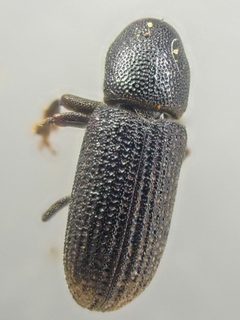
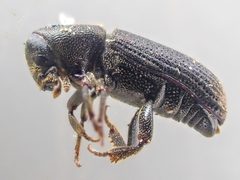
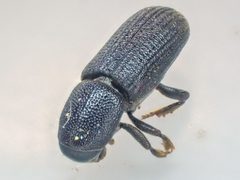
Distinguishing H. gracilis from other Hylastes requires examination of fine morphological details, particularly the elytral declivity structure and pronotal shape. The species may be separated from H. porculus and H. salebrosus by differences in the declivital armature and interstriae punctation. Accurate identification typically requires reference to original descriptions or keys for North American Scolytinae.
Images
Appearance
As a member of the Hylastes, this exhibits the typical of bark beetles: small, cylindrical body form with a compact, rounded pronotum. The species epithet 'gracilis' (Latin for slender or graceful) suggests a relatively slender body proportions compared to . Members of Hylastes typically have crenulate (finely notched or scalloped) elytral declivity, a characteristic referenced in the 'crenulate bark beetle'.
Habitat
Bark beetles in the Hylastes are associated with coniferous forests, where they inhabit the bark and phloem of trees. Specific associations for H. gracilis are not well documented in available sources.
Distribution
Documented from North America and Middle America. Specific regional records include British Columbia, Canada. The is part of the Nearctic fauna of bark beetles.
Behavior
Like other Hylastes , this likely exhibits typical bark beetle including gallery construction in phloem tissue and through communication, though specific behaviors for H. gracilis have not been documented in available sources.
Ecological Role
As a bark beetle, this participates in the decomposition of woody material and nutrient cycling in forest . The specific ecological impact of H. gracilis is not documented; it is not known whether it functions primarily as a primary colonizer of stressed or dead trees or as a secondary invader.
Human Relevance
The economic or forestry significance of H. gracilis has not been documented. Many Hylastes are of minor economic importance compared to more damaging bark beetle such as Dendroctonus.
Similar Taxa
- Hylastes porculusSimilar size and general ; distinguished by declivital structure and pronotal contours
- Hylastes salebrosusOverlapping distribution and conifer association; separated by elytral punctation patterns
- Hylastes tenuisShared slender body form suggested by epithets; requires detailed morphological comparison
More Details
Taxonomic Note
Hylastes gracilis was described by John Lawrence LeConte in 1868, a prolific American entomologist who described thousands of . The Hylastes currently contains approximately 50 species worldwide, primarily distributed in the Holarctic region.