
Hylastes opacus
Gyllenhal, 1813
crenulate bark beetle
Hylastes opacus is a bark beetle in the Curculionidae, Scolytinae, native to the Palearctic region and recently introduced to North America. The breeds in stumps and roots of dead or dying pines (Pinus) and occasionally other conifers. use volatiles as chemical cues to locate suitable breeding material, with documented attraction to nonanal, ethanol, and (-)-α-pinene. The species has been recorded in North American locations including Vermont and New York.
Pronunciation
How to pronounce Hylastes opacus: /hɪˈlæstiːz oʊˈpeɪkəs/
These audio files are automatically generated. While they are not always 100% accurate, they are a good starting point.
Identification
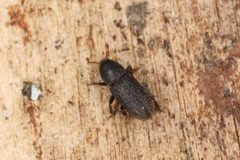
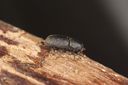
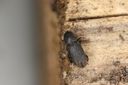
Hylastes opacus can be distinguished from other Hylastes by its crenulate (scalloped) elytral declivity. As a member of the bark beetle tribe Hylastini, it is small, cylindrical, and adapted for life under bark. Identification to species level typically requires examination of elytral punctation patterns and declivital structures.
Images
Habitat
Stumps and roots of dead or dying pines (Pinus) and occasionally other conifers. The specializes in subcortical of coniferous , particularly in the root collar and lower trunk regions.
Distribution
Native to the Palearctic region with a wide distribution across Europe and Asia. Introduced to North America, with confirmed records from the northeastern United States (Vermont, New York) and expanding range in North America.
Host Associations
- Pinus - breeding primary ; stumps and roots of dead or dying trees
- Pinus sylvestris - breeding Scots pine
- Pinus resinosa - breeding red pine
- other conifers - breeding occasional use
Behavior
Uses volatiles as chemical cues to search for suitable host material for feeding and establishment. Strongly attracted to nonanal, an aldehyde compound. Also responds to ethanol and (-)-α-pinene, though synergistic effects between these compounds have not been consistently demonstrated.
Human Relevance
Introduced of potential concern to North American forestry. Attraction to nonanal and other volatiles may enable development of monitoring traps. Chemical studies have used this species to understand bark beetle-host interactions.