
Hylastes
Erichson, 1836
Species Guides
8- Hylastes gracilis(crenulate bark beetle)
- Hylastes longicollis(crenulate bark beetle)
- Hylastes macer(root-feeding bark beetle)
- Hylastes nigrinus
- Hylastes opacus(crenulate bark beetle)
- Hylastes porculus
- Hylastes salebrosus
- Hylastes tenuis
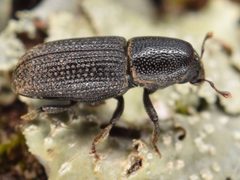
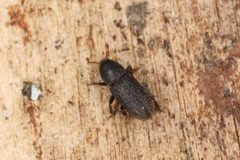
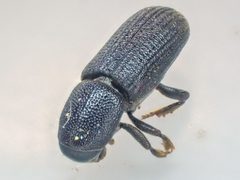
Hylastes is a of crenulate bark beetles in the Curculionidae, comprising over 90 . Members are primarily associated with coniferous , particularly pines and spruces, where they breed in stumps, roots, and stressed or dying trees. Several species are economically significant as of fungal causing tree mortality. The genus has a fossil record extending to the Eocene, with Hylastes perkovskyi described from Rovno amber.
Pronunciation
How to pronounce Hylastes: /hɨˈlæstiːz/
These audio files are automatically generated. While they are not always 100% accurate, they are a good starting point.
Images
Habitat
Associated with coniferous forests; breed in stumps, roots, and lower boles of dead, dying, or stressed conifers. Some species dig through soil to reach root systems. Hylastes nigrinus is strongly associated with Douglas-fir, while other species occur in pine-dominated systems.
Distribution
Widespread in the Northern Hemisphere. Hylastes opacus is native to the Palearctic region and introduced to North America. Hylastes nigrinus occurs in western North America. Records exist from Denmark, Norway, Sweden, and the United States (Vermont, New York, California, Oregon).
Seasonality
Hylastes nigrinus shows peak and in late April and early May in western Oregon, with activity strongly temperature-dependent (seldom below 16°C or above 24°C) and influenced by light intensity (peaking 300–1200 ft-c during late afternoon or early evening).
Diet
Phloem and inner bark of conifer roots and stumps. Feeding occurs on dead, dying, or stressed material; maturation feeding documented on small roots of dead old trees and on roots of young replanted trees weakened by transplant stress.
Host Associations
- Pinus taeda (loblolly pine) - Hylastes is one of the most common bark beetle observed in this ; associated with Leptographium fungal transmission
- Pseudotsuga menziesii (Douglas-fir) - Primary for H. nigrinus; breeding in roots and stumps of -killed and cut trees
- Pinus sylvestris (Scots pine) - for H. opacus and H. cunicularius
- Pinus resinosa (red pine) - for H. opacus
- Pinus radiata - Preferred for H. ater feeding
- Picea abies (Norway spruce) - Main for H. cunicularius; readily accepted though sometimes secondary to pine
- Leptographium terebrantis - Hylastes , primarily H. nigrinus, potentially this fungus to loblolly pine roots
- Leptographium serpens - Associated with Hylastes-mediated transmission to loblolly pine
- Verticicladiella wageneri - H. nigrinus demonstrated to this to Douglas-fir seedlings
Life Cycle
Hylastes nigrinus: galleries initiated in June, eggs laid from late June; five larval instars; majority complete development in one year; and full-grown larvae overwinter in galleries. H. opacus: breeds in stumps and roots of dead or dying .
Behavior
use volatiles as orientation cues. Hylastes opacus attracted to nonanal, ethanol, (−)-α-pinene (separately, without synergism), and spruce turpentine. Hylastes nigrinus attracted to α-pinene, β-pinene, and Douglas-fir resin; digs through soil to reach roots. Hylastes cunicularius aggregates at host material or conspecifics independent of sex; no evidence of ; finds hidden host material by active orientation; prefers root sections over stem sections; fresh cuts enhance attraction.
Ecological Role
Primary and secondary colonizers of stressed, damaged, or dead conifers; contribute to decomposition of woody debris. Some act as for pathogenic fungi, linking activity to forest health issues including black stain root and loblolly pine decline. levels increase in thinned stands, potentially elevating disease risk.
Human Relevance
Several are forest pests of economic concern. Hylastes species Leptographium fungi causing mortality in loblolly pine, an emerging forest health issue in the southeastern United States. Hylastes opacus is an introduced species in North America. Hylastes ater is a pest requiring integrated control approaches. Thinning operations increase activity and associated risk.
Similar Taxa
- DendroctonusBoth are scolytine bark beetles breeding in conifers; Hylastes often breed in material killed by Dendroctinus (e.g., H. nigrinus in Douglas-fir killed by D. pseudotsugae). Dendroctonus species typically attack living trees and have more pronounced gallery patterns, while Hylastes focuses on roots and stumps.
- TomicusBoth use pine and respond to similar host volatiles; Hylastes opacus was unexpectedly captured during experiments targeting T. piniperda attraction. Tomicus typically attack shoots and trunks of living pines, whereas Hylastes species specialize in below-ground portions of dead or stressed trees.
More Details
Fossil Record
Hylastes perkovskyi, described from Eocene Rovno amber, indicates the evolved by the Eocene epoch. Bark beetles as a group have fossil evidence extending to the early Cretaceous.
Natural Enemies
Hylastes nigrinus larval in western Oregon experienced heavy mortality from Medetera vidua (Dolichopodidae) larvae during fall 1965.
Competitive Interactions
Hylastes nigrinus shares stumps and roots with multiple scolytid, curculionid, cerambycid, and buprestid ; data documented for competing species in Douglas-fir systems.
Sources and further reading
- BugGuide
- Wikipedia
- GBIF taxonomy match
- iNaturalist taxon
- NCBI Taxonomy
- Catalogue of Life
- Attraction of Hylastes opacus (Coleoptera: Scolytidae) to nonanal
- OLFACTORY RESPONSES OF HYLASTES NIGRINUS (COLEOPTERA: SCOLYTIDAE) TO VARIOUS HOST MATERIALS
- Host-Derived Attractants for the Beetles Hylastes nigrinus (Coleoptera: Scolytidae) and Steremnius carinatus (Coleoptera: Curculionidae)
- Interactions of Hylastes Species (Coleoptera: Scolytidae) with Leptographium Species Associated with Loblolly Pine Decline
- ON THE BIOLOGY OF HYLASTES NIGRINUS (COLEOPTERA: SCOLYTIDAE) IN WESTERN OREGON
- Host recognition and aggregation behaviour of Hylastes cunicularius Erichson (Col., Scolytidae) in the laboratory1
- Activity of Hylastesnigrinus, a vector of Verticicladiellawageneri, in thinned stands of Douglas-fir
- Interactions of <I>Hylastes</I> Species (Coleoptera: Scolytidae) with <I>Leptographium</I> Species Associated with Loblolly Pine Decline
- Feeding behaviour of the black pine beetle, Hylastes ater (Coleoptera: Scolytidae)