
Dioryctria
Zeller, 1846
Conifer Coneworm Moths, Coneworm Moths
Species Guides
31- Dioryctria abietivorella(fir coneworm)
- Dioryctria albovittella(pinyon tip moth)
- Dioryctria amatella(southern pineconeworm moth)
- Dioryctria auranticella(ponderosa pineconeworm moth)
- Dioryctria banksiella
- Dioryctria baumhoferi
- Dioryctria caesirufella
- Dioryctria cambiicola(Western Pine Moth)
- Dioryctria clarioralis(Blister Coneworm Moth)
Dioryctria is a of snout moths ( Pyralidae) described by Philipp Christoph Zeller in 1846. Commonly known as conifer coneworm , the genus contains approximately 40 in North America, with 25 occurring in western regions. Larvae of most species feed within conifer cones, though some species infest shoots, branches, or bark. Several species are significant forest pests, causing damage to pine, spruce, fir, and cedar trees through cone and seed destruction, shoot boring, and deformation of tree crowns.
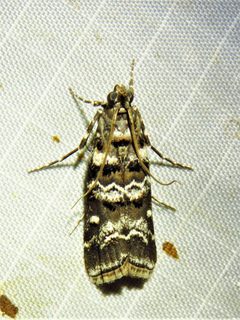
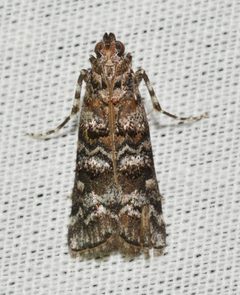
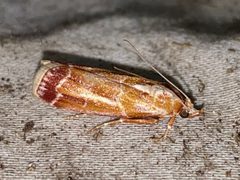
Pronunciation
How to pronounce Dioryctria: //ˌdaɪ.oʊˈrɪk.tri.ə//
These audio files are automatically generated. While they are not always 100% accurate, they are a good starting point.
Identification
Dioryctria can be distinguished from similar by their association with conifer and cone-feeding larval habits. may be confused with other small pyralid moths, but species identification typically requires examination of genitalia or detailed wing pattern analysis. The is characterized by with distinct types. Species-level identification is challenging and often requires dissection or molecular methods. Dioryctria larvae in cones can be distinguished from other cone insects by their tunneling patterns and characteristics.
Images
Appearance
are small , typically 10-15 mm in length with wing expanses around 29 mm. are (thread-like), consisting of a basal scape, , and with tapered flagellomeres. Coloration varies by but adults are often described as dirty brown. The antennae exhibit in size, with males generally possessing longer antennae. Seven types of antennal have been identified: trichodea, coeloconica, auricillica, basiconica, styloconica (two subtypes), Böhm's bristles, and squamiformia. Sensilla trichodea, squamiformia, and basiconica are more abundant in males than females.
Habitat
Conifer forests including pine, spruce, fir, and cedar woodlands. Larvae occur within cones, shoots, branches, or under bark of trees. are attracted to lights at night.
Distribution
Widespread across the Northern Hemisphere. In North America: 40 total, 25 in western regions. In Asia: China (more than 20 provinces), India (North-Western Himalaya, Assam, Himachal Pradesh), Japan, Korea, Pakistan, Taiwan, Thailand. In Europe: Austria, Bulgaria, Denmark, Finland, France, Germany, Greece, Hungary, Ireland, Italy, Netherlands, Norway, Poland, Portugal, Sweden, Switzerland, Turkey, United Kingdom, former Yugoslavia, and Russia (including Siberia, Caucasus, Karelia, and other regions).
Seasonality
Varies by and latitude. Dioryctria abietella completes two per year under laboratory conditions, with third generation larvae during September-October. periods generally occur during warmer months; specific timing depends on local climate and .
Host Associations
- Pinus roxburghii - larval cones and seeds damaged
- Pinus wallichiana - larval cones and seeds damaged
- Pinus gerardiana - larval cones and seeds damaged
- Pinus massoniana - larval shoots and branches infested by D. rubella
- Pinus koraiensis - larval managed forest for associated studies
- Cedrus deodara - larval cones and seeds damaged
- Abies pindrow - larval cones and seeds damaged
- Picea smithiana - larval cones and seeds damaged
- Abies - larval level association
- Larix - larval level association
Life Cycle
Complete with four stages: , larva, pupa, . For D. abietella: eggs laid singly on young cone surfaces, lasting 3-5 days. Larva passes through five instars, becoming full-fed in approximately 25 days. Full-fed larva spins cocoon sealed with white papery , pupating inside cone or protected location. Prepupal period 7-8 days, pupal period 10-14 days. Total development from egg to adult 46-59 days. Two per year with third generation larvae . Other show variation in development sites: some pupate in damaged branches rather than cones.
Behavior
Larvae exhibit concealed feeding within cones, shoots, or bark, making detection and control difficult. Larval feeding creates irregular tunnels, causing broken shoots, clustered side shoots, and deformed broom-like crowns in heavily infested trees. are and attracted to lights. Females locate cones for oviposition; the mechanism involves antennal olfactory (trichodea and auricillica with surface pores) that detect chemical cues.
Ecological Role
Major forest pest affecting conifer through cone and seed destruction. Larval feeding reduces seed production for natural and commercial seed collection. Some damage shoots and branches, deforming tree growth. Serves as for natural enemies including (Baryscapus dioryctriae, Hymenoptera) and dipteran , plus fungal (Fusarium sp.). These natural enemies may provide potential.
Human Relevance
Significant economic impact on conifer forestry and seed production. Several are serious pests requiring management in forestry operations, seed orchards, and Christmas tree farms. Chemical control is often ineffective due to concealed larval feeding within cones. using such as Baryscapus dioryctriae is being investigated as an environmentally friendly alternative. Research has been conducted on Bt (Bacillus thuringiensis) exposure effects for potential control applications.
Similar Taxa
- Crambidae (snout moths)Similar body plan with projecting labial palps; distinguished by -level characters and larval associations—Crambidae larvae typically associated with grasses rather than conifer cones
- Tortricidae (leafroller moths)Some similar in size and ; distinguished by resting posture, wing venation, and larval —Tortricidae larvae roll or tie leaves rather than boring in cones
- Acrolophidae (grass tube moths)Formerly placed in Tineidae, similar small size; distinguished by larval in grass tubes at soil level rather than conifer cones
More Details
Taxonomic History
The was described by Philipp Christoph Zeller in 1846. placement has been refined with modern ; currently placed in Pyralidae, Phycitinae. Formerly, some were classified in Phycitidae. The species Dioryctria actualis has been transferred to Catastia actualis.
Research Significance
Antennal ultrastructure has been studied in detail for D. rubella, revealing seven types with , providing foundation for understanding chemical communication mechanisms. Baryscapus dioryctriae, a newly discovered , shows promise as agent due to high rate, multiple wasps per pupa, favorable sex ratio, and amenability to mass rearing on alternative hosts.
Sources and further reading
- BugGuide
- Wikipedia
- GBIF taxonomy match
- iNaturalist taxon
- NCBI Taxonomy
- Catalogue of Life
- Baryscapus dioryctriae Archives - Entomology Today
- Bug Eric: New Mexico Night Bugs
- Bug Eric: My Personal National Moth Week, 2017
- Bug Eric: September 2017
- New Wasp Species Discovered Parasitizing Pests of Pine Trees
- BIOECOLOGY OF DIORYCTRIA ABIETELLA DENIS AND SCHIFF. A PEST OF CONIFERS IN THE NORTH-WESTERN HIMALAYA
- Dioryctria abietella . [Distribution map].
- Ultrastructure of Antennal Sensilla in Adults of Dioryctria rubella Hampson (Lepidoptera: Pyralidae)
- THE BIOLOGY OF DIORYCTRIA AMATELLA (LEPIDOPTERA: PHYCITIDAE)
- Canadian Species of Dioryctria Zeller (Lepidoptera: Pyralidae)
- Bt Exposure-Induced Death of Dioryctria abietella (Lepidoptera: Pyralidae) Involvement in Alterations of Gene Expression and Enzyme Activity.
- Non-Target Effects of Beta-Cypermethrin on Baryscapus dioryctriae and Ecological Risk Assessment.