
Dioryctria amatella
(Hulst, 1887)
southern pineconeworm moth, Southern Pine Coneworm Moth
Dioryctria amatella is a pyralid whose larvae develop within pine cones, primarily feeding on seeds and cone tissues. The is a significant pest in southeastern U.S. pine forests, with one to four annually. are active from early spring through late autumn. The species overwinters in Cronartium fusiforme fungal cankers on pine trees, utilizing these as protected winter .
Pronunciation
How to pronounce Dioryctria amatella: /di.oˈrɪk.tri.ə æˈmæ.tɛl.ə/
These audio files are automatically generated. While they are not always 100% accurate, they are a good starting point.
Identification
Distinguished from related Dioryctria by forewing pattern details and geographic range. D. amatella occurs in the southeastern United States, overlapping partially with D. auranticella in the southwest. Genitalia examination may be required for definitive identification from . Larvae are found in second-year pine cones, not current-year cones.
Images
Appearance
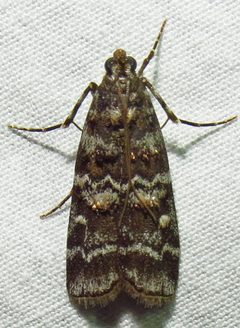
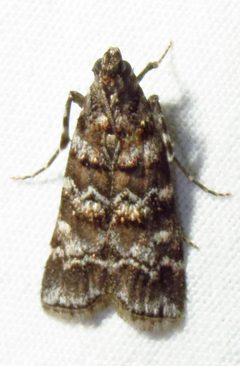
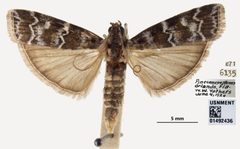
wingspan 27–32 mm. Forewings gray with darker markings, including a distinct discal spot and transverse lines. Hindwings pale gray to whitish. Labial palps project forward, giving a snout-like appearance typical of Pyralidae. Body slender, covered in fine .
Habitat
Pine forests and plantations. Larval is within second-year cones of Pinus . occurs in Cronartium fusiforme cankers on pine trunks and branches, which provide protected microhabitats during winter months.
Distribution
Southeastern United States, from Maryland south through Florida and west into Texas. Associated with native and planted pine forests throughout this range.
Seasonality
active from early April to early November. One to four per year depending on latitude and local climate conditions.
Diet
Larvae feed on pine cone tissues and seeds within developing cones. do not feed.
Host Associations
- Pinus spp. - larval Various pine ; larvae develop in second-year cones
- Cronartium fusiforme - Fungal causing cankers on pine; provides protected sites for larvae and pupae
Life Cycle
deposited singly or in small clusters on cone , needles, and cone surfaces. Females preferentially oviposit on second-year cones over current-year cones. Larvae bore into cones and feed on seeds and cone tissues. Development includes egg, larval, pupal, and stages. occurs within fungal cankers. Egg development rate varies with temperature, with faster development at higher temperatures within the range of 15–30°C.
Behavior
Females exhibit selective oviposition , preferring older (second-year) pine cones over current-year cones. Larvae are concealed feeders within cones. larvae and pupae occupy protected positions within fungal cankers.
Ecological Role
Seed in pine , reducing seed production in trees. Serves as host for including Baryscapus dioryctriae. in fungal cankers contribute to canker ecosystem dynamics.
Human Relevance
Economic pest of pine seed orchards and natural , reducing viable seed production. Management is complicated by larval concealment within cones, making applications generally ineffective. Subject of research using .
Similar Taxa
- Dioryctria auranticellaAlso a coneworm with similar ; distinguished by geographic range (primarily western North America) and subtle wing pattern differences
- Dioryctria pryeriRelated coneworm with overlapping use; distinguished by distribution and morphological details
- Dioryctria abietellaConeworm on conifers; similar larval habits but different geographic distribution and preferences
More Details
Taxonomic history
Originally described as Nephopteryx amatella by Hulst in 1887. placement has varied between Phycitidae and Pyralidae; currently treated as Pyralidae: Phycitinae.
Biological control research
The Chinese Baryscapus dioryctriae, discovered parasitizing related Dioryctria , has been proposed as a potential agent for coneworm moths including D. amatella due to high rates and favorable sex ratios.
Sources and further reading
- BugGuide
- Wikipedia
- GBIF taxonomy match
- iNaturalist taxon
- NCBI Taxonomy
- Catalogue of Life
- Baryscapus dioryctriae Archives - Entomology Today
- Baryscapus dioryctriae - Entomology Today
- Bug Eric: New Mexico Night Bugs
- Bug Eric: My Personal National Moth Week, 2017
- Bug Eric: September 2017
- New Wasp Species Discovered Parasitizing Pests of Pine Trees
- THE BIOLOGY OF DIORYCTRIA AMATELLA (LEPIDOPTERA: PHYCITIDAE)
- THE OCCURRENCE OF DIORYCTRIA AMATELLA AND OTHER INSECTS IN CRONARTIUM FUSIFORME CANKERS
- Oviposition Behavior and Temperature Effects on Egg Development of the Southern Pine Cone worm Dioryctria amatella (Lepidoptera: Pyralidae)