
Baryscapus
Förster, 1856
Baryscapus is a of in the Eulophidae. are endoparasitic, developing within the bodies of other insects. associations span multiple insect orders including Hemiptera, Neuroptera, Coleoptera, Lepidoptera, Diptera, and Hymenoptera. Some species are important agents, particularly against agricultural and forestry pests.
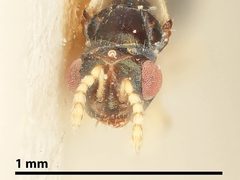
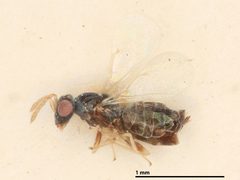
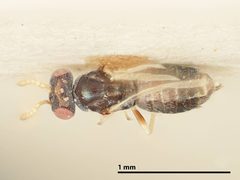
Pronunciation
How to pronounce Baryscapus: /bəˈrɪskəpəs/
These audio files are automatically generated. While they are not always 100% accurate, they are a good starting point.
Images
Habitat
Diverse environments corresponding to ranges; includes pine forests, oak woodlands, and agricultural systems.
Distribution
Widespread distribution with records from North America (California), Europe (Sicily), and Asia (China: Jilin Province).
Host Associations
- Dioryctria spp. - pupal endoparasitoid; key target in pine forests
- Chrysoperla rufilabris - gregarious of chrysopid larvae
- Polistes dominulus - indirect; of associated parasitoidBaryscapus elasmi is hyperparasitoid of Elasmus schmitti, which parasitizes paper wasp larvae
- Lasiosina devitata - first recorded for B. babiyi in Turkey
- Agrilus cuprescens - B. rugglesi of this buprestid in western North America
- Leucoma wiltshirei - hyperparasitoidB. evonymellae as hyperparasitoid in Iran
Life Cycle
Endoparasitic development within bodies. Developmental timing varies by host and ; for B. chrysopae, developmental time ranges from 20.5 to 27.5 days depending on host age at parasitization. may occur within host remains or externally.
Behavior
Females of some paralyze prior to oviposition; others oviposit without paralysis. Host-seeking involves chemosensory perception using antennal including sensilla trichodea and placodea. Gregarious species produce multiple offspring per host.
Ecological Role
Important agents in natural and managed . Some suppress pest in forestry and agriculture, reducing reliance on . Hyperparasitoid species occupy higher in .
Human Relevance
Several are utilized or studied as agents against crop and forest pests. Baryscapus dioryctriae shows promise for management of Dioryctria in Korean pine seed orchards. exposure poses risks to persistence and biocontrol efficacy.
Similar Taxa
- TetrastichusFormerly included some Baryscapus (B. chrysopae as Tetrastichus chrysopae); both are gregarious eulophid with similar
More Details
Chemosensory Biology
Baryscapus dioryctriae possesses 274 putative chemosensory genes including odorant-binding proteins, chemosensory proteins, and ionotropic receptors, facilitating location and mate finding.
Reproductive Biology
Baryscapus servadeii exhibits large- automictic with almost fixed homozygosity. B. chrysopae shows female-biased sex ratios (~82% female) independent of stage.
Pesticide Sensitivity
Sublethal beta-cypermethrin exposure impairs rates, reduces offspring , alters development, and shortens longevity in B. dioryctriae, with transgenerational effects in F1 .
Sources and further reading
- BugGuide
- Wikipedia
- GBIF taxonomy match
- iNaturalist taxon
- NCBI Taxonomy
- Catalogue of Life
- A Lot of Gall | Bug Squad
- Baryscapus dioryctriae - Entomology Today
- Baryscapus dioryctriae Archives - Entomology Today
- New Wasp Species Discovered Parasitizing Pests of Pine Trees
- Host Age Effects on Ovipositional and Developmental Biology of Baryscapus chrysopae (Hymenoptera: Eulophidae), a Parasitoid of Chrysopid Larvae
- Baryscapus babiyi Doğanlar, 1993 (Hymenoptera: Eulophidae) is parasitoid of Lasiosina devitata (Diptera: Chloropidae) in Turkey: description of male and discovery of host
- Non-Target Effects of Beta-Cypermethrin on Baryscapus dioryctriae and Ecological Risk Assessment
- Baryscapus evonymellae (Bouché, 1834) (Hymenoptera: Eulophidae), a hyperparasitoid of Leucoma wiltshirei Collenette, 1938 (Lepidoptera: Erebidae) in Iran
- The establishment of a rearing technique for the fruit fly parasitoid Baryscapus silvestrii increases knowledge of biological, ecological and behavioural traits
- Baryscapus rugglesi (Rohwer, 1919) (Hymenoptera: Eulophidae) discovered in western North America: Redescription, notes on biology, and implications as a parasitoid of its host, Agrilus cuprescens (Ménétries, 1832) (Coleoptera: Buprestidae)
- Bionomics and morphological and molecular characterization of Elasmus schmitti and Baryscapus elasmi (Hymenoptera: Chalcidoidea, Eulophidae), parasitoids associated with a paper wasp, Polistes dominulus (Vespoidea, Vespidae)
- An expanded odorant-binding protein mediates host cue detection in the parasitic wasp Baryscapus dioryctriae basis of the chromosome-level genome assembly analysis
- A population genetic study of the egg parasitoid Baryscapus servadeii reveals large scale automictic parthenogenesis and almost fixed homozygosity
- Morphology and ultrastructure of antennal sensilla of the parasitic wasp Baryscapus dioryctriae (Hymenoptera: Eulophidae)
- Transcriptome Analysis and Identification of Chemosensory Genes in Baryscapus dioryctriae (Hymenoptera: Eulophidae)