
Agrilus cuprescens
(Ménétriés, 1832)
Rose Stem Girdler, Bronze Cane Borer
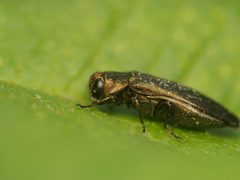
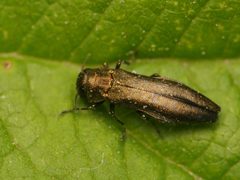
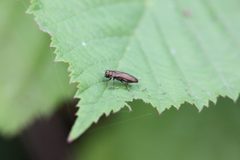
Agrilus cuprescens is a metallic wood-boring beetle in the Buprestidae, commonly known as the rose stem girdler or bronze cane borer. Native to the Palearctic region, it has been introduced to North America where it has been documented as far west as Washington State. The is associated with Rosa species and related Rosaceae as larval , with larvae developing in stems and exhibiting girdling . It serves as host for the Baryscapus rugglesi.
Pronunciation
How to pronounce Agrilus cuprescens: //ˈæɡrɪləs kjuːˈprɛsɛnz//
These audio files are automatically generated. While they are not always 100% accurate, they are a good starting point.
Identification
Agrilus cuprescens can be distinguished from most North American Agrilus by its association with rose stems and its introduced Palearctic origin. Among the six recognized , the nominate subspecies A. c. cuprescens is most widespread. Accurate identification to level typically requires examination of male genitalia due to the morphological similarity among Agrilus species. The species exhibits typical Agrilus : elongate body with metallic coloration, short , and tarsal formula 5-5-5.
Images
Habitat
Associated with rose-dominated including cultivated rose gardens, wild rose thickets, and riparian areas supporting Rosa . In its native European range, occurs in temperate broadleaf and mixed forest zones. In North America, found in anthropogenic habitats with introduced roses as well as naturalized in suitable climates.
Distribution
Native to Europe and Northern Asia (excluding China). Introduced and established in North America, with records from eastern and western United States including a documented in Washington State. GBIF distribution records indicate presence across multiple biogeographic realms including Nearctic, Palearctic, and Indomalaya, though these may reflect both native range and introduced populations.
Host Associations
- Rosa spp. - larval Primary larval ; larvae develop in stems and exhibit girdling
- Other Rosaceae - potential larval Suspected based on typical Agrilus patterns but not yet confirmed
Behavior
Larvae exhibit stem girdling on rose , a distinctive feeding pattern that gives the its . This behavior involves tunneling around the circumference of stems, potentially causing structural damage to host plants.
Ecological Role
Serves as for the Baryscapus rugglesi (Hymenoptera: Eulophidae), which has been documented in western North America. As a stem-boring , contributes to nutrient cycling through wood decomposition, though its primary ecological impact in North America is as an introduced associated with cultivated and ornamental roses.
Human Relevance
Considered a pest of cultivated roses due to larval stem girdling, which can damage or kill canes. The ' introduction to North America likely occurred through horticultural trade. Its reflect both its association (rose stem girdler) and appearance (bronze cane borer).
Similar Taxa
- Other Agrilus speciesMorphologically similar; A. cuprescens distinguished by association with Rosa and Palearctic origin in North American context
- Agrilus rubronigerBoth occur in similar and may be confused, but A. rubroniger is native to North America and associated with different
More Details
Subspecies
Six are recognized: A. c. amethystopterus Semenov, 1890; A. c. caenus Obenberger, 1924; A. c. calcicola Obenberger, 1916; A. c. chrysoderes Abeille de Perrin, 1891; A. c. cuprescens (Ménétriés, 1832); and A. c. paludicola Krogerus, 1923
Sources and further reading
- BugGuide
- Wikipedia
- GBIF taxonomy match
- iNaturalist taxon
- NCBI Taxonomy
- Catalogue of Life
- Lycidae | Beetles In The Bush
- Two new species of Agrilus from Mexico | Beetles In The Bush
- Agrilus fuscipennis on Persimmon | Beetles In The Bush
- GBCT Beetle #2: Agrilus walsinghami | Beetles In The Bush
- North America’s Most Beautiful Agrilus Jewel Beetle | Beetles In The Bush
- A flower visiting jewel beetle that is not an Acmaeodera | Beetles In The Bush
- Agrilus cuprescens(Ménétries) (Coleoptera: Buprestidae), the Rose Stem Girdler, Discovered in the State of Washington, with Comments on Host Plant Associations
- Baryscapus rugglesi (Rohwer, 1919) (Hymenoptera: Eulophidae) discovered in western North America: Redescription, notes on biology, and implications as a parasitoid of its host, Agrilus cuprescens (Ménétries, 1832) (Coleoptera: Buprestidae)