
Elasmus
Westwood, 1833
Species Guides
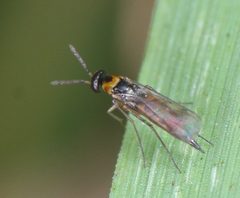
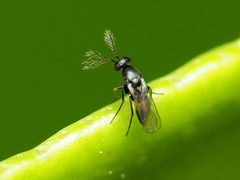
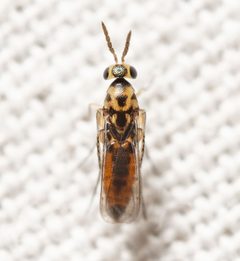
1Elasmus is a of chalcid wasps containing over 200 worldwide. It is the sole member of the Elasminae (formerly Elasmidae), though some authorities now place it within Eulophinae. Species are primarily or hyperparasitoids, with documented including lepidopteran larvae and larvae of Polistes paper wasps.
Pronunciation
How to pronounce Elasmus: //ˈɛlæs.məs//
These audio files are automatically generated. While they are not always 100% accurate, they are a good starting point.
Images
Habitat
Diverse including rice fields and areas where paper wasp nests occur. In agricultural settings, observed in untreated rice plots of Ciherang variety in Indonesia. Associated with abandoned or active paper wasp nests in residential and natural settings.
Distribution
Worldwide distribution with over 200 . Documented occurrences include: Indonesia (Subang district), USA (Kansas, Missouri, New Jersey, Florida, Indiana, Illinois, Nebraska, Colorado, Arizona, southern California, Hawaii), Canada (Ontario), Mexico, China (Beijing, Hubei), India (Haryana, Kerala), and Russia (Karachay-Cherkess).
Seasonality
In rice agroecosystems, abundance begins late in the growing season, around 70 days after rice planting, with activity increasing toward harvest. In temperate regions, from paper wasp nests has been observed in mid-November and January, suggesting late-season or emergence patterns.
Host Associations
- Cnaphalocrosis medinalis - larval Rice leaf folder; rates reached 94.4% near harvest in Indonesia
- Polistes metricus - of larvae/pupaePaper wasp; reared from abandoned nests in Kansas and Missouri
- Polistes exclamans - Infests young nests when foundress is away foraging
Behavior
In agricultural systems, exhibits late-season buildup with extremely high densities per (up to 225 individuals per larva observed). In paper wasp nest associations, targets (larvae and pupae) and may exploit periods when nest defense is reduced.
Ecological Role
agent in agricultural and natural systems. In rice fields, contributes to suppression of Cnaphalocrosis medinalis with rates exceeding 90% near harvest. In paper wasp , acts as a mortality factor for , potentially influencing colony success.
Human Relevance
Beneficial in rice agriculture due to high rates of leaf folder pests, potentially reducing yield losses. Occasionally encountered by entomologists and naturalists rearing insects from paper wasp nests. No documented negative impacts to humans.
Similar Taxa
- DibrachysAlso small reared from paper wasp nests; distinguished by placement (Pteromalidae vs. Eulophidae) and range (Dibrachys has broader host spectrum including hyperparasitism of tachinids and ichneumonids)
More Details
Taxonomic Uncertainty
Classification remains unsettled; treated as sole member of Elasminae by some authorities, but placed in Eulophinae by others. Formerly recognized as distinct Elasmidae.
Hyperparasitism
Some are hyperparasitoids, though specific instances are not detailed in available sources beyond general statements.
Sources and further reading
- BugGuide
- Wikipedia
- GBIF taxonomy match
- iNaturalist taxon
- NCBI Taxonomy
- Catalogue of Life
- Bug Eric: Another Micro Mystery
- Bug Eric: Wasp Wednesday: Polistes exclamans
- Bug Eric: A Potential New Host Record for Calliephialtes grapholithae (Hymenoptera: Ichneumonidae) from a Paper Wasp nest (Hymenoptera: Vespidae: Polistes metricus)
- Penampilan hama pelipat daun Cnaphalocrosis medinalis imigran dan parasitoid elasmus sp. di pertanaman padi