
Dioryctria auranticella
Grote, 1883
ponderosa pineconeworm moth
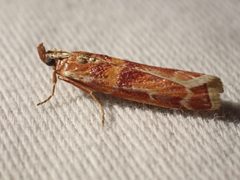
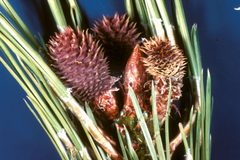
Dioryctria auranticella is a small pyralid whose larvae develop inside the cones of ponderosa pine and knobcone pine. are active in mid-summer and are attracted to lights. The is restricted to western North America, where it functions as a cone pest with potential impact on pine seed production.
Pronunciation
How to pronounce Dioryctria auranticella: /ˌdaɪoʊˈrɪktriə ɔːˌræntɪˈsɛlə/
These audio files are automatically generated. While they are not always 100% accurate, they are a good starting point.
Identification
A small with wingspan 10.5–14 mm. Distinguished from other Dioryctria by association with ponderosa pine cones; precise identification to species level typically requires examination of genitalia or molecular markers. are active in mid-July to early August, which may aid in distinguishing from sympatric coneworm species with different periods.
Images
Habitat
Forests and woodlands dominated by ponderosa pine (Pinus ponderosa) and knobcone pine (Pinus attenuata). Larval is specifically within the cones of these trees.
Distribution
Western North America from southern British Columbia south through California and Arizona, east to South Dakota and New Mexico. Records also exist from Alberta and Saskatchewan in Canada.
Seasonality
on wing from mid-July to early August.
Diet
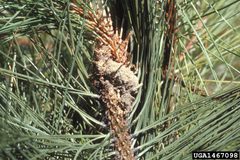
Larvae feed on tissues of Pinus ponderosa and Pinus attenuata cones; occasionally observed feeding on twigs.
Host Associations
- Pinus ponderosa - larval food plantprimary ; larvae feed within cones
- Pinus attenuata - larval food plantsecondary ; larvae feed within cones
Life Cycle
Complete with , larval, pupal, and stages. Larvae develop inside pine cones, feeding on cone tissues. occurs within the cone or nearby. Specific details of voltinism and stage not documented in available sources.
Behavior
Larvae are cone-borers, feeding inside pine cones which provides protection from and environmental extremes. are and attracted to artificial light sources.
Ecological Role
Acts as a seed in ponderosa pine , potentially reducing seed production. Serves as for including Baryscapus dioryctriae in regions where ranges overlap.
Human Relevance
Considered a pest of ponderosa pine where seed production is economically important, such as in managed forests and seed orchards. Chemical control is generally ineffective due to larval concealment within cones, making agents of interest.
Similar Taxa
- Dioryctria pryeriAnother coneworm with similar ; distinguished by association and geographic range
- Dioryctria abietellaOverlapping range and cone-feeding habit; requires morphological or molecular examination for definitive separation
- Other Dioryctria speciesApproximately 40 in north of Mexico, many with similar appearance; identification relies on genitalia dissection or -specificity clues
Sources and further reading
- BugGuide
- Wikipedia
- GBIF taxonomy match
- iNaturalist taxon
- NCBI Taxonomy
- Catalogue of Life
- Bug Eric: My Personal National Moth Week, 2017
- Bug Eric: September 2017
- Baryscapus dioryctriae Archives - Entomology Today
- Baryscapus dioryctriae - Entomology Today
- Bug Eric: New Mexico Night Bugs
- New Wasp Species Discovered Parasitizing Pests of Pine Trees
- Life History of a Ponderosa Pine Coneworm, Dioryctria auranticella (Lepidoptera: Pyralidae)